Introduction
Carbon fiber reinforced plastic (CFRP) is increasingly used in industries such as aviation and automobiles because of its lightweight structure, high strength, and excellent rigidity. However, these same properties make CFRP difficult to recycle.
Thermal decomposition, or pyrolysis, is one approach used to recover carbon fibers from CFRP. However, the pyrolysis of the epoxy resin contained in CFRP can generate various organic compounds and potentially harmful gases.
A study investigated the use of zeolite catalysts to reform gases generated during CFRP pyrolysis. The objective was to determine which zeolite catalyst could most effectively decompose unwanted compounds and convert them into useful basic chemicals.
What Is CFRP?
Carbon Fiber Reinforced Plastic (CFRP) is a composite material made by combining carbon fibers with a polymer resin, commonly epoxy resin.
CFRP is widely used because it offers:
- High strength-to-weight ratio
- High rigidity
- Low weight
- Excellent mechanical performance
- Good durability
These properties make CFRP particularly valuable in aircraft, automobiles, sports equipment, and other high-performance applications.
However, recycling CFRP is challenging because the carbon fibers are strongly bonded to the resin matrix.
Why Is CFRP Recycling Challenging?
The conventional thermal decomposition of CFRP can recover carbon fibers, but the decomposition of the resin can produce a variety of chemical compounds.
In particular, pyrolysis of epoxy resin can generate bisphenol-based compounds, phenols, cresols, and other aromatic compounds.
Therefore, an effective CFRP recycling process should not only recover carbon fibers but also consider the treatment and conversion of the gases generated during resin decomposition.
Using Pyrolysis and Zeolite Catalysts
In the reported study, researchers investigated whether zeolite catalysts could improve the decomposition and reforming of gases generated from CFRP pyrolysis.
Four different zeolite catalysts were evaluated:
- MOR
- MFI
- FAU
- BEA
These catalysts have different pore structures and compositions, which can influence their catalytic performance.
The study particularly examined the formation of aromatic compounds using GC/MS (Gas Chromatography/Mass Spectrometry).
Experimental Method
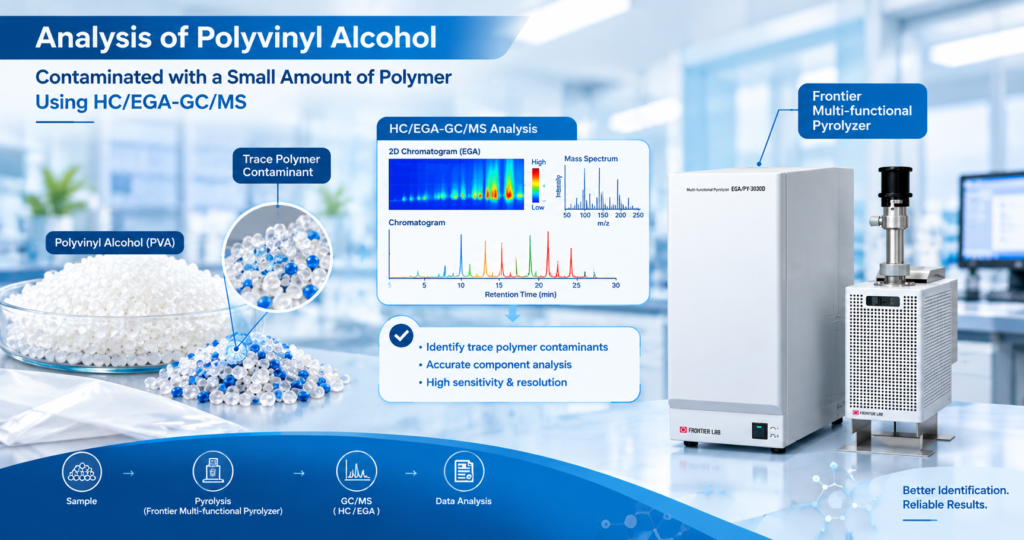
A Multi-Shot Pyrolyzer (EGA/PY-3030D) directly connected to a GC/MS system was used for the analysis.
The CFRP sample used in the experiment was Toray’s T700SC/259 prepreg, containing approximately 40% epoxy resin.
For each experiment:
- CFRP sample: 0.3 mg
- Zeolite catalyst: 3.0 mg
- Pyrolysis/catalytic reaction temperature: 500°C
The CFRP and catalyst were placed in an Eco-Cup and introduced into the pyrolyzer furnace.
During flash pyrolysis, the CFRP decomposed and generated volatile products. These products then interacted with the zeolite catalyst before being separated and detected by GC/MS.
Analytical Conditions
The main analytical conditions included:
Parameter | Condition |
Pyrolysis temperature | 500°C |
Catalytic reaction temperature | 500°C |
GC injection temperature | 300°C |
GC oven | 40°C (2 min) to 320°C |
Heating rate | 20°C/min |
Split ratio | 1/100 |
Separation column | UA+-5 |
Column length | 30 m |
Internal diameter | 0.25 mm |
Film thickness | 0.25 µm |
Column flow | 1 mL/min |
MS scan range | m/z 29–550 |
CFRP sample | 0.3 mg |
Catalyst | 3.0 mg |
Results of CFRP Pyrolysis
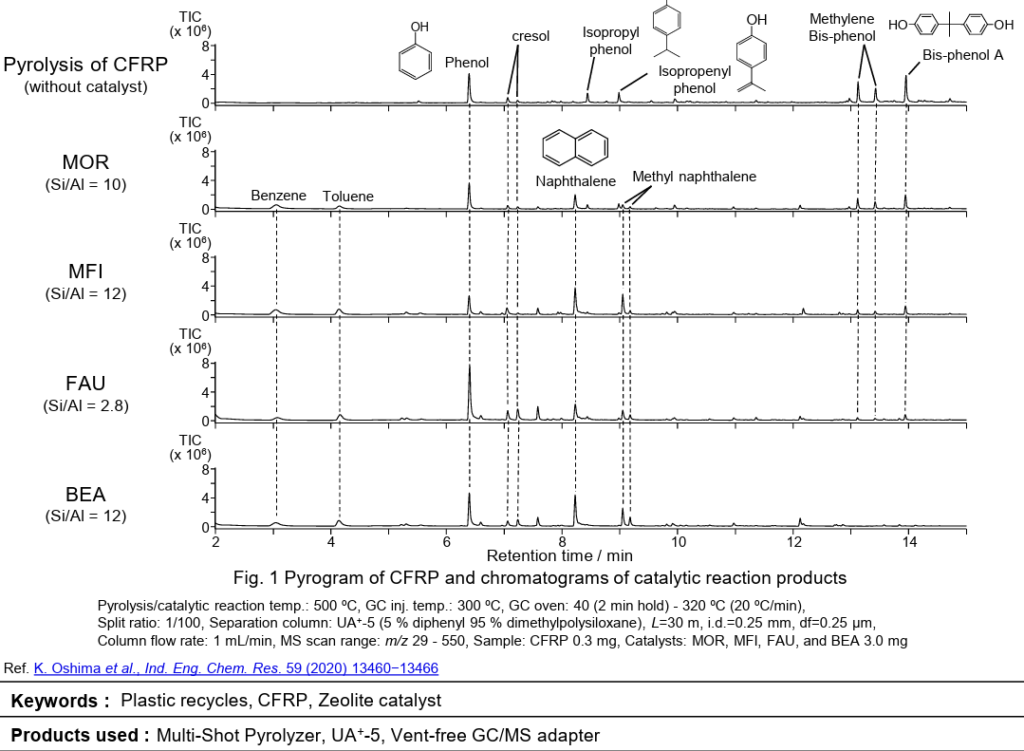
The pyrolysis analysis without a catalyst showed several compounds originating from the epoxy resin.
Among the major products observed were:
- Bisphenol-based compounds
- Phenol
- Cresol
- Other aromatic compounds
These compounds indicate the significant contribution of the epoxy resin to the volatile products generated during CFRP pyrolysis.
Effect of Zeolite Catalysts
When the pyrolysis gases were passed through the zeolite catalysts, significant changes were observed in the chromatograms.
Compared with pyrolysis without a catalyst, the intensity of bisphenol-based compounds decreased after catalytic treatment.
At the same time, compounds such as:
- Benzene
- Toluene
- Naphthalene
- Other basic aromatic chemicals
were detected.
This indicates that the zeolite catalysts promoted the decomposition and transformation of larger oxygen-containing aromatic compounds generated from the epoxy resin.
BEA Zeolite Showed Efficient Decomposition
Among the zeolite catalysts tested, BEA zeolite was found to promote the decomposition of bisphenol-based compounds most efficiently.
This result demonstrates the potential of zeolite catalysts for improving the treatment of gases generated during CFRP pyrolysis.
Catalytic reforming may therefore provide an additional pathway for converting complex compounds from epoxy resin into simpler chemical products.
Role of Pyrolysis-GC/MS in CFRP Recycling Research
Pyrolysis-GC/MS is a powerful analytical technique for investigating polymer decomposition.
The combination of a Multi-Shot Pyrolyzer with GC/MS allows researchers to:
- Thermally decompose a small polymer sample.
- Generate volatile decomposition products.
- Introduce the products directly into a GC system.
- Separate individual compounds.
- Identify compounds using mass spectrometry.
- Compare product distributions with and without catalysts.
This makes the technique useful for polymer recycling research, catalyst screening, material characterization, and degradation studies.
Applications
The findings may be relevant to several areas, including:
CFRP Recycling
Catalytic treatment can support research into improved recycling methods for carbon fiber reinforced plastics.
Catalyst Screening
Pyrolysis-GC/MS can be used to compare different catalysts and evaluate their ability to transform polymer-derived compounds.
Polymer Recycling
The approach can also be applied to the investigation of other plastic and composite recycling processes.
Chemical Product Analysis
GC/MS enables detailed identification of aromatic and other volatile products generated during pyrolysis and catalytic reactions.
Conclusion
CFRP recycling is an important research area because of the increasing use of carbon fiber composites in aviation, automotive, and other industries.
Although pyrolysis can be used to recover carbon fibers, the decomposition of the epoxy resin generates complex organic compounds. The study discussed here demonstrates that zeolite catalysts can modify these pyrolysis products and promote the decomposition of bisphenol-based compounds.
Among the tested catalysts—MOR, MFI, FAU, and BEA—BEA showed the most efficient promotion of bisphenol compound decomposition under the reported conditions.
The combination of Multi-Shot Pyrolyzer, GC/MS, and zeolite catalysts provides a useful approach for studying CFRP pyrolysis and developing improved recycling technologies.
References: This technical note was developed by Frontier Laboratories Ltd. 4-16-20 Saikon, Koriyama, Fukushima, 963-8862 JAPAN. www.frontier-lab.com