Multilayer Polymer Film Analysis Using Py-GC/MS: Qualitative and Quantitative Characterization
Introduction
Multilayer polymer films are widely used in food packaging because combining different polymers in separate layers can provide multiple functional properties, including gas barrier performance, heat sealability, heat resistance, and printability.
However, characterizing these materials can be challenging because several polymers contribute to the same pyrolysis-GC/MS (Py-GC/MS) profile. The presence of multiple polymer components can produce numerous pyrolysis products, making it difficult to identify each polymer individually.
A Frontier Laboratories study, PYA1-167E, demonstrates an approach for both qualitative and quantitative multilayer polymer film analysis using Py-GC/MS combined with F-Search MPs.
The study examined a three-layer bread packaging film with a known composition of polypropylene (PP), polyethylene (PE), and polybutene-1 (PB). The results demonstrate how this approach can identify the individual polymer components and determine their mass composition using appropriate calibration.
Why Multilayer Polymer Film Analysis Is Important
Understanding the polymer composition of a multilayer film is important because each polymer layer can contribute specific properties to the finished material.
In food packaging, for example, multilayer films may be designed to combine properties such as:
- Gas barrier performance
- Heat sealability
- Heat resistance
- Printability
Determining which polymers are present can help laboratories characterize the composition of these complex materials.
Quantitative analysis can provide additional information by determining the relative mass contribution of individual polymer components. This can be useful when comparing an analyzed material with its formulated composition.
In the PYA1-167E study, the model film had a known mass composition of:
Polymer | Formulated mass composition |
Polypropylene (PP) | 82.5% |
Polyethylene (PE) | 12.5% |
Polybutene-1 (PB) | 5.0% |
The study investigated whether Py-GC/MS combined with F-Search MPs could reproduce this composition analytically.
Analytical Challenges of Multilayer Polymer Films
Analyzing a multilayer polymer film is more complicated than analyzing a single polymer.
During pyrolysis, each polymer generates multiple decomposition products. When several polymers are present in the same sample, their pyrolysis products appear together in the chromatogram.
As a result, the resulting pyrogram can contain many peaks originating from different polymer components.
The PYA1-167E technical note specifically describes this challenge: conventional Py-GC/MS analysis of multilayer films can produce many peaks due to the pyrolysis of multiple polymer components, making identification of each polymer difficult.
To address this challenge, the study applied the microplastic analysis method used for mixed samples of multiple polymers to a multilayer film.
The analytical system consisted of:
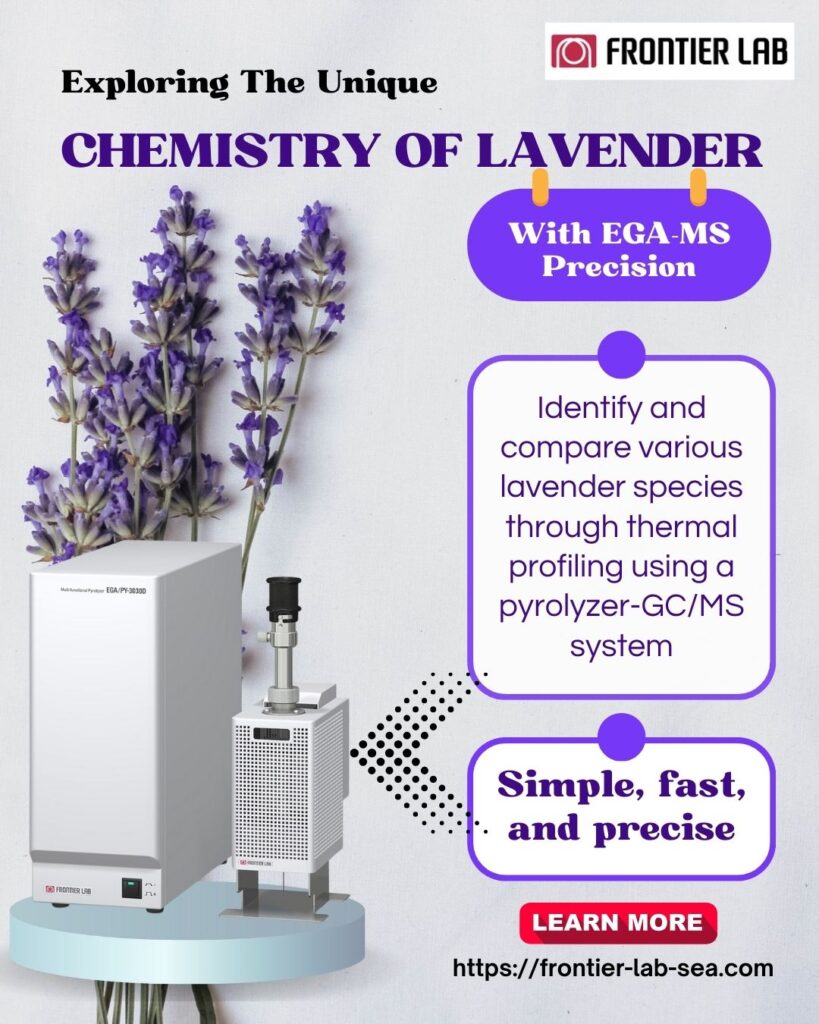
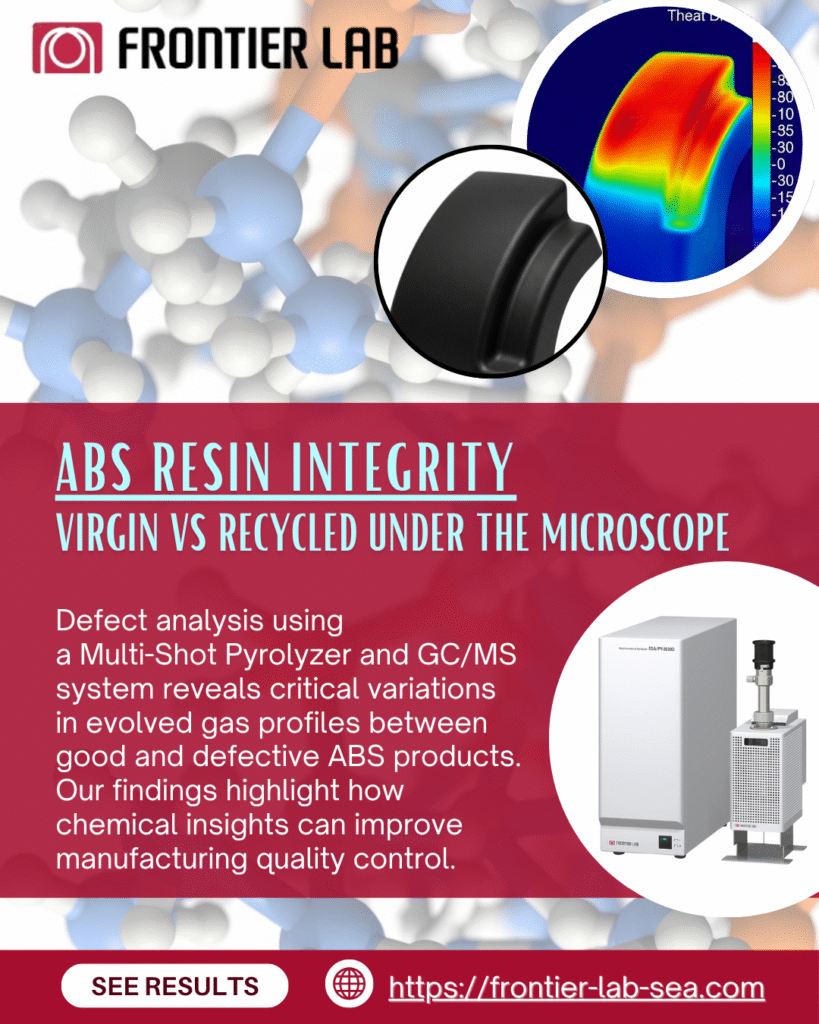
- Multi-Shot Pyrolyzer
- GC/MS
- UAMP Column Kit
- F-Search MPs
- Microplastics Analysis Library
- Polymer calibration standards
Pyrolysis-GC/MS for Multilayer Polymer Analysis
Pyrolysis-GC/MS combines thermal decomposition with gas chromatography and mass spectrometry.
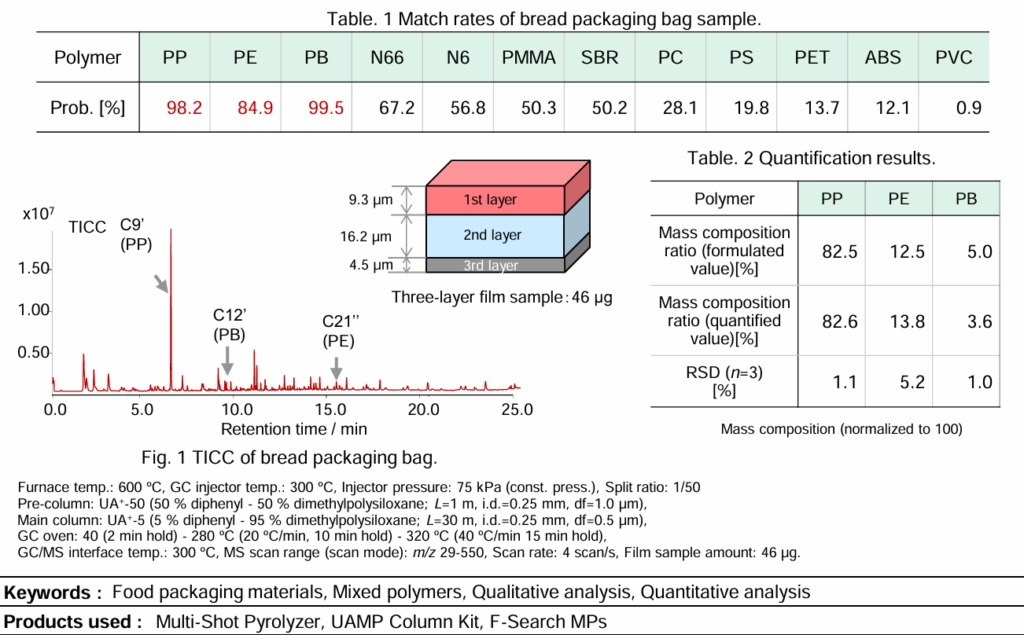
In the PYA1-167E study, a three-layer film used for bread packaging was selected as the model sample. The film had a known composition of PP, PE, and PB.
The film sample was analyzed using a Py-GC/MS system with a Multi-Shot Pyrolyzer directly connected to the GC inlet.
A UAMP Column Kit, consisting of a pre-column and main separation column, was used for the GC separation.
The reported analytical conditions included a furnace temperature of 600 °C, a GC injector temperature of 300 °C, and a film sample amount of 46 µg.
The resulting total ion current chromatogram (TICC) contained characteristic pyrolysis products associated with the polymers in the multilayer film.
[Insert Fig. 1: TICC of bread packaging bag from PYA1-167E]
Three characteristic pyrolyzates were selected for the quantitative analysis:
- 2,4-Dimethyl-1-heptene (C9′) — PP
- 1,20-Heneicosadiene (C21”) — PE
- 2,4-Diethyl-1-octene (C12′) — PB
These characteristic pyrolyzates provided analytical markers for the respective polymer components.
Combining Py-GC/MS with F-Search MPs
The PYA1-167E study combined Py-GC/MS with F-Search MPs to support identification and quantification of the polymers present in the multilayer film.
F-Search MPs was originally developed for analyzing mixed polymer samples in microplastic analysis. In this study, the same approach was applied to the multilayer film.
The researchers used MPCS-SiO₂, a microplastic calibration standard containing 11 polymers, to prepare calibration curves.
Because polybutene-1 (PB) was not included in the calibration standard, PB was additionally registered in the user library of the F-Search MPs analysis software.
This allowed the software to recognize PB during qualitative analysis and enabled the researchers to subsequently prepare an appropriate calibration curve for quantitative analysis.
The approach therefore combined:
Py-GC/MS → Pyrogram → F-Search MPs → Polymer identification → Calibration → Quantification
Qualitative Analysis of Multilayer Polymer Films
The qualitative analysis was performed by analyzing the pyrogram of the bread packaging film using F-Search MPs.
The sample produced high match probabilities for the three polymers known to be present.
Polymer | Match probability |
Polypropylene (PP) | 98.2% |
Polyethylene (PE) | 84.9% |
Polybutene-1 (PB) | 99.5% |
The results showed strong qualitative matches for PP, PE, and PB.
The analysis also evaluated other polymers in the library, including N66, N6, PMMA, SBR, PC, PS, PET, ABS, and PVC. Their reported probabilities were considerably lower than the main polymer components.
This demonstrates how F-Search MPs can help distinguish the principal polymer components within a complex multilayer film pyrogram.
Quantitative Analysis of Polymer Components
After identifying the polymer components, the study investigated their quantitative composition.
Initially, calibration curves obtained using MPCS-SiO₂ were used to estimate the amounts of PP and PE.
The initial results were:
- PP: 31.9 µg
- PE: 8.81 µg
For a sample mass of 46 µg, these values corresponded to a calculated mass composition of approximately 69.3% PP and 19.2% PE.
However, these results were outside the applicable calibration ranges.
The PP result exceeded the upper calibration limit of 19.5 µg, while the PE result was below the lower calibration limit of 14.3 µg.
PB could not be quantified using the MPCS-SiO₂ calibration because PB was not included in the calibration standard.
Polymer-Specific Calibration
To obtain more appropriate quantitative results, calibration curves were prepared separately for PP, PE, and PB using standard samples.
The resulting composition was:
Polymer | Formulated value | Quantified value | RSD (n=3) |
PP | 82.5% | 82.6% | 1.1% |
PE | 12.5% | 13.8% | 5.2% |
PB | 5.0% | 3.6% | 1.0% |
The quantified values were close to the known composition of the bread packaging film.
The maximum relative standard deviation was 5.2%, demonstrating good reproducibility for the reported measurements.
What the Analysis Reveals
The PYA1-167E study demonstrates that Py-GC/MS combined with F-Search MPs can provide both qualitative and quantitative information about a multilayer polymer film.
Identification of PP, PE, and PB
The three main polymer components of the model film were successfully identified:
- Polypropylene (PP)
- Polyethylene (PE)
- Polybutene-1 (PB)
The qualitative match probabilities were 98.2% for PP, 84.9% for PE, and 99.5% for PB.
Characteristic Pyrolysis Products
The study used specific pyrolyzates for quantitative determination:
Polymer | Characteristic pyrolyzate |
PP | 2,4-Dimethyl-1-heptene (C9′) |
PE | 1,20-Heneicosadiene (C21”) |
PB | 2,4-Diethyl-1-octene (C12′) |
These compounds were used as markers for the respective polymer components.
Quantitative Composition
The final quantified mass composition was:
82.6% PP : 13.8% PE : 3.6% PB
This compared closely with the formulated composition:
82.5% PP : 12.5% PE : 5.0% PB
The results demonstrate that quantitative analysis can provide composition values close to the known formulation when appropriate polymer-specific calibration curves are used.
Reproducibility
The reported RSD values were:
- PP: 1.1%
- PE: 5.2%
- PB: 1.0%
The maximum RSD of 5.2% indicates good reproducibility under the analytical conditions described in the technical note.
Importance of Calibration
The study also demonstrates why calibration range and standard selection are important for quantitative polymer analysis.
The initial calibration using MPCS-SiO₂ was not suitable for directly quantifying all three components because PP and PE fell outside the relevant calibration ranges and PB was not included in the standard.
Preparing calibration curves specifically for PP, PE, and PB resulted in quantitative values much closer to the known formulation.
Applications of Multilayer Polymer Film Analysis
The PYA1-167E study demonstrates the use of Py-GC/MS and F-Search MPs for characterization of a multilayer food packaging film.
Within the Plastics & Rubbers application area, this analytical approach can support:
Multilayer Packaging Film Characterization
Analyzing films containing multiple polymer components can help determine the composition of complex packaging materials.
Qualitative Polymer Identification
F-Search MPs can be used with pyrolysis data to support identification of individual polymers in mixed samples.
Quantitative Polymer Analysis
With appropriate calibration standards and calibration curves, the method can be used to determine the mass composition of target polymer components.
Mixed Polymer Analysis
The approach can also be applied to samples where multiple polymers contribute to a single pyrolysis profile.
These applications are based on the analytical approach demonstrated in PYA1-167E and should be considered within the relevant sample and calibration conditions.
Frontier Laboratories Solutions for Polymer Analysis
Frontier Laboratories provides analytical solutions for polymer characterization using pyrolysis-based techniques.
For multilayer polymer film analysis, the PYA1-167E study demonstrates a workflow combining a Multi-Shot Pyrolyzer, UAMP Column Kit, GC/MS, and F-Search MPs.
These technologies can support the identification and quantitative characterization of complex polymer materials.
Explore the relevant Frontier Lab SEA resources:
- [Plastics & Rubbers →]
- [Multi-Shot Pyrolyzer® →]
- [F-Search MPs →]
- [Polymer Analysis Applications →]
- [Related Polymer Analysis Blogs →]
- [PYA1-167E Technical Note →]
- [Contact Frontier Lab SEA →]
Frequently Asked Questions
Multilayer polymer film analysis is the characterization of a film containing multiple polymer materials. It can involve identifying individual polymer components and determining their relative or quantitative composition.
Py-GC/MS thermally decomposes polymer materials and analyzes the resulting pyrolysis products using GC/MS. Because different polymers produce characteristic pyrolysis products, the resulting pyrogram can be compared with reference data to support polymer identification.
Yes. The PYA1-167E study demonstrated quantitative analysis of PP, PE, and PB using characteristic pyrolyzates and polymer-specific calibration curves.
F-Search MPs is software used to support polymer identification from pyrolysis data. In PYA1-167E, it was combined with a Microplastics Analysis Library to analyze the complex pyrogram of a multilayer film.
Different polymer layers can provide different functions within a multilayer material. Characterizing the polymer composition helps determine which materials are present and can provide quantitative information about their composition.
The model bread packaging film contained polypropylene (PP), polyethylene (PE), and polybutene-1 (PB).
The quantified mass composition was 82.6% PP, 13.8% PE, and 3.6% PB, compared with the formulated composition of 82.5% PP, 12.5% PE, and 5.0% PB.
The reported RSD values were 1.1% for PP, 5.2% for PE, and 1.0% for PB, with a maximum RSD of 5.2% for three measurements.