Quantitative Analysis of Irganox 1098 Antioxidant in EVOH Using Py-GC/MS
Introduction to Antioxidant Analysis in Polymer Materials
Antioxidants are commonly incorporated into polymeric materials to improve their performance and processing characteristics. These additives help protect polymers against degradation and can influence the quality and durability of the finished material.
Identifying and quantifying antioxidants in polymers is important for additive characterization, quality assurance, and polymer research. However, the analytical method must be selected according to the physical and chemical properties of the target additive.
Irganox 1098 is an antioxidant used in polymer materials. Because it is nonvolatile, conventional thermal desorption GC/MS (TD-GC/MS) is not suitable for its analysis.
Irganox 1098 analysis in EVOH using Py-GC/MS provides an alternative approach. Instead of relying on direct thermal desorption of the intact antioxidant, this method detects a characteristic thermal decomposition product and uses it for quantitative determination.
In the investigated study, BHT-quinone-methide was identified as a pyrolysis product of Irganox 1098. Using an absolute calibration method and extracted ion chromatograms, the concentration of Irganox 1098 in ethylene-vinyl alcohol copolymer (EVOH) was determined to be 5,217 ppm, with an RSD of 0.9%.
Why Analyze Antioxidants in Polymer Materials?
Polymer formulations often contain additives that influence their processing, stability, and final properties. Antioxidants are among the important additives used to help protect polymer materials from degradation.
Analyzing these additives can help laboratories and manufacturers:
Identify specific antioxidants in polymer formulations.
Determine additive concentrations in polymer materials.
Investigate the composition of polymer products.
Support quality assurance and formulation studies.
Compare additive levels between different material samples.
The choice of analytical technique depends on the volatility and thermal behavior of the target additive.
For volatile additives, thermal desorption GC/MS may be suitable. However, nonvolatile additives such as Irganox 1098 require an alternative analytical approach.
Why Is Thermal Desorption GC/MS Not Suitable for Irganox 1098?
Thermal desorption GC/MS is commonly used to analyze additives that can be released from a polymer by heating without decomposing the polymer matrix.
The sample is heated to a temperature sufficient to desorb the target additive. The released compounds are then transferred to the GC/MS system for separation and detection.
However, this approach has a limitation when the target compound is nonvolatile.
Irganox 1098 is nonvolatile, making direct thermal desorption unsuitable for its analysis. Instead of being released as an intact compound under the required conditions, it requires a different analytical strategy.
Pyrolysis-GC/MS addresses this challenge by thermally decomposing the sample and investigating characteristic decomposition products of the target additive.
What Is Py-GC/MS Analysis?
Pyrolysis-Gas Chromatography/Mass Spectrometry (Py-GC/MS) combines controlled thermal decomposition with gas chromatographic separation and mass spectrometric detection.
During analysis, a small amount of sample is rapidly heated in a pyrolyzer. The resulting volatile decomposition products are transferred to the GC system, separated by chromatography, and detected by mass spectrometry.
For additive analysis, a characteristic pyrolysis product can be used as an indicator of the target compound.
In the case of Irganox 1098, the analysis focused on BHT-quinone-methide, a thermal decomposition product of the antioxidant.
This approach allows a nonvolatile additive to be investigated through its characteristic pyrolysis products rather than relying on direct volatilization of the original compound.
Analytical Approach for Irganox 1098 in EVOH
The study investigated the quantitative determination of Irganox 1098 in ethylene-vinyl alcohol copolymer (EVOH).
A small amount of EVOH containing approximately 5,000 ppm of Irganox 1098 was pulverized before analysis.
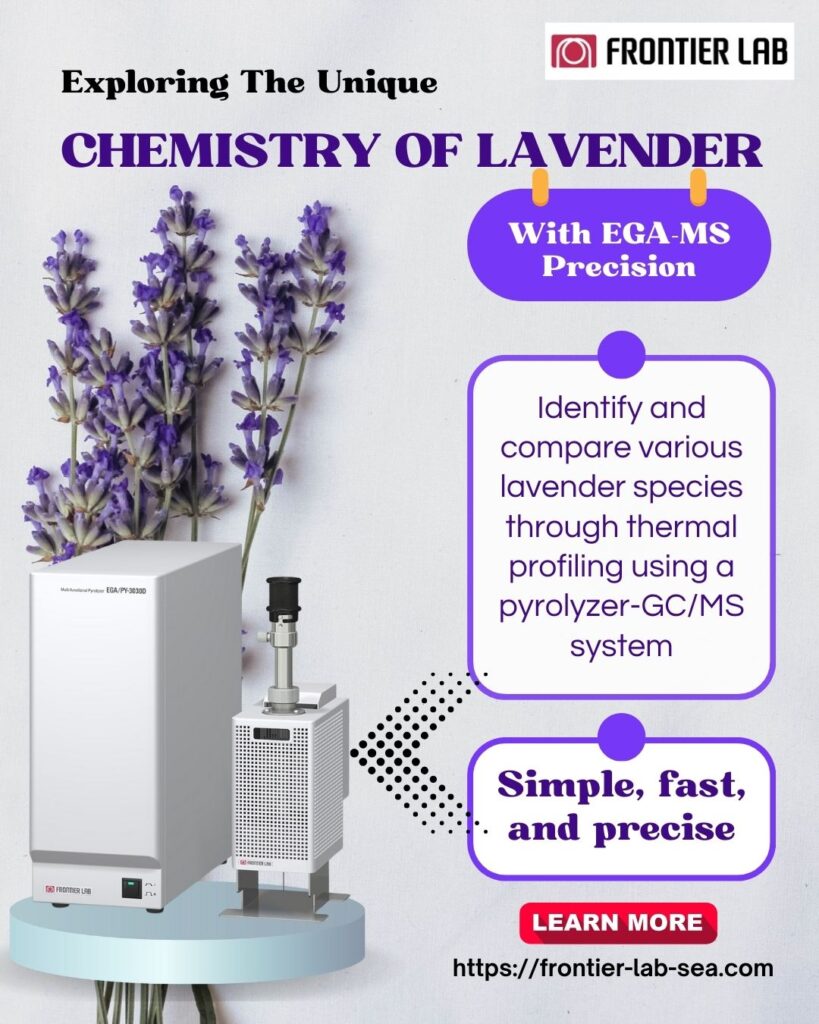
The analytical procedure used a Multi-Shot Pyrolyzer (EGA/PY-3030D) directly connected to the split injector of a gas chromatograph.
The sample was pyrolyzed at 600°C, and the resulting products were separated using a 15 m chromatographic column before detection with a quadrupole mass spectrometer.
An absolute calibration method was used to generate the calibration curve for quantitative determination.
The main analytical steps were:
Prepare and pulverize the EVOH sample containing Irganox 1098.
Analyze the antioxidant and identify its characteristic pyrolysis product.
Perform Py-GC/MS analysis of the EVOH sample.
Monitor selected ions using extracted ion chromatograms.
Generate an absolute calibration curve using the selected ion peak area.
Determine the Irganox 1098 concentration in the polymer sample.
Identification of BHT-Quinone-Methide as a Characteristic Pyrolysis Product
One of the important steps in the analysis was identifying a suitable pyrolysis product of Irganox 1098.
The pyrogram of Irganox 1098 showed a peak corresponding to BHT-quinone-methide, a thermal decomposition product of the antioxidant.
The mass spectrum of this compound contained two characteristic ions:
m/z 161: Base peak
m/z 218: Molecular ion
These ions provided the basis for monitoring the characteristic pyrolysis product during analysis.
Identifying a suitable decomposition product is important when developing a quantitative Py-GC/MS method for nonvolatile additives.
Py-GC/MS Results: Detection of Irganox 1098 in EVOH
The total ion chromatogram (TIC) of the EVOH sample showed several pyrolysis product peaks.
However, the peaks associated with Irganox 1098 were present among the other pyrolysis products and could not be clearly distinguished in the overall TIC chromatogram.
To improve detection, extracted ion chromatograms (EICs) were generated using the characteristic ions of BHT-quinone-methide.
Extracted Ion Chromatograms for Improved Detection
The EICs monitored two ions:
m/z 161
m/z 218
Both extracted ion chromatograms showed a clear peak at a retention time of approximately 1.8 minutes.
This made it possible to identify the characteristic signal associated with the Irganox 1098 pyrolysis product, even though the corresponding peaks were not readily distinguishable in the overall TIC.
The use of selected ions therefore helped improve the detection of the target additive in the complex EVOH pyrolysis profile.
Quantitative Determination of Irganox 1098 Using Absolute Calibration
After identifying the characteristic pyrolysis product, an absolute calibration method was used for quantitative analysis.
The peak area of the m/z 161 ion was selected to generate the calibration curve.
Based on this calibration approach, the Irganox 1098 concentration in the EVOH sample was determined.
Key Analytical Results
| Parameter | Reported result |
|---|---|
| Target additive | Irganox 1098 |
| Polymer matrix | Ethylene-vinyl alcohol copolymer (EVOH) |
| Approximate spiked concentration | 5,000 ppm |
| Pyrolysis temperature | 600°C |
| Characteristic pyrolysis product | BHT-quinone-methide |
| Monitored ions | m/z 161 and m/z 218 |
| Retention time | Approximately 1.8 minutes |
| Calibration method | Absolute calibration |
| Quantification signal | Peak area of m/z 161 |
| Determined concentration | 5,217 ppm |
| Number of measurements | 2 |
| Relative standard deviation | 0.9% |
The measured Irganox 1098 concentration was 5,217 ppm, with an RSD of 0.9% across two measurements.
The result demonstrates the use of a characteristic pyrolysis product and extracted ion chromatograms for quantitative analysis of a nonvolatile antioxidant in EVOH.
Why Use Extracted Ion Chromatograms for Polymer Additive Analysis?
Polymer samples often generate complex chromatograms containing multiple decomposition products.
When the target compound produces a characteristic signal among these other compounds, the total ion chromatogram may not provide sufficient selectivity for clear detection.
Extracted ion chromatograms help address this challenge by displaying signals associated with selected mass-to-charge ratios.
In the Irganox 1098 investigation:
The overall TIC contained overlapping pyrolysis product peaks.
The m/z 161 and m/z 218 EICs showed a clear peak at approximately 1.8 minutes.
The m/z 161 peak area was used for absolute calibration and quantitative determination.
This demonstrates how selected-ion monitoring can support additive analysis in complex polymer matrices.
Advantages of Py-GC/MS for Nonvolatile Polymer Additives
1. Analysis of nonvolatile additives
Py-GC/MS can investigate nonvolatile additives by monitoring their characteristic thermal decomposition products.
2. Characteristic product identification
Identifying a suitable pyrolysis product provides a target signal for qualitative and quantitative analysis.
3. Improved detection using EIC
Extracted ion chromatograms help distinguish selected compounds from complex pyrolysis product profiles.
4. Quantitative determination
With an appropriate calibration approach, Py-GC/MS can be used to determine additive concentrations in polymer materials.
5. Small sample requirements
The reported investigation used approximately 200 µg of spiked EVOH sample, demonstrating the use of a small sample quantity for this analysis.
Instrumentation and Analytical Conditions
The study used a Multi-Shot Pyrolyzer (EGA/PY-3030D) directly interfaced with the split injector of a GC system.
The pyrolysis products were separated using a 15 m separation column and detected using a quadrupole mass spectrometer.
The main reported analytical conditions were:
| Parameter | Reported condition |
|---|---|
| Pyrolysis furnace temperature | 600°C |
| GC oven temperature | 40–350°C |
| GC oven heating rate | 20°C/min |
| Final GC oven hold | 4 minutes |
| Column flow rate | 1.2 mL/min |
| Split ratio | 1:50 |
| Separation column | UA+-1 |
| Column length | 15 m |
| Column internal diameter | 0.25 mm |
| Film thickness | 0.1 µm |
| Mass scan range | m/z 29–650 |
| Irganox 1098 sample weight | Approximately 1.5 µg |
| Spiked EVOH sample weight | Approximately 200 µg |
The selected pyrolysis conditions and chromatographic settings were used to identify and quantify Irganox 1098 through its characteristic decomposition product.
Explore the Frontier Laboratories product range to learn more about analytical systems for polymer and additive characterization.
Broader Applications in Polymer Analysis and Material Science
Py-GC/MS and other thermal analysis techniques support the investigation of polymer additives, degradation products, and complex material compositions across research laboratories and industrial sectors in India and Southeast Asia.
Plastics & Rubber Analysis: Characterizing polymer materials, identifying additives and plasticizers, and investigating thermal decomposition products.
Applied Pyrolysis Research: Exploring Py-GC/MS, EGA-MS, and other thermal analysis techniques for investigating complex materials and chemical components.
Advanced Materials Characterization: Studying complex polymer systems, material composition, and thermal degradation behavior.
Paints and Coatings Analysis: Investigating organic additives, coating components, and chemical characteristics of formulated materials.
Microplastics Analysis: Exploring analytical approaches for polymer identification and the characterization of microplastic materials.
These application areas demonstrate the wider role of thermal analysis and pyrolysis-based techniques in polymer research and material characterization. The appropriate analytical method depends on the target compound, polymer matrix, and research objective.
For laboratories investigating polymer additives and nonvolatile compounds, the right analytical configuration can support method development and quantitative analysis. Explore the Frontier Laboratories SEA Products page or contact Frontier Laboratories SEA for application-specific guidance.
Conclusion
Py-GC/MS provides an effective analytical approach for investigating nonvolatile additives in polymer materials when direct thermal desorption is not suitable.
In the investigated EVOH sample, Irganox 1098 was analyzed through its characteristic thermal decomposition product, BHT-quinone-methide. The m/z 161 and m/z 218 extracted ion chromatograms showed a clear peak at approximately 1.8 minutes, allowing the target signal to be distinguished from the complex total ion chromatogram.
Using an absolute calibration method based on the m/z 161 peak area, the Irganox 1098 concentration was determined to be 5,217 ppm, with an RSD of 0.9% across two measurements.
This approach demonstrates how characteristic pyrolysis products and selected-ion analysis can support quantitative determination of nonvolatile antioxidants in polymer matrices.
For researchers and laboratories working on polymer additive analysis, quality assurance, and material characterization, Py-GC/MS offers a useful analytical option for investigating compounds that are not suitable for conventional thermal desorption analysis.
Frequently Asked Questions (FAQs)
Irganox 1098 is an antioxidant additive used in polymeric materials. It is incorporated into formulations to help improve polymer performance and stability.
Irganox 1098 is nonvolatile. Thermal desorption GC/MS requires the target additive to be released from the polymer without decomposing the polymer matrix. Since Irganox 1098 is not suitable for direct thermal desorption, Py-GC/MS provides an alternative approach.
The antioxidant is investigated through its thermal decomposition product, BHT-quinone-methide. The characteristic ions m/z 161 and m/z 218 are monitored using extracted ion chromatograms.
BHT-quinone-methide is a thermal decomposition product of Irganox 1098 identified during Py-GC/MS analysis. Its mass spectrum showed m/z 161 as the base peak and m/z 218 as the molecular ion.
The analysis determined an Irganox 1098 concentration of 5,217 ppm in the investigated EVOH sample.
Relative standard deviation measures the variation between repeated measurements relative to their average. The reported RSD of 0.9% across two measurements indicates good repeatability under the investigated analytical conditions.
Extracted ion chromatograms display signals associated with selected mass-to-charge ratios. They can help distinguish target compounds from other pyrolysis products that may overlap in the total ion chromatogram.
Yes. Py-GC/MS can be used to investigate suitable polymer additives through their characteristic thermal decomposition products. The analytical conditions and selected detection ions depend on the target additive and polymer matrix.