Characterization of Organic Pigments Using Py-GC/MS and Development of a Searchable Pigment Database
Introduction
Organic pigments are widely used in paint and ink formulations to provide colour and functional properties. However, identifying these pigments can be challenging, particularly when analysing complex formulations containing multiple pigments with similar chemical structures.
Many organic pigments are insoluble in organic solvents, making conventional solvent-based extraction and analysis difficult. In addition, pigments with similar molecular structures may produce analytical results that are challenging to distinguish using conventional approaches.
Pyrolysis-Gas Chromatography/Mass Spectrometry (Py-GC/MS) offers an effective analytical approach for characterizing organic pigments. The technique enables direct sample analysis without requiring pretreatment such as solvent extraction. Pyrolysis products are separated using a high-resolution capillary GC column and identified using mass spectral and retention information.
A study involving 35 organic pigments demonstrated how Py-GC/MS can support pigment characterization and the development of a searchable mass spectral database. The approach was also applied to distinguish structurally similar pigments, including Pigment Yellow 93 and Pigment Yellow 94.
Why Is Organic Pigment Identification Challenging?
Organic pigments present several analytical challenges:
Low solubility: Many organic pigments are insoluble in organic solvents, making solvent extraction difficult.
Similar chemical structures: Different pigments can have closely related molecular structures, complicating identification.
Complex formulations: Paint and ink samples may contain multiple pigments and other formulation components.
Nonvolatile characteristics: Many pigments have relatively high molecular weights and are not suitable for conventional direct GC analysis.
These challenges make reliable pigment identification important for paint formulation analysis, material characterization and quality evaluation.
How Py-GC/MS Supports Organic Pigment Analysis
Py-GC/MS combines thermal decomposition with gas chromatography and mass spectrometry to characterize nonvolatile materials.
The sample is heated in a pyrolyzer, generating smaller volatile compounds known as pyrolyzates. These compounds are transferred to the gas chromatograph, where they are separated according to their chromatographic properties. The separated compounds are then detected by mass spectrometry.
Pigment identification can use two complementary types of information:
1. Mass spectral information
The mass spectra of individual pyrolysis products provide information that can help identify the compounds generated from each pigment.
2. Gas chromatographic retention information
The retention behaviour of the separated pyrolysis products provides an additional identification parameter.
Combining mass spectral and GC retention information helps distinguish pigments that have similar chemical structures.
An important advantage is that samples can be analysed directly without pretreatment such as solvent extraction.
Characterization of 35 Organic Pigments
The study evaluated 35 organic pigments using a multi-functional pyrolyzer coupled with GC/MS.
The investigated pigment groups included:
Condensation disazo pigments with similar structures
Azo lake pigments
Phthalocyanine pigments
The analysis involved two complementary techniques:
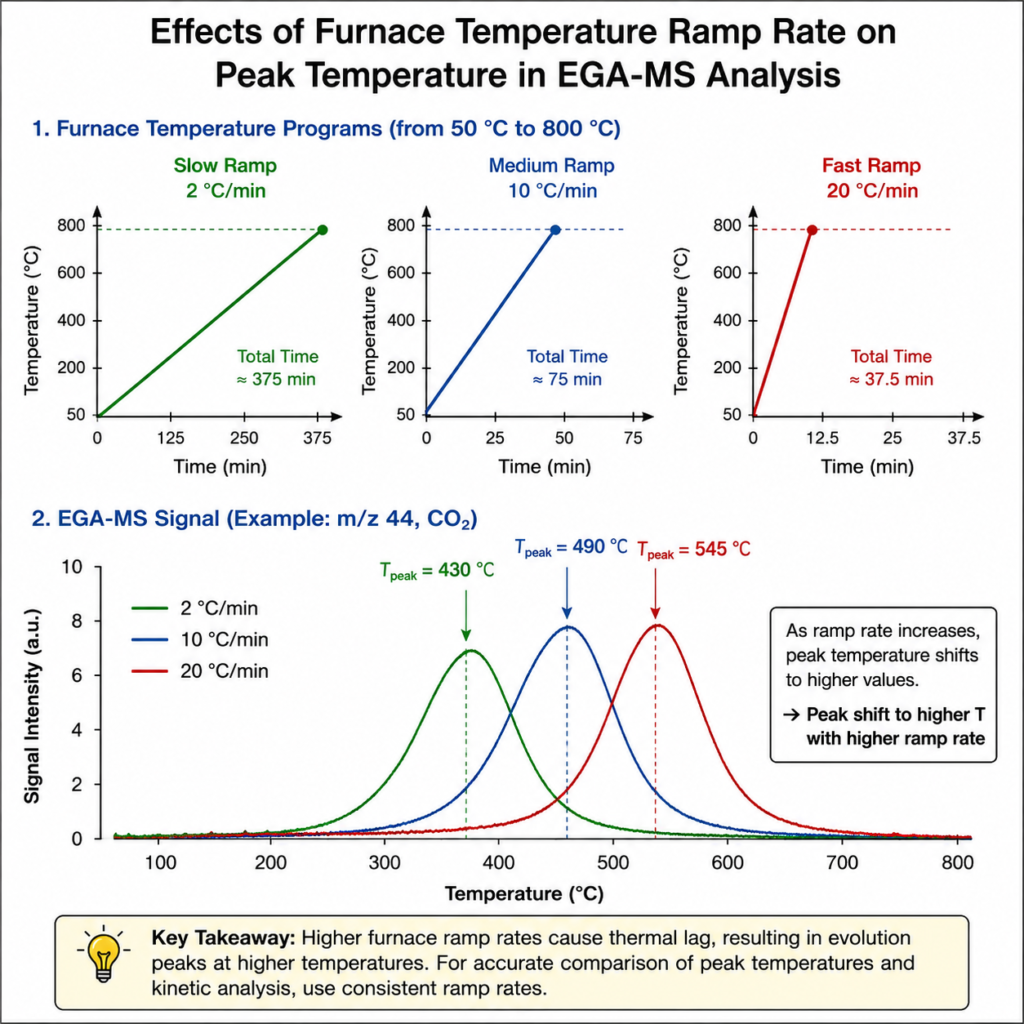
Evolved Gas Analysis–Mass Spectrometry (EGA-MS)
EGA-MS was used to examine the thermal behaviour of the pigments and the temperature ranges at which evolved compounds were detected.
Pyrolysis-GC/MS
Py-GC/MS was performed at 600°C to generate and separate pigment-specific pyrolysis products. The resulting mass spectral information was used to develop a searchable organic pigment library with F-Search software.
This database approach provides a reference for identifying pigments in unknown samples. Additional organic pigments can also be incorporated into the library.
Differentiating Pigment Yellow 93 and Pigment Yellow 94
One important example in the study involved Pigment Yellow 93 and Pigment Yellow 94.
These two organic pigments have similar molecular structures, making their differentiation an analytical challenge.
The study used EGA-MS and Py-GC/MS to examine their thermal behaviour and pyrolysis products.
1. EGA-MS analysis
EGA-MS was performed by heating the samples from 100°C to 600°C at a heating rate of 20°C/min.
The thermograms showed different characteristic thermal behaviour for the two pigments:
Pigment Yellow 93 showed a characteristic peak at approximately 386°C.
Pigment Yellow 94 showed a characteristic peak at approximately 402°C.
The difference between the reported peak temperatures was approximately 16°C.
This difference in thermal behaviour provides an additional parameter for distinguishing the two pigments.
2. Py-GC/MS analysis
Py-GC/MS was conducted at a pyrolysis temperature of 600°C.
The generated pyrolysis products were separated using a capillary GC column and identified using their mass spectral information.
The resulting pyrograms showed characteristic peaks that helped distinguish Pigment Yellow 93 from Pigment Yellow 94.
The study used the major pyrolysis peaks and their identification information to support the development of a pigment database.
3. Developing a searchable pigment database
The mass spectral information obtained from the Py-GC/MS analysis was incorporated into a searchable library using F-Search software.
This database can be used as a reference when analysing unknown samples containing pigments with similar structures.
The library can also be expanded by adding data from additional organic pigments, supporting future identification work.
Identification of Multiple Pigments in Complex Samples
Py-GC/MS is particularly useful when analysing samples containing multiple pigments.
The pyrolysis products generated from individual pigments can be separated through GC before mass spectrometric identification.
This enables analysts to examine the individual pyrolysis products rather than relying only on the overall composition of a complex sample.
According to the study, this approach is useful because the pyrolyzates of each pigment can be separated, identified and quantitated when multiple pigments are present.
The combination of chromatographic separation, mass spectral information and a searchable reference library supports pigment identification in unknown samples.
Experimental Conditions and Instrumentation
The following table summarizes the reported analytical conditions.
| Parameter | Experimental condition |
|---|---|
| Instrument | Multi-functional 3030D Pyrolyzer coupled with GC/MS |
| Number of pigments | 35 organic pigments |
| EGA-MS temperature range | 100–600°C |
| EGA heating rate | 20°C/min |
| Py-GC/MS pyrolysis temperature | 600°C |
| GC oven temperature | 40–320°C |
| GC oven heating rate | 20°C/min |
| Separation column | Ultra ALLOY+-5 |
| Column stationary phase | 5% diphenyl, 95% dimethylpolysiloxane |
| Column length | 30 m |
| Column internal diameter | 0.25 mm |
| Film thickness | 0.25 µm |
| Split ratio | 1/30 |
| Sample weight | Approximately 70 µg |
| Database software | F-Search |
Products and components used:
Multi-functional Pyrolyzer
Vent-free GC/MS adapter
Ultra ALLOY+-5 capillary column
F-Search mass spectral library software
Advantages of Py-GC/MS for Organic Pigment Characterization
The study demonstrates several useful capabilities of Py-GC/MS for pigment analysis.
Direct sample analysis
Samples can be analysed directly without pretreatment such as solvent extraction, which is useful for pigments that are insoluble in organic solvents.
Characterization of nonvolatile pigments
Py-GC/MS can be applied to relatively high-molecular-weight, nonvolatile organic pigments that are difficult to analyse using conventional direct GC approaches.
Differentiation of structurally similar pigments
The combination of pyrolysis product mass spectra and GC retention information helps distinguish pigments with similar structures.
Analysis of multiple pigments
GC separation enables the pyrolysis products of different pigments in a sample to be separated and examined.
Searchable mass spectral database development
F-Search can be used to build a pigment library from Py-GC/MS data. Additional pigment information can be incorporated to support identification of unknown samples.
Broader Applications in Paints, Coatings and Material Characterization
Organic pigment characterization is relevant to several areas of materials research and industrial analysis.
Paint and coating formulation: Characterization of organic pigments used in paint and coating materials.
Printing inks: Analysis and identification of organic pigments used in ink formulations.
Unknown pigment identification: Comparison of unknown samples against a searchable mass spectral library.
Material characterization: Investigation of the thermal behaviour and pyrolysis products of organic materials.
Complex formulation analysis: Separation and identification of pyrolysis products from samples containing multiple pigments.
Explore related analytical capabilities from Frontier Lab SEA:
Paints and Coatings Analysis – Analytical approaches for paints and coating materials.
Applied Pyrolysis Research – Applications of pyrolysis-based analytical techniques.
Advanced Materials Analysis – Characterization of advanced and functional materials.
Products – Explore analytical instrumentation and solutions.
Conclusion
Identifying organic pigments can be challenging because many pigments are insoluble in organic solvents and may have similar molecular structures.
The characterization of 35 organic pigments using Py-GC/MS demonstrates how thermal analysis, chromatographic separation and mass spectral identification can be combined to investigate these materials.
The comparison of Pigment Yellow 93 and Pigment Yellow 94 illustrates how differences in thermal behaviour and pyrolysis product profiles can support pigment differentiation.
Furthermore, incorporating Py-GC/MS data into a searchable F-Search mass spectral library provides a reference for identifying unknown pigments. The library can be expanded as additional pigment data become available.
For laboratories and researchers working with paints, coatings, inks and organic materials, Py-GC/MS offers a useful approach to pigment characterization and identification.
To learn more about pyrolysis-based analytical solutions, visit Frontier Lab SEA.
Frequently Asked Questions (FAQs)
Py-GC/MS is an analytical technique that uses thermal decomposition to generate volatile compounds from a sample. These pyrolysis products are separated by gas chromatography and identified using mass spectrometry.
Many organic pigments are insoluble in organic solvents and have relatively high molecular weights. Py-GC/MS allows direct sample analysis without solvent extraction and helps characterize pigments through their pyrolysis products.
Yes. Py-GC/MS combines mass spectral information and GC retention data to help distinguish pigments with similar structures. The study demonstrated this approach using Pigment Yellow 93 and Pigment Yellow 94.
The reported EGA thermogram showed a characteristic peak at approximately 386°C for Pigment Yellow 93 and approximately 402°C for Pigment Yellow 94, giving a temperature difference of about 16°C.
Evolved Gas Analysis–Mass Spectrometry (EGA-MS) examines the thermal behaviour of a sample by monitoring evolved compounds during heating. It provides information about characteristic temperature ranges and complements Py-GC/MS analysis.
F-Search is used to create and search a mass spectral library. In this application, Py-GC/MS data from organic pigments were incorporated into a searchable database that can support the identification of unknown pigments.
Yes. The GC separation step allows pyrolysis products from different pigments to be separated. The study describes Py-GC/MS as useful for separating, identifying and quantitating pyrolyzates from multiple pigments in a sample.
A total of 35 organic pigments were analysed using EGA-MS and Py-GC/MS. The evaluated groups included condensation disazo pigments, azo lake pigments and phthalocyanine pigments.