Usefulness of Backflush Combined with Smart Pre-Column in Pyrolysis-GC/MS Measurements
Introduction
Pyrolysis-Gas Chromatography/Mass Spectrometry (Py-GC/MS) is a powerful analytical technique for characterizing polymeric materials by analyzing the characteristic compounds generated during pyrolysis. However, one of the challenges in Py-GC/MS is the formation of high-boiling-point compounds during pyrolysis.
These high-boiling compounds can remain in the separation column and may require column cleaning through bakeout procedures. This can increase measurement time and potentially affect the performance of the separation column.
One effective strategy is to prevent high-boiling-point compounds from entering the separation column. The combination of a Smart Pre-Column (SMC) and backflush (BF) using a Multi-Functional Splitless Sampler (MFS-2015E) provides an approach for retaining and removing these compounds efficiently.
The Smart Pre-Column, which does not contain a coated stationary phase, can temporarily retain high-boiling compounds before they reach the separation column. Backflush can then be used to rapidly remove the retained compounds.
This technical evaluation investigated the usefulness of combining a Smart Pre-Column with backflush during high-density polyethylene (HDPE) pyrolysis-GC/MS analysis, with particular attention to the detection range and reproducibility of target compounds.
Challenge of High-Boiling Compounds in Py-GC/MS
During pyrolysis, polymers generate a wide range of volatile and semi-volatile products. While compounds relevant to the analysis need to reach the separation column, high-boiling compounds can remain in the column for extended periods.
This can lead to:
- Accumulation of high-boiling compounds in the separation column
- Increased column contamination
- The need for periodic column bakeout
- Longer overall measurement time
- Potential effects on subsequent measurements
Therefore, controlling the transfer of high-boiling compounds is important for efficient and reliable Py-GC/MS analysis.
Smart Pre-Column and Backflush Approach
A Smart Pre-Column provides an additional section between the GC inlet and the analytical separation column.
Unlike conventional capillary columns, the Smart Pre-Column used in this evaluation does not have a coated stationary phase. This design allows high-boiling compounds to be retained in the pre-column while target pyrolysis products are transferred to the separation column.
After the target compounds have passed through, backflush can be initiated to reverse the flow and remove the retained high-boiling compounds.
The combination can therefore help prevent unwanted compounds from entering and contaminating the main separation column.
Figure 1. Connection diagram of Smart Pre-Column, MFS-2015E Splitter, and separation column.
Experimental Conditions
The evaluation was performed using a Multi-Shot Pyrolyzer (EGA/PY-3030D) directly interfaced with the GC inlet of a GC/MS system.
One end of the Smart Pre-Column was connected to the GC inlet, while the other end was connected to the splitter of the Multi-Functional Splitless Sampler (MFS-2015E). The splitter was connected to the separation column and mass detector.
Approximately 0.3 mg of HDPE was placed in an Eco-Cup LF and pyrolyzed at 600 °C.
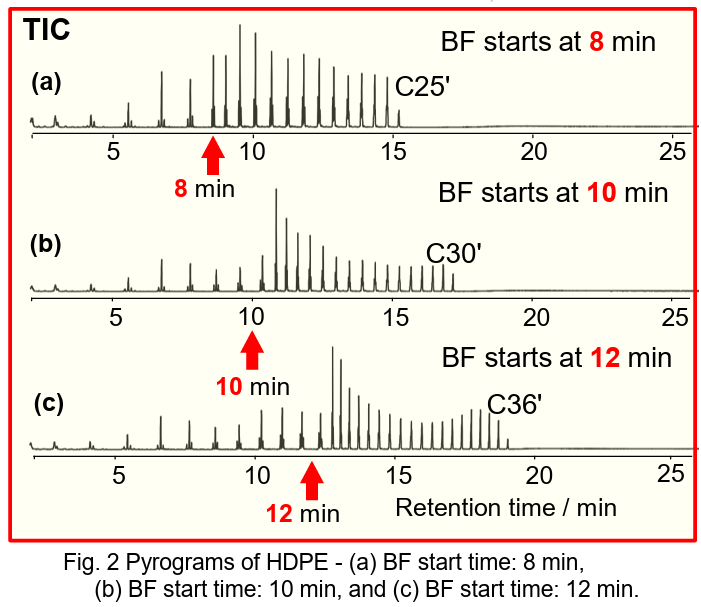
Pyrograms were obtained under conditions without backflush and with backflush initiated at 8, 10, and 12 minutes after the start of measurement.
Analytical Conditions
Parameter | Condition |
Pyrolysis furnace temperature | 600 °C |
GC injector temperature | 300 °C |
Split ratio | 1/50 |
Injector pressure | Constant pressure, 75 kPa for Fig. 2 |
Injector condition | Constant flow rate for Fig. 3 |
GC oven temperature | 40 °C (2 min hold) – 350 °C |
Oven heating rate | 20 °C/min |
Final hold | 12.5 min |
Smart Pre-Column | UAD™-2M, 2.0 m × 0.25 mm i.d. |
Separation column | UA+-5, 30 m × 0.25 mm i.d., 0.25 µm film |
MS scan range | m/z 29–600 |
Sample amount | Approximately 0.3 mg |
Effect of Backflush Timing on HDPE Pyrograms
The timing of backflush had a significant effect on the high-boiling compounds detected during HDPE pyrolysis.
Without backflush, compounds extending up to approximately C44 were detected.
When backflush was initiated at different times, the upper limit of the detected high-boiling compounds changed.
Backflush Start Time | Highest Compound Detected |
No backflush | Up to C44 |
8 minutes | Up to C25 |
10 minutes | Up to C30 |
12 minutes | Up to C36 |
These results demonstrate that backflush can effectively limit the transfer of high-boiling compounds to the separation column.
Figure 2. Pyrograms of HDPE with different backflush start times: (a) 8 min, (b) 10 min, and (c) 12 min.
Optimization of Backflush Start Time
The appropriate backflush timing depends on the compounds that need to be detected.
The evaluation considered polymers commonly produced in large quantities and frequently targeted in microplastics analysis, including:
- Polyethylene (PE)
- Polypropylene (PP)
- Polystyrene (PS)
- Polyvinyl chloride (PVC)
- Polycarbonate (PC)
- Polymethyl methacrylate (PMMA)
- Polyethylene terephthalate (PET)
- Nylon 6 (N6)
- Nylon 66 (N66)
- Acrylonitrile-butadiene-styrene resin (ABS)
- Styrene-butadiene rubber (SBR)
- Polyurethane (PU)
Based on the evaluation, a 10-minute backflush start time was determined to be an optimal condition.
At this timing, styrene trimer, which has the longest retention time among the relevant pyrolyzates evaluated, could be reliably detected while minimizing the overall analysis duration.
This demonstrates the importance of selecting a backflush time that balances the detection of target compounds with the removal of unwanted high-boiling compounds.
Reproducibility Evaluation
The effect of backflush on analytical reproducibility was also investigated.
For this evaluation, methyl stearate was added as an internal standard (ISTD) to the HDPE sample.
The ratio of the total peak area of the diene and monoene peaks in the hydrocarbon EIC at m/z 82 to the peak area of the ISTD EIC at m/z 298 was evaluated.
The reproducibility test was conducted with four measurements (n=4).
For compounds in the C14 to C29 range, the reproducibility was found to be less than 2% RSD.
This result confirms that the use of backflush combined with the Smart Pre-Column can support quantitative analysis with high accuracy while reducing the influence of high-boiling compounds.
Figure 3. Typical pyrogram of ISTD-added HDPE obtained during the reproducibility measurement.
Why Combine Smart Pre-Column with Backflush?
The combination of these two approaches provides several advantages for Py-GC/MS measurements.
1. Reduces Separation Column Contamination
The Smart Pre-Column can retain high-boiling compounds before they reach the main separation column, helping protect the analytical column.
2. Enables Efficient Removal of High-Boiling Compounds
Because the Smart Pre-Column does not contain a coated stationary phase, retained compounds can be rapidly removed using backflush.
3. Reduces Measurement Time
Backflush prevents unwanted high-boiling compounds from traveling through the entire separation column, helping minimize the time required for analysis.
4. Supports Reproducible Quantitative Analysis
The reproducibility evaluation showed less than 2% RSD for the C14–C29 range, demonstrating good analytical reproducibility.
5. Useful for Polymer and Microplastics Analysis
The approach is particularly relevant to polymer characterization and Py-GC/MS-based microplastics analysis, where multiple polymer types and their characteristic pyrolysis products may need to be evaluated.
Applications
The Smart Pre-Column and backflush approach can be applied to various polymer-related analytical applications, including:
- Polymer material analysis
- Pyrolysis-GC/MS analysis
- Microplastics analysis
- Polyethylene characterization
- Polypropylene characterization
- Polystyrene characterization
- Polymer identification
- Quantitative pyrolysis analysis
- Analysis of high-boiling pyrolysis products
Key Findings
The evaluation using HDPE demonstrated that the combination of Smart Pre-Column and backflush can effectively control high-boiling pyrolysis products.
The major findings were:
- Without backflush, compounds up to C44 were detected.
- Backflush at 8 minutes limited detection to approximately C25.
- Backflush at 10 minutes limited detection to approximately C30.
- Backflush at 12 minutes limited detection to approximately C36.
- A 10-minute backflush time provided an effective balance between target compound detection and analysis time.
- Styrene trimer could be reliably detected under the selected condition.
- Reproducibility for C14–C29 compounds was less than 2% RSD (n=4).
Conclusion
High-boiling-point compounds generated during pyrolysis can remain in the separation column and create contamination, increasing the need for column bakeout and extending measurement time.
The combination of a Smart Pre-Column and backflush provides an effective strategy for addressing this challenge. The Smart Pre-Column can retain high-boiling compounds before they enter the separation column, while backflush enables their efficient removal.
In the HDPE evaluation, a 10-minute backflush start time provided a suitable balance between detecting important pyrolysis products and minimizing the transfer of unwanted high-boiling compounds. The reproducibility study also demonstrated less than 2% RSD for the C14–C29 range, confirming the potential for accurate quantitative analysis.
Overall, combining Smart Pre-Column technology with backflush can contribute to faster, cleaner, and highly reproducible Py-GC/MS measurements, particularly for polymeric materials and microplastics analysis.
Contact Us
Interested in improving your Py-GC/MS workflow and reducing high-boiling compound contamination?
Frequently Asked Questions (FAQs)
A Smart Pre-Column helps retain high-boiling-point compounds generated during pyrolysis before they enter the main separation column, reducing column contamination.
Backflush is a technique that changes the flow direction after the target compounds have passed through, allowing unwanted compounds retained in the pre-column to be removed efficiently.
High-boiling compounds can remain in the separation column and require bakeout for removal. Backflush helps remove these compounds before they enter the main separation column.
A 10-minute backflush start time was determined to be optimal for the evaluated polymer applications because it reliably detected styrene trimer while minimizing analysis duration.
Without backflush, high-boiling compounds extending up to approximately C44 were detected in the HDPE pyrogram.
The reproducibility for the C14–C29 range was less than 2% RSD based on four measurements (n=4).
Yes. The evaluation included polymers commonly targeted in microplastics analysis, making the Smart Pre-Column and backflush approach useful for polymeric materials and microplastics-related Py-GC/MS applications.