How Calibration Supports Quantitative Pyrolysis-GC/MS Analysis
Quantitative analysis using Pyrolysis-GC/MS (Py-GC/MS) can provide valuable information about the amount of specific polymer or organic components present in complex materials. While Py-GC/MS is widely used for material identification and characterization, quantitative determination requires additional method development, calibration, and reproducibility assessment.
A reliable quantitative Py-GC/MS method depends on controlled pyrolysis conditions, appropriate reference materials or calibration standards, consistent sample preparation, and suitable data-processing procedures.
This makes calibration and reproducibility important considerations when Py-GC/MS is applied beyond qualitative material identification.
Introduction to Quantitative Analysis Using Pyrolysis-GC/MS
Pyrolysis-GC/MS combines thermal decomposition with gas chromatography and mass spectrometry.
During analysis, a sample is introduced into a pyrolyzer where controlled heating decomposes the material into characteristic volatile products. These products are separated by gas chromatography and subsequently identified using mass spectrometry.
For qualitative analysis, characteristic pyrolysis products can be used to identify polymers, resins, binders, and other organic components.
For quantitative analysis, the analytical response must additionally be related to the concentration or amount of the target component through an appropriate calibration approach.
The basic workflow can be represented as:
Sample → Controlled Pyrolysis → Pyrolysis Products → GC Separation → MS Detection → Calibration → Quantitative Determination
The exact quantitative workflow depends on the material, target component, sample matrix, and analytical objective.
Why Quantitative Py-GC/MS Requires Method Development
Py-GC/MS measurements can be affected by several experimental variables. Even small differences in sample preparation, sample mass, heating conditions, or instrument parameters can influence the resulting pyrolysis products and analytical response.
Therefore, quantitative analysis requires more than simply measuring a chromatographic peak.
A quantitative method may need to establish:
- Suitable calibration standards or reference materials
- Appropriate target pyrolysis products
- Calibration range
- Sample preparation procedure
- Pyrolysis conditions
- GC/MS operating conditions
- Data-processing criteria
- Repeatability and reproducibility
- Detection and quantification capability where applicable
- Quality-control procedures
The method should be developed according to the characteristics of the material and the intended quantitative measurement.
From Polymer Identification to Quantitative Determination
One of the important strengths of Py-GC/MS is its ability to generate characteristic chemical information from polymeric materials.
For example, a polymer can produce characteristic pyrolysis products that help distinguish it from other materials.
However, identifying a polymer and determining how much of that polymer is present are different analytical objectives.
Identification asks:
What material or polymer is present?
Quantification asks:
How much of the target component is present under the defined analytical method?
Moving from identification to quantification therefore requires an established relationship between analytical response and known component amount.
This is where calibration becomes important.
How Calibration Supports Quantitative Py-GC/MS
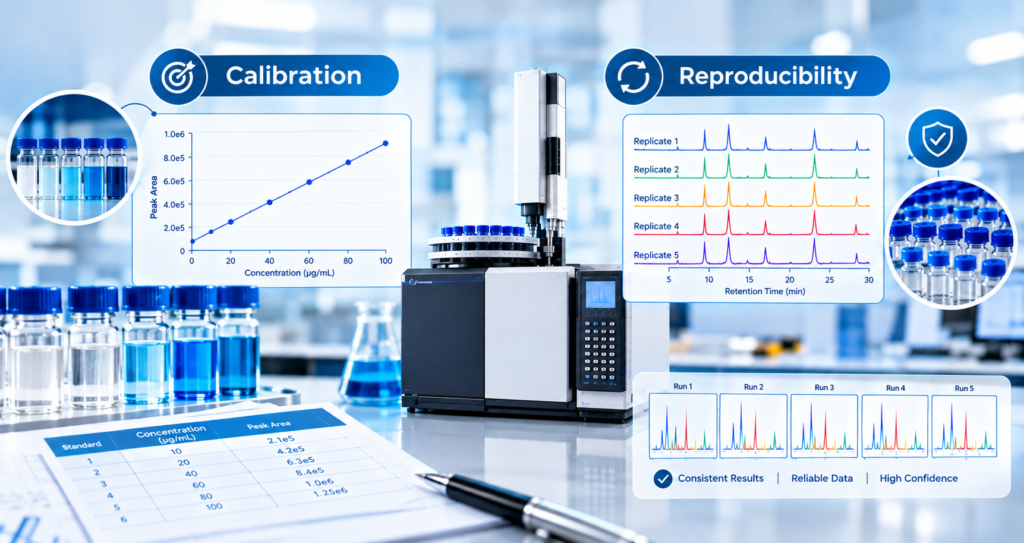
Calibration establishes the relationship between the amount of a target component and the measured analytical response.
A series of reference materials or standards containing known amounts of the target component can be analyzed under controlled conditions.
The resulting response can then be evaluated against the known amount.
A simplified calibration workflow is:
Known Amount → Py-GC/MS Analysis → Measured Response → Calibration Model
The resulting calibration model can subsequently be used to estimate the amount of the target component in an unknown sample, provided the unknown falls within the validated scope of the method.
The suitability of the calibration approach depends on the material, target compound or polymer, matrix, and measurement conditions.
Selection of Calibration Standards and Reference Materials
Reference materials are an important part of quantitative Py-GC/MS method development.
The selected material should be sufficiently representative of the target component and analytical application.
Depending on the application, calibration may involve:
- Pure polymer reference materials
- Known formulations
- Certified or characterized reference materials
- Prepared mixtures containing known component concentrations
- Internal standards or reference compounds where appropriate
For complex materials, matrix effects and differences between reference materials and real samples should also be considered.
A calibration material that behaves differently during pyrolysis from the target component in the sample may affect quantitative accuracy.
Calibration Curves in Pyrolysis-GC/MS
A calibration curve is commonly established by analyzing multiple levels of known target concentration or amount.
The analytical response is then plotted against the corresponding known amount.
Depending on the analytical method, the response may be based on selected chromatographic peak areas, characteristic pyrolysis products, summed responses, or another validated measurement parameter.
A simplified representation is:
X-axis: Known amount or concentration
Y-axis: Analytical response
The resulting relationship is evaluated to determine whether the selected calibration model is suitable for the intended analytical range.
Calibration should be assessed rather than assuming that every response will show a perfectly linear relationship across all concentrations.
Internal Standards and Quantitative Measurement
Internal standards can be useful in quantitative analytical methods because they may help compensate for certain variations in sample preparation and measurement.
An internal standard is introduced at a known amount and analyzed alongside the target material.
The target response can then be evaluated relative to the response of the internal standard.
The suitability of an internal standard depends on the analytical objective and the chemistry of the sample.
It should provide a consistent and distinguishable response under the selected analytical conditions without interfering with the target measurement.
Controlling Pyrolysis Conditions for Reproducible Results
Controlled pyrolysis is fundamental to reproducible Py-GC/MS measurements.
The thermal decomposition behavior of a material can depend on factors such as:
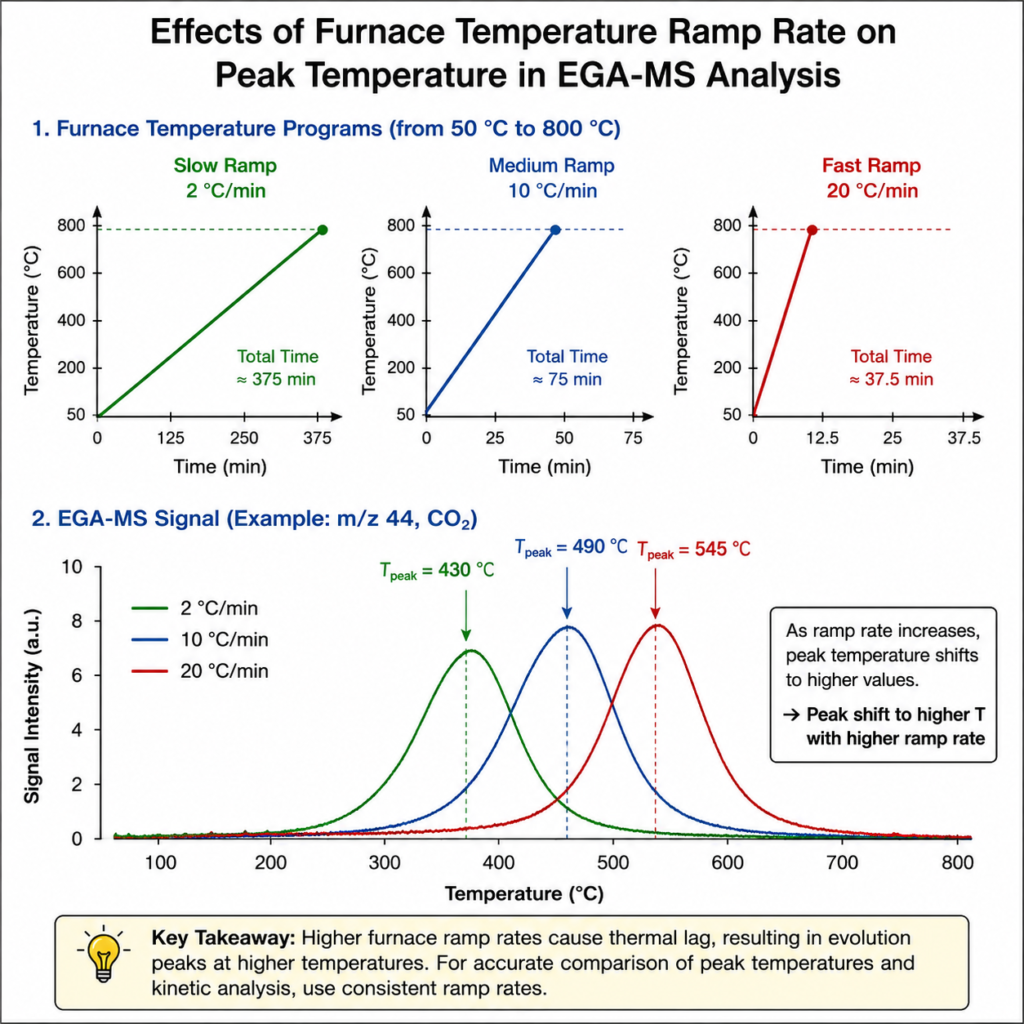
- Furnace temperature
- Heating profile
- Temperature ramp
- Pyrolysis time
- Sample mass
- Sample placement
- Atmosphere
- Carrier gas conditions
- Sample preparation
Changes in these parameters can alter the formation and relative abundance of pyrolysis products.
For quantitative work, these conditions should therefore be defined and consistently maintained throughout calibration and sample measurements.
Evaluating Reproducibility in Py-GC/MS
Reproducibility refers to the consistency of analytical results when measurements are repeated under defined conditions.
Repeated analysis can help determine whether the selected method provides sufficiently consistent results for its intended purpose.
Important measurements may include:
- Peak area
- Relative response
- Target-to-internal-standard ratio
- Calculated concentration
- Polymer component percentage
- Retention time
- Characteristic pyrolysis-product response
Replicate measurements can be used to assess variation and identify potential sources of analytical instability.
For quantitative applications, reproducibility should be evaluated using representative samples and appropriate measurement conditions.
Factors That Can Affect Quantitative Py-GC/MS Results
Furnace Temperature and Heating Conditions
Pyrolysis temperature and heating conditions influence thermal decomposition and the products generated from the sample.
A change in temperature or heating profile can therefore influence analytical response.
Sample Mass and Sample Preparation
Small differences in sample mass, homogeneity, particle size, or preparation can affect the amount of material undergoing pyrolysis.
Consistent sample preparation is particularly important when comparing calibration standards and unknown samples.
Pyrolysis Time
The time available for thermal decomposition can influence the formation of pyrolysis products.
Consistent timing and controlled experimental conditions can contribute to improved repeatability.
Carrier Gas and Instrument Conditions
Carrier gas flow and other instrument parameters influence the transfer and separation of pyrolysis products.
These parameters should remain consistent between calibration and sample measurements.
GC Separation and MS Detection
Chromatographic separation and MS detection conditions can also affect the measured analytical response.
Changes to GC temperature programs, column conditions, MS parameters, or other instrumental settings may affect quantitative results.
Quantification of Polymer Components in Complex Samples
Many real-world materials contain multiple polymers or organic components.
Examples include:
- Plastics
- Polymer blends
- Rubber materials
- Paints and coatings
- Adhesives
- Packaging materials
- Composite materials
- Environmental particulate samples
- Microplastics
In these applications, Py-GC/MS can provide characteristic chemical information that supports the identification of individual polymer components.
For quantitative determination, the method must account for the response behavior of the target components and the characteristics of the sample matrix.
A suitable calibration strategy can then be developed for the specific analytical objective.
Quantitative Py-GC/MS for Polymer Composition Analysis
Polymer blends can contain two or more polymeric components in different proportions.
Py-GC/MS can help characterize the chemical composition of such materials by monitoring characteristic pyrolysis products.
When an appropriate quantitative method has been established, the analytical response can be related to known polymer amounts to estimate component proportions.
This can support applications such as:
- Polymer blend characterization
- Material comparison
- Quality control
- Raw material evaluation
- Recycling research
- Product development
The quantitative method should be validated for the specific polymer system rather than assuming identical response behavior across different polymer types.
Quantitative Analysis of Plastics and Microplastics
Py-GC/MS is also used in the characterization of plastic and microplastic materials.
Qualitative Py-GC/MS can help identify polymer types based on their characteristic pyrolysis products.
Quantitative approaches can additionally be developed to determine the amount of specific polymer components in a sample.
This can be relevant to environmental research and material analysis where samples may contain multiple polymer types.
Sample preparation, calibration, matrix effects, and detection conditions should be carefully considered when developing quantitative methods for environmental samples.
Quantitative Applications in Paints and Coatings
Paints and coatings can contain resins, polymer binders, additives, pigments, and other components.
Py-GC/MS is particularly useful for the characterization of thermally decomposable organic components such as polymer binders and resins.
For quantitative applications, calibration can be developed for selected organic components where the analytical response can be appropriately related to known amounts.
Pigments, fillers, metals, and inorganic components may require complementary analytical techniques.
For broader paint and coating characterization, see:
Paints & Coatings Analysis:
https://frontier-lab-sea.com/paints-and-coatings-analysis/
Method Validation for Quantitative Py-GC/MS
Method validation helps establish whether a quantitative analytical procedure is suitable for its intended application.
Depending on the purpose of the method, relevant characteristics may include:
- Calibration performance
- Repeatability
- Reproducibility
- Accuracy or recovery where applicable
- Analytical range
- Detection capability
- Quantification capability
- Selectivity
- Stability
- Robustness
The appropriate validation parameters depend on the analytical method and intended use.
A method developed for research screening may have different requirements from one intended for routine quality-control measurements.
Applications of Quantitative Py-GC/MS
Quantitative Py-GC/MS methods can support a variety of research and industrial applications.
Polymer Composition Analysis
Determination of polymer components in blends and complex materials.
Plastics and Microplastics Analysis
Identification and quantitative determination of selected polymer components in plastic-related samples.
Paints and Coatings
Characterization and quantitative assessment of selected organic resin or binder components.
Rubber and Elastomer Analysis
Characterization of polymeric components in rubber and elastomeric materials.
Complex Material Characterization
Comparative analysis of unknown materials, reference materials, formulations, and products.
Advantages of Quantitative Py-GC/MS
When appropriately developed, quantitative Py-GC/MS can offer several analytical benefits:
- Chemical identification and quantitative analysis in one workflow
- Analysis of complex polymeric materials
- Characterization of multiple organic components
- Small sample requirements in many applications
- Strong chemical specificity from MS detection
- Compatibility with comparative material analysis
- Potential for quantitative polymer-component determination with appropriate calibration
The actual performance of a quantitative method depends on the material, analytical conditions, calibration strategy, and validation procedure.
Limitations and Complementary Analytical Techniques
Py-GC/MS should not be treated as a universal analytical method for every material component.
It is particularly valuable for organic polymers, resins, binders, and other thermally decomposable organic components.
Inorganic pigments, mineral fillers, metals, elemental composition, morphology, and other material characteristics may require complementary techniques.
A complete material characterization strategy may therefore combine Py-GC/MS with other analytical approaches depending on the research question.
Frontier Laboratories Solutions for Quantitative Py-GC/MS
Frontier Laboratories provides pyrolysis-based analytical solutions for polymer and organic material characterization.
The EGA/PY-3030D Multi-Functional Pyrolyzer can be used as part of Py-GC/MS workflows for investigating thermally generated products and characterizing polymeric materials.
Frontier Laboratories also provides F-Search, a pyrolysis mass spectral database and search system that can support interpretation and identification of pyrolysis products.
For research applications involving quantitative Py-GC/MS, method development can be structured around:
Sample Characterization → Pyrolysis Conditions → Calibration Strategy → Reproducibility Assessment → Quantitative Determination
For further information about applied pyrolysis research, visit:
Applied Pyrolysis Research:
https://frontier-lab-sea.com/applied-pyrolysis-research/
You can also explore additional technical resources through the:
Frontier Lab Blog:
https://frontier-lab-sea.com/frontier-lab-blog/
Conclusion
Quantitative analysis using Pyrolysis-GC/MS requires a carefully controlled analytical workflow that goes beyond polymer identification.
Calibration provides the relationship between known component amounts and analytical response, while reproducibility studies help evaluate the consistency of the measurement.
By controlling sample preparation, pyrolysis conditions, chromatographic separation, MS detection, and calibration procedures, Py-GC/MS can be developed into a quantitative method for selected polymer and organic material applications.
The appropriate approach depends on the material, target component, analytical objective, and required level of quantitative performance.
Looking for Py-GC/MS solutions for quantitative polymer or organic material analysis? Contact Frontier Laboratories SEA to discuss your analytical requirements:
https://frontier-lab-sea.com/contact-frontier-lab-sea/
Frequently Asked Questions (FAQs)
Yes. Py-GC/MS can be used for quantitative analysis when an appropriate calibration strategy, controlled analytical conditions, and suitable validation procedures are established for the specific application.
Calibration establishes the relationship between a known amount of a target component and the analytical response obtained during Py-GC/MS analysis.
Reproducibility helps determine whether repeated measurements provide consistent analytical results under defined conditions.
Quantitative methods can be developed for selected polymer and organic components in materials such as plastics, polymer blends, rubber, paints, coatings, and environmental samples.
No. Quantitative capability depends on the target component, analytical response, calibration strategy, sample matrix, and validated method. Inorganic and non-pyrolyzable components may require complementary techniques.
Sample preparation, sample mass, pyrolysis temperature, heating conditions, pyrolysis time, carrier gas, GC separation, MS detection, calibration, and data processing can all influence analytical results.