Polyvinyl alcohol (PVA) is a water-soluble synthetic polymer used in a wide range of industrial and commercial applications. During manufacturing, processing, storage, or handling, PVA materials may become contaminated with small amounts of other polymers or organic materials.
Detecting a minor contaminant in a polymer matrix can be challenging when the main polymer produces a strong analytical response that interferes with the detection of the contaminant.
Heart-cut/Evolved Gas Analysis-Gas Chromatography/Mass Spectrometry (HC/EGA-GC/MS) provides an approach for reducing this type of interference. By selecting a specific temperature range during evolved gas analysis, only the desired fraction of the thermal decomposition products is transferred for subsequent GC/MS analysis.
A Frontier Laboratories technical study demonstrated this approach for a white-turbid PVA sample suspected of containing an unknown polymer contaminant.
Why Analyze Polymer Contamination in PVA?
The presence of even a small amount of an unintended polymer can affect the characteristics or performance of a PVA material.
Contamination analysis may be relevant to:
- Raw material quality control
- Manufacturing investigations
- Product troubleshooting
- Supplier comparison
- Polymer identification
- Quality assurance
- Investigation of unexpected appearance or properties
However, identifying a minor contaminant can be difficult when the analytical signal from the main polymer dominates the measurement.
This creates a challenge for conventional pyrolysis-GC/MS analysis.
The Challenge of Detecting Small Amounts of Polymer Contaminants
When a contaminated PVA sample is analyzed by pyrolysis-GC/MS, the major PVA component can generate strong pyrolysis-related signals.
These signals can interfere with the detection and interpretation of compounds originating from a minor contaminant.
In the technical study, peaks associated with the suspected contaminant could not be clearly isolated because of interference generated by the ionization of the PVA base polymer.
This is an important consideration when analyzing materials containing a dominant polymer and a relatively small amount of an unknown component.
Instead of analyzing the entire evolved gas profile by conventional GC/MS, a selective approach can be used.
What Is HC/EGA-GC/MS?
HC/EGA-GC/MS combines Heart-Cut (HC) analysis with Evolved Gas Analysis (EGA) and GC/MS.
In EGA-MS, the sample is heated under controlled conditions and the gases evolved during thermal decomposition are monitored as a function of furnace temperature.
This produces an EGA thermogram that can show different thermal regions associated with components in the sample.
A selected temperature region can then be used as a heart-cut zone.
Only the material evolved within this pre-selected temperature range is transferred to the GC/MS system for detailed analysis.
The principle can be represented as:
Sample → Controlled Heating → EGA-MS → Select Temperature Range → Heart-Cut → GC Separation → MS Identification
This selective approach can reduce the contribution from unwanted components and make minor components easier to investigate.
How Heart-Cut Analysis Reduces Matrix Interference
The key advantage of HC/EGA-GC/MS in this application is selective transfer.
Instead of transferring the entire evolved gas profile into the GC column, the analyst selects a temperature interval that is relevant to the component of interest.
This can reduce the influence of the dominant polymer matrix.
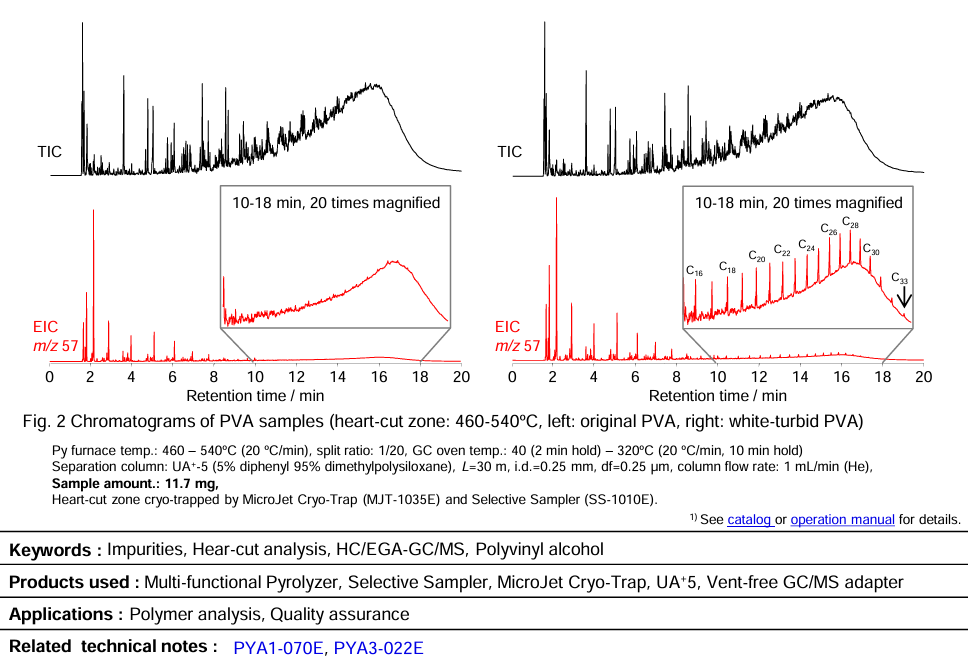
In the PVA contamination study, a temperature range of 460–540°C was selected as the heart-cut zone.
The evolved material from this range was then cryo-trapped before GC/MS analysis.
This enabled the researchers to focus the chromatographic analysis on a selected portion of the thermal decomposition profile.
Experimental Analysis of PVA and Contaminated PVA
The study compared two samples:
- Original PVA
- White-turbid PVA suspected of contamination by an unknown polymer
Both samples were initially analyzed using EGA-MS.
The EGA thermograms showed similar overall profiles.
Because the main PVA component dominated the response, direct comparison of the total ion current (TIC) chromatograms did not clearly reveal the suspected contaminant.
The HC/EGA-GC/MS approach was therefore applied to investigate the selected temperature region.
EGA-MS Preliminary Analysis
EGA-MS was first used to examine the thermal behavior of the samples.
The experimental conditions included:
- Pyrolysis furnace temperature: 100–700°C
- Temperature ramp: 20°C/min
- Sample amount: 0.2 mg
- Split ratio: 1/50
- GC oven temperature: 300°C
- Column flow: 1 mL/min He
- EGA tube: UAD™-2.5N
- EGA tube length: 2.5 m
- EGA tube internal diameter: 0.15 mm
The resulting EGA thermograms were used to determine an appropriate region for selective heart-cut analysis.
Selecting the 460–540°C Heart-Cut Zone
The 460–540°C temperature range was selected for heart-cut analysis.
The purpose was to isolate a portion of the evolved material where the contribution from the suspected contaminant could be investigated with reduced interference from the main PVA matrix.
The selected fraction was cryo-trapped using a MicroJet Cryo-Trap (MJT-1035E) and Selective Sampler (SS-1010E) before GC/MS analysis.
This demonstrates how EGA can be used as a preliminary step for selecting an appropriate thermal region for more focused analysis.
TIC and EIC Comparison
The total ion current chromatograms of the two samples did not show obvious differences.
This illustrates one of the challenges of detecting a minor component within a dominant polymer matrix.
However, the analysis became more informative when an extracted ion chromatogram (EIC) at m/z 57 was examined.
In the white-turbid PVA sample, peaks associated with saturated hydrocarbons ranging approximately from C16 to C33 were observed.
These peaks were not observed in the corresponding EIC of the original PVA sample.
The observation suggested that the white-turbid PVA sample contained a polymer or polymers with a saturated hydrocarbon structure.
What the Results Indicate
The results demonstrate the value of selective analysis when a minor polymer contaminant is present within a major polymer matrix.
The overall TIC chromatograms did not provide an obvious distinction between the two samples.
However, examination of the selected ion response revealed additional peaks in the suspected contaminated sample.
The observed saturated hydrocarbon-related peaks from approximately C16–C33 provided evidence supporting the presence of a contaminating polymer or polymers with a saturated hydrocarbon structure.
This interpretation is based on the analytical results reported in Frontier Laboratories technical note PYA3-025E.
Why EIC Can Be Useful for Polymer Contamination Analysis
TIC provides an overview of the total detected ion signal.
For complex polymer samples, however, a strong response from the main polymer can make smaller signals difficult to interpret.
An EIC focuses on a selected mass-to-charge ratio.
In this study, m/z 57 was used to investigate hydrocarbon-related signals in the selected heart-cut fraction.
This selective data interpretation helped reveal peaks that were not readily apparent in the overall TIC chromatogram.
Advantages of HC/EGA-GC/MS for PVA Impurity Analysis
HC/EGA-GC/MS can provide several benefits when investigating minor components in polymer materials.
Selective Thermal Fraction Analysis
EGA allows the analyst to observe how the sample evolves with temperature and identify a suitable region for further analysis.
Reduced Matrix Interference
Heart-cutting limits the material transferred to the GC/MS system to a selected thermal region, helping reduce contributions from unwanted portions of the sample.
Targeted GC/MS Investigation
The selected fraction can be subjected to detailed chromatographic and mass-spectral analysis.
Support for Minor Component Detection
The approach can improve the ability to investigate small amounts of contaminants within a dominant polymer matrix.
Combination of Thermal and Chromatographic Information
EGA provides temperature-dependent information, while GC/MS provides chromatographic and mass-spectral information from the selected fraction.
Applications of HC/EGA-GC/MS
The approach can be considered for analytical challenges involving complex polymer samples and minor components.
Potential applications include:
- Polymer contamination analysis
- Polymer impurity identification
- Quality assurance
- Raw material investigation
- Product troubleshooting
- Unknown polymer identification
- Comparative material analysis
- Research and development
The suitability of the method depends on the sample composition and analytical objective.
Instrumentation Used in the Study
The Frontier Laboratories study used a Multi-Shot Pyrolyzer EGA/PY-3030D interfaced with GC/MS.
The system also incorporated:
- Selective Sampler SS-1010E
- MicroJet Cryo-Trap MJT-1035E
- UA+5 separation column
- Vent-free GC/MS adapter
The EGA/PY-3030D provides a platform for controlled thermal analysis and pyrolysis-based characterization of polymeric materials.
Detailed GC/MS Conditions for Heart-Cut Analysis
For the selected 460–540°C heart-cut zone, the study reported:
- Pyrolysis furnace temperature: 460–540°C
- Temperature ramp: 20°C/min
- Split ratio: 1/20
- GC oven: 40°C, 2 min hold → 320°C at 20°C/min, 10 min hold
- Separation column: UA+5
- Column length: 30 m
- Internal diameter: 0.25 mm
- Film thickness: 0.25 µm
- Column flow: 1 mL/min He
- Sample amount: 11.7 mg
- Heart-cut fraction: Cryo-trapped using MicroJet Cryo-Trap and Selective Sampler
These conditions are specific to the reported technical study and should not be assumed to be universally applicable to every PVA contamination analysis.
Considerations When Analyzing Polymer Impurities
The analytical conditions should be selected according to the thermal behavior and chemical composition of the sample.
Important considerations include:
- Difference in thermal decomposition behavior between matrix and contaminant
- Appropriate EGA temperature range
- Sample homogeneity
- Sample amount
- Heart-cut window
- GC separation
- Selected ion monitoring or EIC strategy
- Availability of reference materials
- Interpretation of mass spectra
A preliminary EGA-MS analysis can therefore be useful for understanding the thermal profile before selecting conditions for targeted HC/EGA-GC/MS analysis.
Frontier Laboratories Approach to Polymer Contamination Analysis
Frontier Laboratories’ pyrolysis-based analytical technologies can support investigations where conventional analysis may be affected by complex polymer matrices.
The EGA/PY-3030D Multi-Functional Pyrolyzer can be integrated with GC/MS for EGA, pyrolysis, and selective analytical workflows.
The Selective Sampler SS-1010E and MicroJet Cryo-Trap MJT-1035E can be used as part of a heart-cut workflow for collecting selected evolved fractions.
This approach can be particularly useful when the analytical objective is to investigate minor components within a major polymer matrix.
Related Research and Technical Resources
For broader information on applied pyrolysis research:
For additional Frontier Laboratories technical content:
For analytical requirements and technical inquiries:
Contact Frontier Laboratories SEA
Conclusion
Detecting a small amount of polymer contamination in a dominant PVA matrix can be challenging because the strong response from the base polymer may interfere with the detection of minor components.
The Frontier Laboratories study described in technical note PYA3-025E demonstrates how HC/EGA-GC/MS can address this challenge by combining EGA-based thermal separation with selective heart-cutting and GC/MS analysis.
In the study, the 460–540°C heart-cut region was investigated, and EIC analysis at m/z 57 revealed saturated hydrocarbon-related peaks from approximately C16 to C33 in the white-turbid PVA sample. These findings suggested contamination by a polymer or polymers possessing a saturated hydrocarbon structure.
The example illustrates how targeted thermal fractionation and selective detection can provide additional analytical information when minor polymer contaminants are difficult to identify using conventional approaches.
Looking for pyrolysis-based solutions for polymer contamination or impurity analysis?
Contact Frontier Laboratories SEA to discuss your analytical requirements:
Frequently Asked Questions (FAQs)
HC/EGA-GC/MS combines evolved gas analysis with heart-cutting and GC/MS. A selected temperature region of the evolved material is transferred for detailed chromatographic and mass-spectral analysis.
A dominant PVA matrix can generate strong signals that interfere with minor contaminants. Heart-cutting allows a selected thermal region to be analyzed separately, potentially reducing this interference.
The Frontier Laboratories technical note used a 460–540°C heart-cut zone for the reported PVA contamination analysis.
The extracted ion chromatogram at m/z 57 showed peaks associated with saturated hydrocarbons from approximately C16 to C33 in the white-turbid PVA sample. These peaks were not observed in the corresponding original PVA sample.
The technique can be considered for other complex polymer samples where a minor component is difficult to isolate because of interference from the primary matrix. The appropriate conditions depend on the sample and analytical objective.
The study used a Frontier Laboratories EGA/PY-3030D Multi-Functional Pyrolyzer with a Selective Sampler, MicroJet Cryo-Trap, and GC/MS system.