Pyrolysis-GC/MS for Paint and Coating Failure Investigation
Introduction to Paint and Coating Failure Analysis
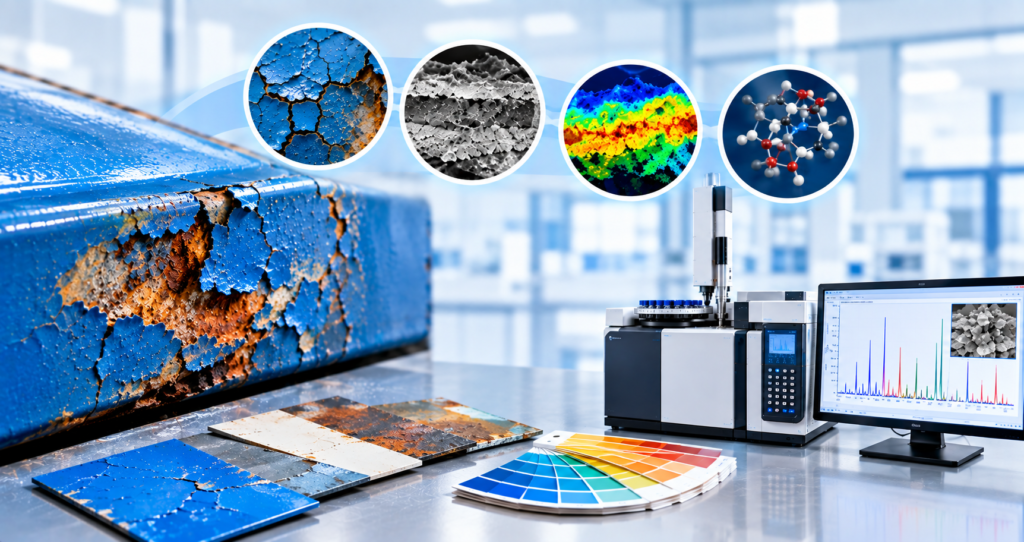
Paint and coating systems are designed to protect surfaces and maintain performance under demanding environmental and operating conditions. However, coatings can eventually develop defects or fail to perform as expected.
Common problems include peeling, cracking, blistering, discoloration, loss of adhesion, and surface degradation.
Identifying the visible defect is only the first step. Understanding why the coating failed may require investigation of its chemical composition, polymer binder, resin system, additives, and changes caused by aging or environmental exposure.
Paint and coating failure analysis combines physical observation with chemical and material characterization techniques to investigate the causes of coating deterioration.
Pyrolysis-Gas Chromatography/Mass Spectrometry (Py-GC/MS) can support this process by providing chemical information about polymeric and organic components in failed coatings.
Common Causes of Coating Failure
Coating failure can result from formulation differences, application conditions, environmental exposure, substrate issues, aging, or chemical degradation.
Peeling
Peeling occurs when the coating separates from the substrate or from an underlying coating layer.
Possible contributing factors include poor adhesion, surface contamination, incompatible coating layers, moisture, or changes in the binder system.
Chemical characterization can help determine whether the coating composition is consistent with the expected material.
Cracking
Cracking can develop when a coating loses flexibility or experiences mechanical, thermal, or environmental stresses.
Changes in the polymer binder or degradation of organic components may contribute to changes in coating properties.
Blistering
Blistering can occur when localized areas of the coating become raised from the surface.
Moisture, trapped materials, substrate conditions, osmotic effects, and coating-system incompatibility can all contribute to blister formation.
Chemical analysis can help investigate whether compositional differences are associated with the failure.
Discoloration
Changes in color can result from environmental exposure, chemical reactions, oxidation, UV exposure, or degradation of formulation components.
Paint degradation analysis can help investigate changes in the organic composition of an aged coating.
Loss of Adhesion
Loss of adhesion can occur because of substrate conditions, improper surface preparation, incompatible layers, environmental exposure, or changes in the coating material.
Comparing failed and reference samples can provide additional chemical evidence during the investigation.
Surface Degradation
Long-term exposure to UV radiation, heat, moisture, chemicals, and weathering can change the structure and composition of coating materials.
Coating degradation analysis can help investigate these chemical changes.
Why Chemical Characterization Is Important
Visual inspection can identify what a coating failure looks like, but it does not always reveal the underlying chemical cause.
Two coatings may appear similar while having different polymer or resin compositions.
Similarly, a coating that has undergone environmental aging may have a different chemical profile from the original material.
Chemical characterization can help answer questions such as:
- Is the failed coating chemically similar to the reference coating?
- Has the polymer binder changed?
- Is the expected resin system present?
- Has degradation affected the organic components?
- Are unexpected organic materials present?
- Did the formulation change between batches?
- Is the failure associated with material composition?
Using chemical information alongside microscopy, physical testing, environmental exposure data, and other analytical techniques can provide a more comprehensive failure investigation.
How Pyrolysis-GC/MS Supports Failure Investigation
Py-GC/MS failure analysis provides a way to investigate polymeric and organic components in coating materials.
The workflow can be summarized as:
Failed coating → controlled pyrolysis → characteristic pyrolysis products → GC separation → MS identification → chemical profile → comparison and interpretation
During pyrolysis, the coating sample is rapidly heated under controlled conditions.
Polymer binders and other high-molecular-weight organic materials decompose into smaller compounds.
These pyrolysis products are then separated by gas chromatography and identified using mass spectrometry.
The resulting chromatographic profile can be compared with a reference coating or known material.
This can help identify chemical differences that may not be apparent through visual inspection alone.
Identifying Polymer and Resin Components
Polymer binders and resins are critical to the performance of many coating systems.
Changes in their chemical composition can influence properties such as:
- Adhesion
- Flexibility
- Hardness
- Durability
- Chemical resistance
- Weather resistance
- Film formation
Py-GC/MS can characterize polymeric materials by analyzing their characteristic pyrolysis products.
Resin Identification
Different resin systems can produce different pyrolysis profiles.
By comparing the chromatographic pattern and mass-spectral information with reference materials, analysts can support the identification of resin components in failed coatings.
Polymer Binder Characterization
Py-GC/MS can also be used to investigate whether the polymer binder in a failed sample is consistent with the expected material.
This can be particularly useful when investigating unknown, aged, damaged, or suspect coating samples.
Comparing Failed and Reference Coatings
One of the most useful approaches in coating failure investigations is to compare the failed material with a known reference.
Reference samples may include:
- Original coating material
- Unexposed coating
- Approved production material
- Known-good coating
- Previous production batch
- Material from an unaffected area
The failed and reference samples can be analyzed under comparable Py-GC/MS conditions.
Their chromatographic profiles can then be compared for differences in:
- Characteristic pyrolysis products
- Peak patterns
- Relative signal intensities
- Polymer-derived products
- Organic additives
- Overall chemical fingerprints
A close chemical similarity can provide evidence that the polymeric composition remains comparable, while significant differences may indicate formulation changes, degradation, contamination, or another chemical factor requiring further investigation.
Investigating Polymer Degradation
Environmental exposure can cause changes in polymeric coating materials.
Factors such as:
- UV radiation
- Heat
- Oxygen
- Moisture
- Chemicals
- Weathering
- Long-term outdoor exposure
can contribute to material degradation.
Polymer degradation analysis using Py-GC/MS can help investigate changes in the chemical profile of a coating before and after exposure.
For example, an unexposed reference coating can be compared with a weathered or deteriorated sample.
Differences in pyrolysis profiles may provide information about chemical changes associated with degradation.
However, Py-GC/MS results should be interpreted together with exposure history and other analytical evidence when determining the cause of failure.
Identifying Unexpected Organic Components
Unexpected organic compounds can sometimes contribute to coating performance problems.
Potential sources may include:
- Contamination
- Incorrect raw materials
- Formulation changes
- Processing residues
- Unexpected additives
- Material from another coating layer
Py-GC/MS can provide information about these organic components by identifying characteristic pyrolysis products.
Comparing the resulting profile with reference materials can help determine whether unexpected chemical components are present.
This can be valuable during paint defect analysis and troubleshooting investigations.
Understanding Changes in Coating Composition
A coating may fail because its composition differs from the intended formulation.
For example, differences may occur due to:
- Raw material substitution
- Supplier changes
- Batch variation
- Incorrect formulation
- Aging
- Environmental degradation
- Contamination
Py-GC/MS can help investigate these possibilities by comparing the chemical fingerprints of different samples.
Rather than evaluating only one compound, analysts can examine the complete pyrolysis profile to identify broader compositional differences.
Using Py-GC/MS for Troubleshooting
Paint troubleshooting often requires a systematic approach.
A typical analytical workflow may include:
Step 1: Examine the Failure
Document the location, appearance, extent, and type of coating defect.
Step 2: Collect Appropriate Samples
Samples may be collected from failed and unaffected areas, together with suitable reference materials.
Step 3: Characterize the Materials
Py-GC/MS can be used to investigate the polymeric and organic components of the coating.
Step 4: Compare Chemical Profiles
Failed, unaffected, original, or reference materials can be compared under suitable analytical conditions.
Step 5: Investigate Differences
Significant differences can be further investigated using complementary techniques and relevant process or environmental information.
Step 6: Determine Possible Causes
Chemical evidence can then be considered alongside application conditions, substrate properties, environmental exposure, and physical testing.
This approach helps move from visible coating defect → chemical evidence → possible failure mechanism.
Applications in Quality Control and R&D
Py-GC/MS can support coating failure analysis beyond individual failure investigations.
Quality Control
Manufacturers can compare production batches with approved reference materials to investigate unexpected chemical differences.
Raw Material Evaluation
Polymer resins and binders can be characterized before they are incorporated into finished formulations.
Product Development
R&D teams can compare coating formulations before and after changes in resin, binder, additive, or processing conditions.
Aging Studies
Reference and aged coatings can be compared to investigate chemical changes resulting from environmental exposure.
Comparative Product Analysis
Different commercial or reference coatings can be evaluated to investigate similarities and differences in their organic composition.
Case Study / Technical Note Examples
Evaluation of Deterioration Degree of Exterior Wall Coatings Using Micro-UV Irradiator
Controlled UV exposure can be used to investigate how exterior wall coating materials change during accelerated aging.
The Evaluation of Deterioration Degree of Exterior Wall Coatings Using Micro-UV Irradiator technical note provides a strong application connection for understanding coating deterioration and analytical evaluation.
This creates a useful workflow for coating degradation investigations:
UV exposure → coating deterioration → chemical characterization → comparison of material profiles
By connecting accelerated aging studies with analytical techniques such as Py-GC/MS, researchers can investigate changes in coating composition associated with environmental exposure.
From Failure Analysis to Analytical Solution
For laboratories investigating coating degradation, the analytical workflow can progress from:
Failure observation → sample collection → Py-GC/MS characterization → reference comparison → degradation investigation → material interpretation
This approach can provide useful chemical evidence as part of a broader coating failure investigation.
Benefits of Py-GC/MS for Coating Failure Analysis
Py-GC/MS provides several benefits for paint and coating failure analysis:
- Characterization of polymer binders
- Resin identification
- Investigation of coating degradation
- Chemical fingerprinting
- Comparison of failed and reference coatings
- Investigation of formulation differences
- Identification of unexpected organic components
- Support for quality-control investigations
- Support for R&D and aging studies
- Analysis of complex polymer-containing materials
- Complementary chemical information for failure investigations
The ability to investigate polymeric materials through their characteristic pyrolysis products makes Py-GC/MS particularly useful for coating materials that cannot be directly analyzed by conventional GC/MS.
Frontier Laboratories Solutions
Frontier Laboratories provides analytical pyrolysis solutions for the characterization of polymers, resins, coatings, and other complex materials.
For coating failure investigations, Py-GC/MS can support analysis of:
- Failed coatings
- Reference coatings
- Aged coatings
- Polymer binders
- Resin systems
- Organic additives
- Unknown coating materials
The EGA/PY-3030D Multi-Functional Pyrolyzer can be incorporated into Py-GC/MS workflows for polymer and material characterization.
Analytical tools such as F-Search can further support interpretation by helping compare pyrolysis data and identify characteristic products.
Explore Frontier Laboratories Solutions
EGA/PY-3030D Multi-Functional Pyrolyzer →
F-Search →
Need to Investigate a Coating Failure?
Explore analytical pyrolysis solutions from Frontier Laboratories for coating material characterization, polymer degradation analysis, resin identification, and comparative analysis of failed and reference materials.
Conclusion
Coating failures can result from many factors, including formulation differences, environmental exposure, application conditions, substrate problems, contamination, and chemical degradation.
While visual inspection can identify the type of defect, determining the underlying cause may require detailed chemical characterization.
Pyrolysis-GC/MS provides a valuable analytical approach for paint and coating failure analysis by characterizing polymeric and organic components through their characteristic pyrolysis products.
The workflow can be summarized as:
Failed coating → pyrolysis → characteristic products → GC/MS analysis → chemical fingerprint → reference comparison
This approach can support polymer binder characterization, resin identification, paint degradation analysis, coating composition comparison, and investigation of unexpected organic components.
Py-GC/MS can also complement techniques such as FTIR, microscopy, thermal analysis, and other material characterization methods.
For coating manufacturers, R&D teams, and analytical laboratories, integrating chemical characterization into failure investigations can provide valuable evidence for understanding coating performance and deterioration.
Contact
Frequently Asked Questions (FAQs)
Paint and coating failure analysis is the investigation of coating defects and performance problems to determine their possible causes. It can include visual, physical, chemical, and material characterization.
Py-GC/MS can characterize polymeric and organic components in coating samples. Comparing the chemical profiles of failed and reference materials can help identify compositional differences or changes associated with degradation.
Yes. Different polymer and resin systems can generate characteristic pyrolysis products. These profiles can be compared with reference materials to support resin identification.
Py-GC/MS can help investigate chemical changes in polymeric and organic components associated with coating aging or degradation. Results should be interpreted alongside exposure conditions and complementary analytical data.
Yes. Comparing the pyrolysis profiles of failed and reference samples is an important application of Py-GC/MS in coating failure investigations.
Py-GC/MS can provide chemical information relevant to investigations involving peeling, cracking, blistering, discoloration, loss of adhesion, surface degradation, and other coating performance problems.
Yes. Characteristic pyrolysis products can provide information about unexpected organic materials, additives, contaminants, or formulation components.
Py-GC/MS can help compare failed, unaffected, original, or reference materials and identify chemical differences that may contribute to a coating failure.
Yes. Py-GC/MS can be used to compare coating materials before and after controlled aging or UV exposure, helping investigate chemical changes associated with deterioration.
Not always. Coating failures can have multiple causes. Py-GC/MS provides chemical information that should ideally be evaluated together with visual inspection, application history, environmental exposure, substrate conditions, and complementary analytical techniques.
Reference samples provide a baseline for comparison. Analyzing a known-good or original coating alongside a failed sample can make chemical differences easier to identify and interpret.
Frontier Laboratories’ analytical pyrolysis solutions, including the EGA/PY-3030D Multi-Functional Pyrolyzer and F-Search, can support polymer and organic component characterization for paint and coating investigations.