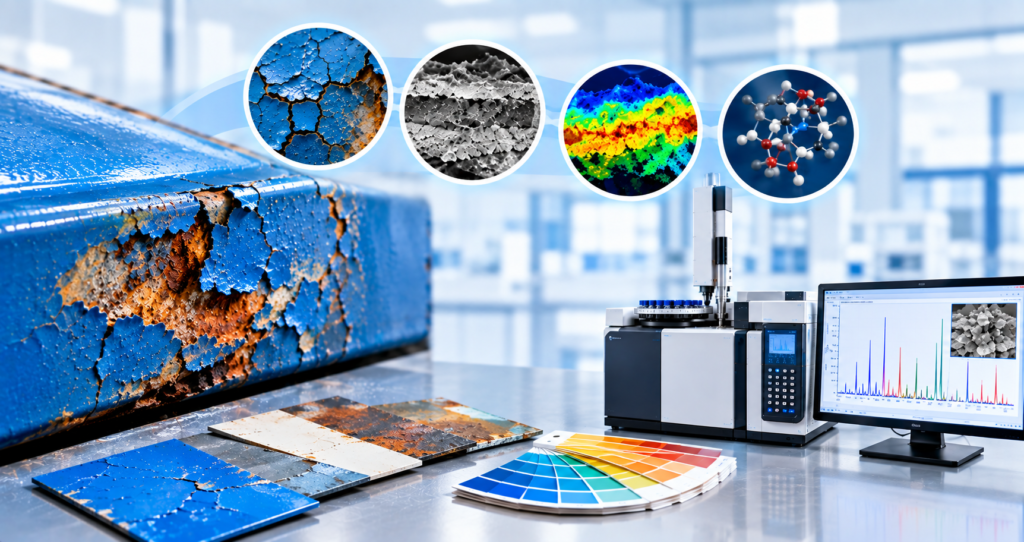
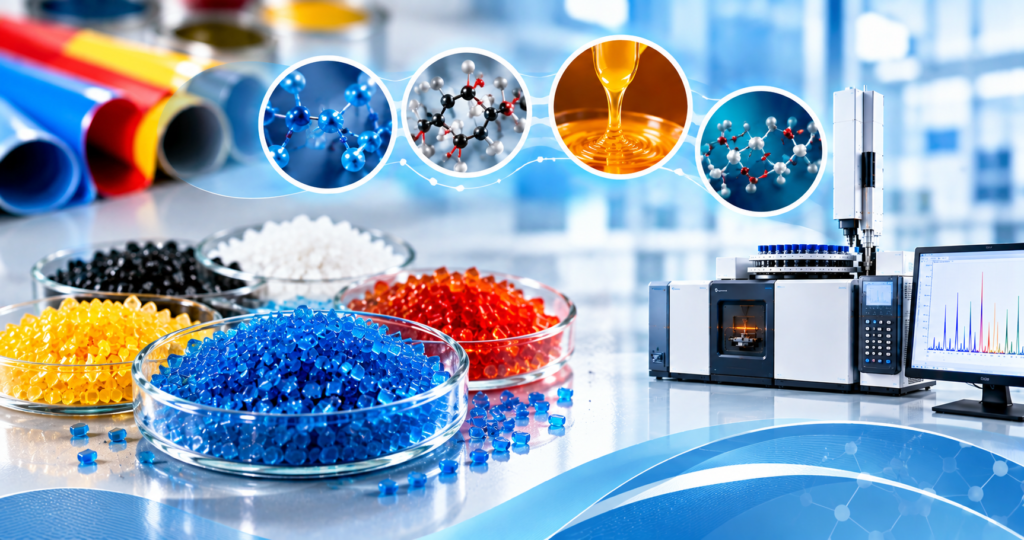
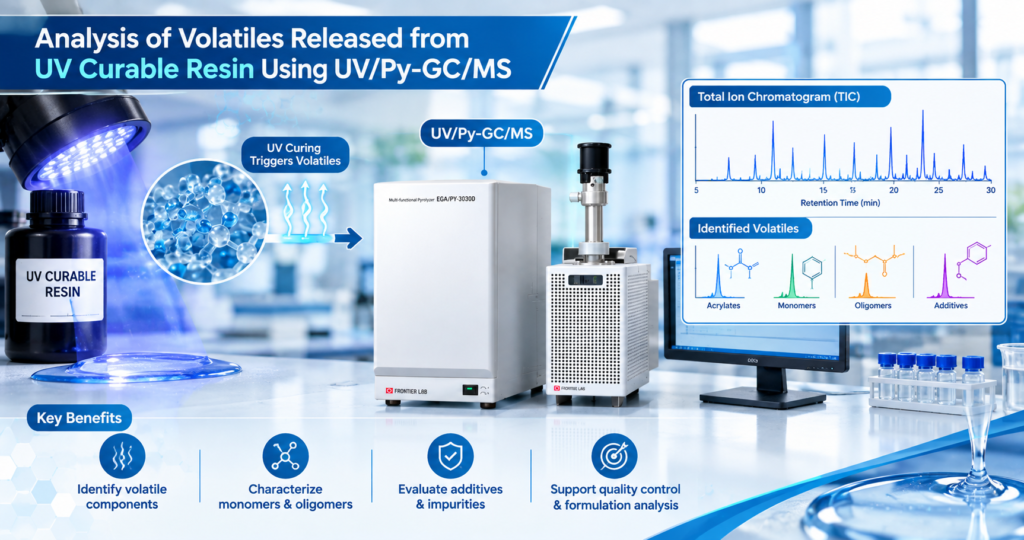
Paint Formulation Analysis Using Pyrolysis-GC/MS
Introduction to Paint Formulation Analysis
Paint and coating formulations are complex mixtures designed to provide specific properties such as adhesion, durability, flexibility, hardness, chemical resistance, corrosion protection, and appearance.
A typical formulation can contain polymer binders or resins, additives, pigments, fillers, and other organic components. Understanding how these components contribute to the final formulation is important for product development, quality control, raw material evaluation, and troubleshooting.
Paint formulation analysis provides chemical information that can help manufacturers and laboratories compare formulations, identify polymeric components, and investigate differences between materials.
Pyrolysis-Gas Chromatography/Mass Spectrometry (Py-GC/MS) is particularly useful for characterizing polymeric and other high-molecular-weight organic materials that cannot always be analyzed directly by conventional GC/MS.
The technique uses controlled thermal decomposition to convert complex materials into smaller characteristic compounds. These pyrolysis products are then separated by GC and identified using MS, producing a chemical profile that can be used for formulation characterization.
What Makes Paint and Coating Formulations Complex?
Paint formulations rarely consist of a single chemical component. Instead, their performance is determined by the interaction of multiple materials.
Depending on the type of paint or coating, a formulation may contain:
- Polymer binders
- Resins
- Pigments
- Fillers
- Plasticizers
- Stabilizers
- Surfactants
- Dispersing agents
- Curing agents
- Other organic additives
The concentration and chemical nature of these components can vary significantly between formulations.
Even small changes in the binder, resin, or additive system can influence the final properties of the coating.
This makes detailed paint formulation characterization important when developing new products, evaluating raw materials, comparing competing formulations, or investigating unexpected performance.
Key Components of Paint Formulations
Understanding the major components of a paint formulation helps establish why chemical characterization is required.
Polymer Binders
The polymer binder forms the film and can strongly influence adhesion, flexibility, durability, chemical resistance, and mechanical properties.
Examples include different polymer and resin systems selected according to the intended coating application.
Resins
Resins can form the primary polymeric framework of a coating or contribute to curing and performance.
Resin analysis in paint can provide useful information about the chemical identity and composition of the formulation.
Pigments
Pigments provide color, opacity, and other functional properties.
While Py-GC/MS primarily provides information about thermally decomposable organic components, pigment-containing formulations can be investigated as part of a broader analytical workflow.
Additives
Additives can be included in relatively small quantities but may have important effects on formulation performance.
Examples include stabilizers, plasticizers, dispersants, surfactants, and other modifiers.
Fillers
Fillers can affect properties such as viscosity, mechanical strength, cost, texture, and durability.
A complete formulation investigation may therefore require Py-GC/MS alongside complementary analytical methods to characterize both organic and inorganic components.
Why Resin and Binder Characterization Matters
The polymer binder or resin system is one of the most important parts of many coating formulations.
Changes in resin chemistry can influence:
- Adhesion
- Flexibility
- Hardness
- Chemical resistance
- Weather resistance
- Thermal behavior
- Durability
- Film formation
For this reason, polymer binder analysis can be valuable during both formulation development and quality-control investigations.
However, polymeric materials are generally not suitable for direct GC analysis because of their high molecular weight and low volatility.
Pyrolysis provides a solution by breaking the polymer into smaller compounds that can be analyzed by GC/MS.
The resulting pyrolysis profile can provide chemical information about the original binder or resin.
How Py-GC/MS Supports Paint Formulation Analysis
The analytical workflow can be summarized as:
Paint formulation → controlled pyrolysis → characteristic pyrolysis products → GC separation → MS identification → chemical fingerprint
1. Sample Introduction
A small quantity of the paint or coating formulation is introduced into the pyrolysis system.
Depending on the sample and analytical objective, appropriate sample preparation may be performed before analysis.
2. Pyrolysis
The sample is rapidly heated under controlled conditions.
Polymer binders, resins, and other organic components decompose into smaller molecules.
3. Transfer of Pyrolyzates
The resulting pyrolysis products are transferred into the GC for separation.
Efficient transfer and controlled analytical conditions help generate representative and reproducible profiles.
4. GC Separation
The individual pyrolysis products are separated according to their chemical and physical properties.
This creates a chromatographic profile containing peaks associated with different compounds.
5. MS Identification
The separated compounds enter the mass spectrometer, where mass spectra are obtained.
These spectra can be compared with reference data, libraries, standards, or known materials.
6. Formulation Fingerprinting
The complete chromatographic profile can then be evaluated as a chemical fingerprint.
This can help compare formulations and characterize their polymeric and organic components.
Identification of Polymer and Resin Components
One of the key applications of Py-GC/MS formulation analysis is the characterization of polymer and resin components.
Different polymers can produce different combinations of pyrolysis products.
By examining these characteristic products and the overall chromatographic pattern, analysts can obtain information about the polymeric materials present in a formulation.
Polymer Binder Analysis
Py-GC/MS can help characterize the polymer binder within a finished coating formulation.
This is particularly useful when the binder is difficult to isolate or when the formulation contains multiple components.
Resin Identification
Different resin systems can produce characteristic pyrolysis profiles.
Comparing an unknown sample with known reference materials can help determine whether the materials have similar or different resin chemistry.
Mixed Resin Systems
Some formulations may contain more than one polymeric material.
In such cases, evaluating the complete chromatographic profile can help identify multiple chemical contributions rather than relying on a single marker compound.
Characterization of Organic Components
Paint formulations may contain organic components beyond the primary polymer binder.
These can include:
- Plasticizers
- Stabilizers
- Modifiers
- Dispersing agents
- Surfactants
- Other formulation additives
Py-GC/MS can provide information about thermally decomposable organic components and their contribution to the overall chemical profile.
This can be especially useful when comparing formulations that appear physically similar but may differ chemically.
For complex formulations, interpretation of multiple characteristic compounds is generally more informative than relying on one individual peak.
Comparing Different Paint Formulations
Comparative analysis is an important application of coating formulation analysis.
Py-GC/MS can be used to compare chemical profiles between:
- Different product formulations
- Different production batches
- Different suppliers
- Original and modified formulations
- Commercial and reference products
- New and aged coatings
Differences in chromatographic patterns can indicate changes in polymer, resin, or other organic components.
This can help laboratories investigate whether two formulations have similar chemical compositions or identify areas requiring further investigation.
Raw Material Evaluation
The chemical quality of raw materials can directly affect the performance and consistency of the final coating.
Polymer resins, binders, and organic additives can therefore be evaluated before they are incorporated into a formulation.
Py-GC/MS can support raw material evaluation by providing characteristic chemical profiles that can be compared with approved or reference materials.
Potential applications include:
- Incoming raw material inspection
- Supplier comparison
- Batch-to-batch evaluation
- Identification of unexpected material changes
- Reference material characterization
This information can support better control over formulation consistency.
Quality Control of Paint Formulations
Quality control requires consistent raw materials and reproducible formulations.
Small chemical differences between production batches may not always be apparent through visual or physical inspection alone.
Paint chemical characterization using Py-GC/MS can provide an additional layer of analytical information.
By comparing chromatographic fingerprints, laboratories can investigate:
- Batch-to-batch consistency
- Raw material variations
- Formulation changes
- Unexpected organic components
- Differences between reference and production samples
Py-GC/MS can therefore complement physical and performance-based quality-control testing.
Formulation Development and R&D
During product development, researchers may need to understand how changes in formulation chemistry affect coating performance.
Py-GC/MS can support R&D by helping characterize the chemical composition of prototype formulations.
For example, researchers can compare formulations after changing:
- Resin type
- Polymer binder
- Additive system
- Raw material supplier
- Component concentration
- Curing chemistry
The resulting chemical profiles can be evaluated alongside physical and performance testing.
This provides an analytical approach for understanding formulation changes during coating R&D.
Investigating Differences Between Reference and Unknown Samples
When an unknown coating needs to be compared with a known reference, chemical fingerprinting can provide useful evidence.
A reference sample can first be analyzed to establish its characteristic Py-GC/MS profile.
The unknown sample can then be analyzed under comparable conditions.
The resulting chromatograms can be compared based on:
- Characteristic pyrolysis products
- Peak patterns
- Relative signal intensities
- Overall chromatographic profile
- Mass-spectral information
A close match may support chemical similarity, while significant differences can indicate differences in polymer, resin, or other organic components.
For reliable interpretation, reference standards and complementary analytical techniques may be used where appropriate.
Advantages of Py-GC/MS for Formulation Characterization
Py-GC/MS offers several advantages for paint formulation characterization:
- Characterization of polymeric materials
- Resin and polymer binder analysis
- Chemical fingerprinting of formulations
- Analysis of complex organic mixtures
- Comparison of reference and unknown samples
- Support for raw material evaluation
- Batch-to-batch quality assessment
- Support for formulation development
- Investigation of formulation differences
- Analysis using small sample quantities
- Identification of characteristic pyrolysis products
Another important advantage is that Py-GC/MS can analyze polymeric materials indirectly through their pyrolysis products, making materials that are difficult to introduce directly into GC more accessible to chromatographic and mass-spectral analysis.
Frontier Laboratories Solutions for Paint Formulation Analysis
Frontier Laboratories provides analytical pyrolysis solutions for the characterization of polymers, resins, and complex organic materials.
For paint and coating applications, Py-GC/MS can be used to investigate formulation components and generate chemical profiles that support material identification and comparison.
Frontier Laboratories solutions can support analytical workflows involving:
- Paint formulation analysis
- Polymer binder analysis
- Resin characterization
- Coating composition analysis
- Raw material evaluation
- Quality control
- Product development
- Comparative analysis
The EGA/PY-3030D Multi-Functional Pyrolyzer can be incorporated into analytical workflows for investigating polymeric and complex materials.
F-Search can also support identification and interpretation by comparing pyrolysis data with reference information and helping analysts investigate characteristic pyrolysis products.
Explore Frontier Laboratories Solutions
EGA/PY-3030D Multi-Functional Pyrolyzer →
F-Search →
Need to Characterize an Unknown Coating Formulation?
Explore analytical pyrolysis solutions from Frontier Laboratories for polymer and organic component characterization, resin identification, and coating formulation analysis.
Conclusion
Paint formulations contain multiple components that work together to determine the performance and characteristics of the final coating.
Understanding the chemistry of polymer binders, resins, and other organic components can be important for formulation development, quality control, raw material evaluation, comparative analysis, and troubleshooting.
Pyrolysis-GC/MS provides a practical analytical approach for paint formulation analysis by converting polymeric and other high-molecular-weight organic materials into characteristic pyrolysis products.
The workflow can be summarized as:
Paint formulation → pyrolysis → characteristic products → GC separation → MS identification → chemical fingerprint
This chemical fingerprint can then be used to support polymer binder analysis, resin identification, coating composition analysis, and comparison of different formulations.
For complex coating materials, Py-GC/MS can also complement techniques such as FTIR, TGA, DSC, microscopy, and other analytical methods to provide a more comprehensive understanding of formulation chemistry.
Overall, Py-GC/MS offers valuable capabilities for laboratories involved in paint formulation characterization, coating R&D, quality control, raw material evaluation, and chemical investigation of unknown or reference materials.
Contact
Frequently Asked Questions (FAQs)
Paint formulation analysis is the chemical characterization of the components present in a paint or coating formulation. It can involve investigating polymer binders, resins, additives, pigments, fillers, and other components using one or more analytical techniques.
Py-GC/MS thermally decomposes polymeric and other organic materials into smaller compounds. These pyrolysis products are separated by GC and identified using MS, providing a chemical profile that can help characterize the formulation.
Yes. Polymer binders can produce characteristic pyrolysis products. Analysis of these products and the overall chromatographic profile can support polymer binder identification and characterization.
Yes. Different resin systems can generate characteristic pyrolysis profiles. Comparing these profiles with reference materials can help support resin identification.
Py-GC/MS is particularly useful for characterizing polymeric and other thermally decomposable organic components, including binders, resins, and selected additives or modifiers.
Many polymers have high molecular weights and cannot be directly vaporized for conventional GC analysis. Pyrolysis breaks the polymer into smaller compounds that can be separated and analyzed by GC/MS.
Yes. Py-GC/MS can generate chemical fingerprints that can be compared between different formulations, production batches, reference materials, and unknown samples.
Yes. Chemical fingerprints can be used as part of quality-control investigations to evaluate batch consistency, raw material differences, and formulation changes.
Py-GC/MS can help researchers investigate chemical changes resulting from different resins, binders, additives, or formulation conditions during product development.
Not necessarily. Py-GC/MS provides valuable chemical information about polymeric and organic components, but it can be combined with techniques such as FTIR, thermal analysis, microscopy, and other methods for more comprehensive coating characterization.