UV-curable resins are widely used in applications such as microelectronics packaging, electronic adhesives, optical components, and precision materials. During UV curing, chemical reactions within the resin can generate volatile organic compounds (VOCs) and other volatile products.
These released compounds can be important because some volatiles may contribute to metal surface corrosion, material contamination, and deterioration of product quality.
Understanding which compounds are released during curing—and, where required, determining their amounts—is therefore an important part of resin development, process optimization, and quality evaluation.
UV/Py-GC/MS combines ultraviolet irradiation with pyrolysis-gas chromatography/mass spectrometry to investigate volatile compounds released from UV-curable materials under controlled conditions.
A Frontier Laboratories technical study, PYA5-001E, demonstrated this approach using an acrylic UV-curable resin dry film used as a mask material for an etching process in electronics packaging.
Why Analyze Volatiles from UV-Curable Resins?
UV-curable resins undergo chemical changes when exposed to ultraviolet light.
During the curing process, volatile compounds may be generated or released from the resin formulation. Depending on their chemical composition and concentration, these compounds can affect surrounding materials or the final product.
Volatile analysis can therefore provide information relevant to:
- Resin formulation development
- UV-curing process evaluation
- Semiconductor packaging
- Electronic materials
- Optical components
- Adhesives
- Product quality investigations
- Volatile emission characterization
Qualitative analysis can help identify the compounds being released, while quantitative analysis can provide information about the amount of selected volatile components.
The Challenge of Analyzing Curing-Related Volatiles
Traditional analysis of curing-related volatiles may involve additional sample preparation or separate analytical steps.
A useful analytical method should ideally capture compounds released during the curing process while maintaining controlled experimental conditions.
The UV/Py-GC/MS approach combines UV irradiation and pyrolysis-GC/MS so that the volatile compounds released during irradiation can be collected and subsequently analyzed by GC/MS.
This allows the analytical process to investigate the material under a controlled UV exposure condition.
What Is UV/Py-GC/MS?
UV/Py-GC/MS is an analytical approach in which a sample is exposed to ultraviolet irradiation using a micro UV irradiator, while volatile compounds released from the sample are collected for subsequent GC/MS analysis.
The general workflow is:
UV Irradiation → Volatile Release → Cryo-Trapping → GC Separation → MS Detection → Compound Identification
The technique can be useful for studying volatile compounds generated or released during the curing of UV-sensitive materials.
UV/Py-GC/MS Workflow
The analytical workflow used in the Frontier Laboratories study involved several stages.
1. Sample Preparation
A small disc-shaped sample was cut from the UV-curable dry film.
The sample had a diameter of approximately 3 mm and a mass of 350 µg.
2. UV Irradiation
The sample was irradiated using a Micro UV Irradiator UV-1047Xe equipped with a xenon lamp.
The irradiation was performed under helium atmosphere at 60°C for 10 minutes.
3. Cryo-Trapping of Released Volatiles
During UV irradiation, volatile compounds released from the resin were transferred toward the separation column.
The head of the separation column was immersed in liquid nitrogen to cryo-trap the evolved volatile compounds.
This enabled the compounds released during the irradiation period to be collected before GC/MS analysis.
4. GC/MS Analysis
After the UV irradiation was completed, the separation column was removed from the liquid nitrogen.
GC/MS analysis was then initiated to separate and identify the trapped volatile components.
5. Comparison With a Non-Irradiated Sample
For comparison, the resin was also analyzed under otherwise identical conditions without UV irradiation.
This comparison allowed the researchers to distinguish compounds associated with UV irradiation from compounds observed without irradiation.
UV-Irradiated vs Non-Irradiated Resin
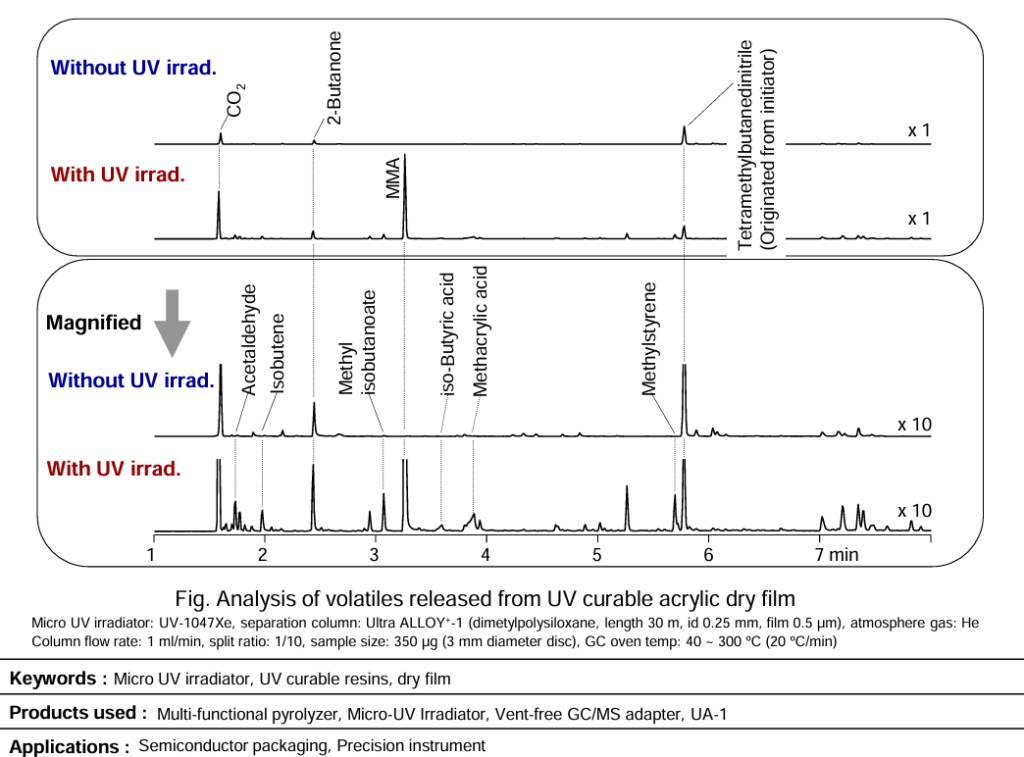
The comparison produced an important difference in the chromatographic profiles.
Without UV irradiation, the analysis primarily showed decomposed polymerization initiator.
Following UV irradiation, several organic compounds were detected.
The results demonstrated that UV exposure generated or released additional volatile compounds from the acrylic UV-curable resin.
Volatile Compounds Detected After UV Irradiation
The UV-irradiated sample showed various organic compounds, including:
- Methyl methacrylate (MMA)
- Acetaldehyde
- Isobutene
- Methyl isobutanoate
- Iso-butyric acid
- Methacrylic acid
- Methylstyrene
- 2-Butanone
- CO₂
A significant result reported in the technical note was the detection of approximately 300 ppm of methyl methacrylate (MMA) relative to the original sample weight.
This demonstrates how UV/Py-GC/MS can provide both qualitative information and quantitative information for selected volatile components when an appropriate analytical approach is used.
Detection of Methyl Methacrylate
Methyl methacrylate was observed in the UV-irradiated sample and was reported at approximately 300 ppm relative to the original sample weight.
The detection of MMA is particularly relevant for acrylic UV-curable resin systems because it provides an example of a volatile organic compound released during UV exposure.
Quantitative determination of specific volatile compounds can be useful when evaluating resin formulations, curing conditions, and potential volatile-related product concerns.
Why Compare UV Irradiation With No UV Irradiation?
A control measurement without UV irradiation provides an important reference.
In this study, the non-irradiated sample showed primarily decomposed polymerization initiator, while UV irradiation resulted in additional volatile organic compounds.
This comparison helps distinguish:
Compounds present or generated under the baseline analytical condition
from
Compounds released in response to UV irradiation.
Such comparative analysis can provide useful insight into the chemical changes associated with curing.
Applications of UV/Py-GC/MS
UV/Py-GC/MS can be relevant to several industries and research areas involving UV-curable materials.
Semiconductor Packaging
UV-curable materials are used in semiconductor and electronics packaging applications.
Characterizing volatiles released during curing can help investigate potential material interactions and process-related concerns.
Electronic Adhesives
UV-curable adhesives used in electronic components can release volatile compounds during curing.
Analyzing these compounds can support material evaluation and formulation development.
Optical Materials
Optical components and assemblies may use UV-curable resins or adhesives.
Volatile analysis can help investigate compounds released during the curing process.
Precision Instruments
Volatile emissions from resin systems may be relevant when materials are used around sensitive components.
Characterization can help support material selection and quality investigations.
UV-Curable Dry Films
The technical study specifically analyzed an acrylic UV-curable dry film used as a mask material for an etching process in electronics packaging.
Advantages of UV/Py-GC/MS
The approach demonstrated in the Frontier Laboratories technical note provides several analytical advantages.
Direct Investigation of UV-Induced Volatiles
The sample can be exposed to UV irradiation under controlled conditions while the released compounds are collected for analysis.
Minimal Sample Preparation
The study used a small dry-film sample without complicated pre-treatment.
Controlled UV Exposure
The Micro UV Irradiator provides a controlled irradiation environment.
Cryo-Trapping of Volatiles
Released compounds can be trapped during irradiation and subsequently analyzed by GC/MS.
Qualitative and Quantitative Information
The technique can identify multiple volatile compounds and, where an appropriate quantitative method is applied, determine the amount of selected components.
Experimental Conditions Reported in the Technical Study
The Frontier Laboratories technical note PYA5-001E reported the following conditions:
Parameter | Experimental condition |
Sample | Acrylic UV-curable resin dry film |
Sample shape | 3 mm diameter disc |
Sample amount | 350 µg |
UV irradiator | UV-1047Xe |
Light source | Xenon lamp |
Atmosphere | He |
UV irradiation temperature | 60°C |
UV irradiation time | 10 minutes |
Cryo-trapping | Liquid nitrogen |
Separation column | Ultra ALLOY+-1 |
Column length | 30 m |
Column ID | 0.25 mm |
Film thickness | 0.5 µm |
Column flow | 1 mL/min |
Split ratio | 1/10 |
GC oven | 40–300°C |
Heating rate | 20°C/min |
These conditions are specific to the reported study and should not be assumed to be universally applicable to every UV-curable resin.
Understanding the Role of the Micro UV Irradiator
The Micro UV Irradiator UV-1047Xe was used to expose the sample to UV light before and during volatile collection.
The controlled irradiation conditions are important because volatile release can depend on exposure conditions such as:
- UV intensity
- Irradiation time
- Temperature
- Atmosphere
- Resin formulation
- Sample thickness
- Curing characteristics
Controlling these parameters helps make comparisons between samples more meaningful.
Role of Cryo-Trapping in Volatile Analysis
Volatile compounds released during UV irradiation need to be collected efficiently for subsequent analysis.
In the reported study, the head of the separation column was immersed in liquid nitrogen during irradiation.
This cryogenic condition allowed evolved volatile compounds to be trapped.
After irradiation, the column was removed from the liquid nitrogen and GC/MS analysis was initiated.
This workflow allows the compounds released during the defined UV exposure period to be captured for chromatographic separation and mass-spectral identification.
Understanding UV-Induced Chemical Changes
The comparison between irradiated and non-irradiated samples provides a way to investigate chemical changes associated with UV exposure.
In the reported study:
Without UV irradiation:
Decomposed polymerization initiator was primarily observed.
With UV irradiation:
Multiple organic volatile compounds were detected, including MMA and several other compounds.
This difference demonstrates the analytical value of simulating UV exposure and directly investigating the volatile products released from the resin.
Quantitative Analysis of Volatile Components
While identifying volatile compounds is important, some applications also require quantitative information.
The reported study detected approximately 300 ppm MMA against the original sample weight.
Quantitative analysis of volatile compounds requires suitable calibration and analytical procedures appropriate to the target compound and sample matrix.
Calibration standards, response factors, reproducibility, and other method-performance considerations should be established according to the intended analytical application.
Considerations for UV-Curable Resin Volatile Analysis
Different UV-curable resin formulations can behave differently under irradiation.
Important factors to consider include:
- Resin chemistry
- Photoinitiator composition
- UV exposure conditions
- Irradiation temperature
- Sample thickness
- Curing time
- Atmosphere
- Volatile collection efficiency
- GC/MS conditions
Therefore, analytical conditions should be optimized for the specific resin system and research objective.
Frontier Laboratories Solutions
Frontier Laboratories provides analytical solutions for investigating volatile compounds released from UV-curable materials.
The workflow demonstrated in technical note PYA5-001E used:
- Multi-Functional Pyrolyzer
- Micro UV Irradiator UV-1047Xe
- Vent-Free GC/MS Adapter
- Ultra ALLOY+-1 separation column
Together, these components support a workflow for controlled UV irradiation, volatile collection, and GC/MS characterization.
For applied pyrolysis research and related analytical applications:
Explore additional technical resources:
For technical requirements and inquiries:
Contact Frontier Laboratories SEA
Conclusion
UV-curable resins can release volatile compounds during the curing process, making volatile analysis relevant to material development, electronics packaging, adhesives, optical applications, and quality evaluation.
The Frontier Laboratories technical study PYA5-001E demonstrates how UV/Py-GC/MS can be used to analyze volatile compounds released from an acrylic UV-curable resin dry film.
Under controlled UV irradiation at 60°C for 10 minutes, the study detected several organic volatile compounds, including approximately 300 ppm methyl methacrylate (MMA) relative to the original sample weight.
By combining controlled UV irradiation, cryo-trapping, and GC/MS analysis, UV/Py-GC/MS provides a practical approach for investigating volatile compounds released during the curing process.
Looking for analytical solutions for UV-curable resin and volatile analysis?
Contact Frontier Laboratories SEA to discuss your application
Frequently Asked Questions (FAQs)
UV/Py-GC/MS combines ultraviolet irradiation with pyrolysis-GC/MS to investigate volatile compounds released from materials during controlled UV exposure.
Volatile compounds released during curing may contribute to corrosion, contamination, or deterioration of product quality. Their analysis can support resin development and process evaluation.
The technical note reported approximately 300 ppm methyl methacrylate (MMA) relative to the original sample weight.
The study analyzed an acrylic UV-curable resin dry film used as a mask material for an etching process in electronics packaging.
During UV irradiation, volatile compounds were cryo-trapped at the head of the separation column, which was immersed in liquid nitrogen.
The sample was irradiated under helium atmosphere at 60°C for 10 minutes using the UV-1047Xe Micro UV Irradiator.
The approach can be considered for other UV-curable resins, adhesives, films, and related materials. Specific irradiation, collection, and GC/MS conditions should be established according to the material and analytical objective.