Polymer and Resin Analysis in Paints
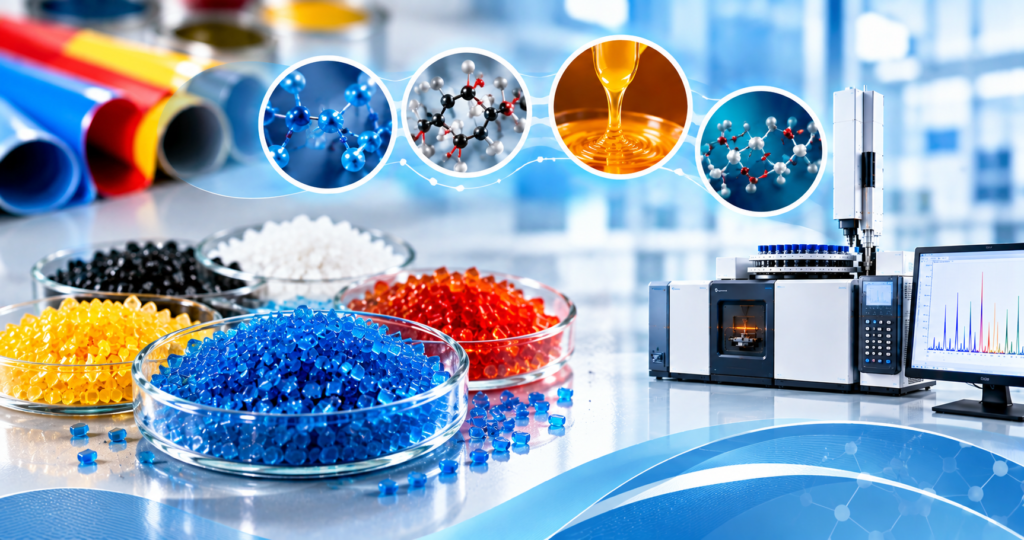
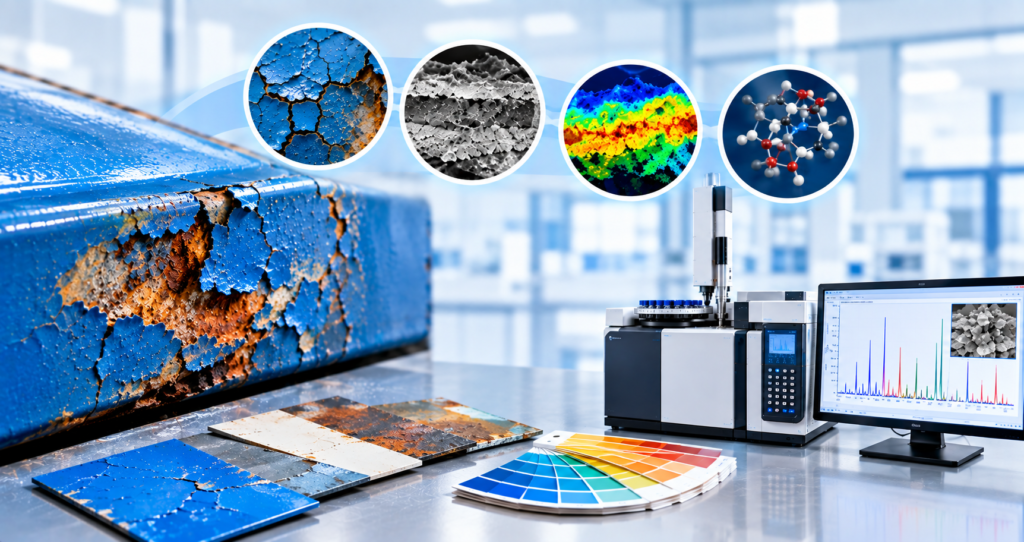
Paints and coatings are complex material systems designed to provide protection, durability, adhesion, appearance, and resistance to environmental conditions. Their performance depends significantly on the chemical composition of the resins, polymer binders, additives, and other organic components used in the formulation.
Understanding these materials is important for product development, raw material evaluation, quality control, comparative analysis, and failure investigation. However, many polymers and high-molecular-weight organic materials are not suitable for direct analysis by conventional gas chromatography.
Pyrolysis-GC/MS (Py-GC/MS) provides an effective analytical approach by thermally decomposing polymeric materials into characteristic smaller molecules that can be separated and identified by GC/MS.
This makes Py-GC/MS particularly useful for resin characterization in paints and coatings, polymer binder analysis, coating composition characterization, and investigation of organic components in complex coating materials.
Role of Resins and Polymer Binders in Coatings
Resins and polymer binders are among the most important organic components of paint and coating formulations. The binder forms the continuous film and contributes significantly to the final performance of the coating.
Depending on the formulation, the resin or polymer binder can influence:
- Adhesion
- Hardness
- Flexibility
- Chemical resistance
- Moisture resistance
- Weather resistance
- Film formation
- Durability
- Thermal performance
- Surface appearance
A change in the polymer binder can therefore result in significant changes in coating performance.
For paint manufacturers and research laboratories, confirming the identity and consistency of the resin or polymer binder can be an important part of formulation development and quality control.
Common Resin Systems Used in Paints and Coatings
Paint and coating formulations use different resin and polymer systems depending on the intended application and required performance.
Common examples include:
- Acrylic resins
- Alkyd resins
- Epoxy resins
- Polyester-based systems
- Polyurethane-related systems
- Styrene-containing polymers
- Specialty polymer and resin systems
Some coatings may contain blends or combinations of different polymeric materials.
Because different polymer structures can produce different thermal decomposition products, Py-GC/MS can help generate characteristic chemical profiles that support resin and polymer identification.
The appropriate analytical conditions depend on the sample composition, target materials, pyrolysis temperature, and analytical objective.
Why Resin Characterization Is Important
Resin characterization in paints and coatings can support several stages of the product lifecycle.
Raw Material Evaluation
Incoming resin and polymer materials can be compared against approved reference materials to investigate consistency.
Formulation Development
R&D teams can evaluate different resin systems and investigate the effects of formulation changes.
Quality Control
Production batches can be compared with reference materials to identify unexpected changes in polymer or organic composition.
Comparative Material Analysis
Different products, suppliers, or formulations can be compared to determine chemical similarities and differences.
Failure Investigation
Failed coatings can be compared with known-good or unaffected materials to investigate possible changes in resin or polymer composition.
This makes resin analysis useful across both routine and advanced coating investigations.
How Pyrolysis-GC/MS Characterizes Polymer Materials
Many polymers are high-molecular-weight, non-volatile materials that cannot be directly analyzed using conventional GC/MS.
Pyrolysis addresses this challenge by heating the sample under controlled conditions and breaking the polymer into smaller thermal decomposition products.
These products are subsequently separated by gas chromatography and identified using mass spectrometry.
A simplified analytical workflow is:
Coating sample → Controlled pyrolysis → Characteristic pyrolysis products → GC separation → MS identification → Chemical fingerprint → Material characterization
The resulting pattern of products can provide information about the original polymer or resin system.
This approach allows laboratories to investigate polymeric materials without requiring the original high-molecular-weight material to pass directly through the GC column.
Identification of Polymer and Resin Components
Py-GC/MS can be used to investigate chemical signatures associated with polymer and resin components in coating materials.
Depending on the sample and analytical conditions, it can support:
- Polymer binder identification
- Resin system characterization
- Comparison of resin materials
- Investigation of mixed polymer systems
- Unknown coating characterization
- Confirmation of expected organic polymer components
The resulting chromatographic profile can function as a chemical fingerprint of the analyzed material.
For example, an unknown coating can be compared with known resin or coating references. Similar characteristic pyrolysis products and chromatographic patterns may provide evidence of related polymer chemistry.
Characterization of Complex Coating Materials
Paint and coating formulations rarely contain only one chemical component.
A typical formulation may contain polymer binders, resins, organic additives, pigments, fillers, and other formulation ingredients.
Py-GC/MS is particularly useful for investigating the organic fraction of these complex materials.
It can support characterization of:
- Organic polymers
- Resins
- Polymer binders
- Organic modifiers
- Plasticizers
- Stabilizers
- Surfactants
- Dispersing agents
- Other thermally generated organic components
However, Py-GC/MS should not be considered a technique for directly characterizing every component of a coating.
Many pigments and fillers are inorganic and may require other analytical techniques for direct characterization.
Therefore, Py-GC/MS is particularly valuable for organic polymers, resins, binders, and other thermally generated organic components within complex coating materials.
Analysis of Organic Additives in Paints and Coatings
In addition to polymer binders and resins, paint formulations can contain organic additives that influence processing, stability, appearance, and performance.
Depending on the formulation, these may include:
- Plasticizers
- Stabilizers
- Modifiers
- Surfactants
- Dispersing agents
- Processing-related organic materials
- Other formulation additives
Py-GC/MS can help investigate thermally generated products associated with these organic components.
This can be useful when comparing formulations or investigating unexpected organic materials.
For example, if two coatings have similar physical characteristics but different chemical profiles, organic additive analysis can provide additional information for understanding the formulation differences.
Comparative Characterization of Coating Materials
Comparative analysis is one of the practical applications of Py-GC/MS.
Samples can be compared based on:
- Characteristic pyrolysis products
- Chromatographic peak patterns
- Relative signal intensities
- Polymer-derived products
- Organic additive profiles
- Overall chemical fingerprints
Potential comparisons include:
Different suppliers
Resin materials from different suppliers can be evaluated and compared.
Different production batches
Batch-to-batch consistency can be investigated using chemical profiles.
Different formulations
Candidate coating formulations can be compared during product development.
Original and aged materials
Samples before and after exposure can be investigated for chemical differences.
Known and unknown materials
Unknown coatings can be compared against suitable reference samples.
This approach can provide useful analytical evidence for material identification and troubleshooting.
Reference vs. Unknown Material Analysis
Unknown coating materials can be challenging when the original formulation information is unavailable.
Py-GC/MS can support the investigation by generating a chemical profile that can be compared with appropriate reference materials.
Reference samples may include:
- Known resin materials
- Approved coating formulations
- Original production samples
- Previous batches
- Unaffected coating regions
- Commercial reference products
The analysis can focus on similarities and differences in characteristic pyrolysis products and overall chromatographic profiles.
A typical workflow is:
Unknown coating → Py-GC/MS analysis → Chemical profile → Reference comparison → Characteristic product evaluation → Material interpretation
This can help determine whether an unknown coating is chemically consistent with a known resin or formulation.
Where required, Py-GC/MS can be combined with complementary analytical techniques for a broader characterization of the coating.
Applications of Py-GC/MS in Paint R&D
Research and development teams need reliable information about how changes in raw materials and formulations affect coating properties.
Py-GC/MS can support R&D activities such as:
Resin Selection
Different resin and polymer systems can be compared during formulation development.
Formulation Comparison
Candidate formulations can be investigated for chemical differences.
Raw Material Screening
Organic polymeric raw materials can be characterized before being incorporated into new formulations.
Supplier Comparison
Resins from different suppliers can be compared against reference materials.
Product Optimization
Successful formulations can be compared with alternative formulations to investigate chemical differences.
Aging and Exposure Studies
Coatings before and after controlled exposure can be compared to investigate changes in polymeric and organic components.
Py-GC/MS can therefore complement physical performance testing and other analytical methods during coating development.
Applications in Quality Control
Consistent raw materials and formulations are essential for maintaining coating quality.
Py-GC/MS can support quality-control activities such as:
- Batch-to-batch comparison
- Resin identification
- Raw material verification
- Reference sample comparison
- Investigation of unexpected organic components
- Formulation consistency checks
- Supplier-to-supplier comparison
For example, when a production batch shows unexpected performance, its chemical profile can be compared with an approved reference batch.
Differences in the polymer or organic component profile may provide useful information for further investigation.
Py-GC/MS can therefore form part of a broader analytical workflow for coating quality control.
Advantages of Py-GC/MS for Resin and Polymer Characterization
Py-GC/MS provides several advantages when characterizing polymeric and organic materials in paints and coatings.
Polymer Material Characterization
It enables the investigation of polymeric materials through their characteristic pyrolysis products.
Resin Identification
Characteristic product patterns can help distinguish different resin and polymer systems.
Chemical Fingerprinting
Chromatographic profiles can provide useful fingerprints for material comparison.
Complex Organic Material Analysis
It can investigate organic components within complex coating formulations.
Reference Comparison
Unknown, aged, failed, or production samples can be compared with suitable references.
Support for R&D and Quality Control
The technique can support formulation development, raw material evaluation, QC, and troubleshooting.
Complementary Analytical Capability
Py-GC/MS can be combined with other techniques when characterization of inorganic pigments, fillers, or other components is also required.
Frontier Laboratories Analytical Solutions
Frontier Laboratories provides analytical pyrolysis solutions for the characterization of polymers, resins, and other complex organic materials.
For paint and coating analysis, the EGA/PY-3030D Multi-Functional Pyrolyzer can be incorporated into an analytical workflow for investigating thermal decomposition products from polymeric materials.
F-Search can support the interpretation and identification of pyrolysis data through comparison with reference information.
Paints & Coatings Analysis
Explore Frontier Laboratories’ paint and coating analysis resources:
From Material Characterization to Enquiry
A practical analytical pathway can be structured as:
Paint & Coatings Application → Resin & Polymer Characterization → EGA/PY-3030D → F-Search → Technical Information → Contact / Enquiry
This creates a natural connection between technical information and analytical solutions.
Looking for Py-GC/MS Solutions in India or Southeast Asia?
Paint manufacturers, research laboratories, and analytical facilities across India and Southeast Asia can use Py-GC/MS as part of a broader workflow for polymer, resin, and organic material characterization.
Contact Frontier Laboratories SEA to discuss your material analysis requirements:
Conclusion
Resins and polymer binders play a critical role in determining the performance and durability of paints and coatings. Characterizing these materials can support formulation development, raw material evaluation, quality control, comparative analysis, and failure investigation.
Pyrolysis-GC/MS provides a valuable analytical approach for characterizing organic polymers, resins, binders, and other thermally generated organic components in complex coating materials.
By converting polymeric materials into characteristic pyrolysis products and analyzing them using GC/MS, laboratories can obtain chemical profiles that support material identification and comparison.
For complex coating systems, Py-GC/MS can work alongside complementary analytical techniques to provide a broader understanding of material composition.
Frequently Asked Questions (FAQs)
Resin characterization involves investigating the chemical nature and composition of resin or polymer binder materials used in a coating. It can support formulation development, quality control, raw material evaluation, and material comparison.
Yes. Py-GC/MS can generate characteristic thermal decomposition products from polymeric materials, which can help identify and characterize resin and polymer systems.
Py-GC/MS is particularly useful for coatings containing organic polymers, resins, polymer binders, and other thermally generated organic components.
Py-GC/MS is not intended to directly characterize all pigments. Many pigments and fillers are inorganic and may require complementary analytical techniques for direct characterization.
Conventional GC/MS is generally designed for volatile or semi-volatile compounds. Py-GC/MS first thermally decomposes polymeric materials into smaller compounds that can then be separated and identified by GC/MS.
Depending on the polymer systems and analytical conditions, characteristic pyrolysis products and chromatographic patterns can help distinguish different polymer binders.
Py-GC/MS can support the analysis of various organic additives and thermally generated organic components. Suitability depends on the chemical nature and concentration of the component.
Yes. Py-GC/MS can generate chemical profiles that can be compared between different coating formulations, batches, suppliers, or reference materials.
Yes. An unknown coating can be analyzed and its chemical profile compared with suitable reference materials to support material identification and characterization.
Yes. It can support resin selection, formulation comparison, raw material evaluation, supplier comparison, product development, and aging studies.
Yes. It can support batch comparison, raw material verification, reference sample analysis, and investigation of unexpected organic composition changes.
Py-GC/MS can characterize important organic components, particularly polymers, resins, binders, and other thermally generated organic materials. A complete characterization of all components, including inorganic pigments and fillers, may require complementary analytical techniques.