Analysis of Polyethersulfone (PES) Using EGA-MS
Polyethersulfone (PES) is a high-performance engineering plastic known for its excellent mechanical strength, heat resistance, and ability to be molded into complex shapes. These properties make PES useful in machinery components as well as electrical and electronic applications.
During polymer processing, particularly molding, understanding the gases evolved from a material can be important for evaluating thermal behavior and identifying potentially harmful gaseous products.
Technical Note PYA3-049E reports the use of Evolved Gas Analysis-Mass Spectrometry (EGA-MS) to investigate a PES sample in an air atmosphere as a preliminary study for analyzing gases generated during the molding process at approximately 400 °C.
Why Analyze Gases Evolved from PES During Molding?
Polymer processing involves heating materials within a defined temperature range. Although PES has high thermal resistance, thermal desorption or decomposition products can still be generated under processing conditions.
Analyzing these evolved gases can help researchers:
- Examine the thermal behavior of PES
- Identify gases generated at different temperature ranges
- Investigate potential evolved components during molding
- Determine suitable temperature ranges for further analysis
- Support subsequent thermal desorption and pyrolysis investigations
EGA-MS provides a temperature-resolved approach that can be used as a preliminary analytical step before more detailed investigations.
How EGA-MS Supports PES Analysis
EGA-MS combines controlled heating with mass spectrometric detection.
A PES sample is heated at a controlled temperature ramp while the gases evolved from the sample are continuously introduced into the MS detector.
The resulting EGA curve shows changes in evolved gas intensity as a function of furnace temperature.
The analytical workflow can be summarized as:
PES sample → Controlled heating → Evolved gases → MS detection → EGA curve → Temperature-zone analysis → Mass spectral interpretation
This allows researchers to identify temperature regions where significant gas evolution occurs.
Experimental Approach for PES EGA-MS Analysis
The measurements in Technical Note PYA3-049E were performed using a GC/MS system equipped with a Multi-Shot Pyrolyzer EGA/PY-3030D directly interfaced with the GC inlet.
For EGA-MS measurements in air, a specially designed flow path was used.
The experimental conditions included:
Parameter | Condition |
Pyrolyzer | EGA/PY-3030D Multi-Shot Pyrolyzer |
Atmosphere | Air |
Furnace temperature | 100–700 °C |
Temperature ramp | 20 °C/min |
Sample amount | 0.2 mg |
Additional low-temperature analysis | 100–400 °C |
Sample amount for low-temperature analysis | 20 mg |
GC inlet temperature | 300 °C |
GC oven temperature | 300 °C |
Split ratio | 1/50 |
Deactivated metal tube | UAD™-2.5N |
Tube dimensions | 0.15 mm i.d. × 2.5 m |
Column flow | 1.0 mL/min |
MS scan range | m/z 42–600 |
EGA-MS Results for Polyethersulfone
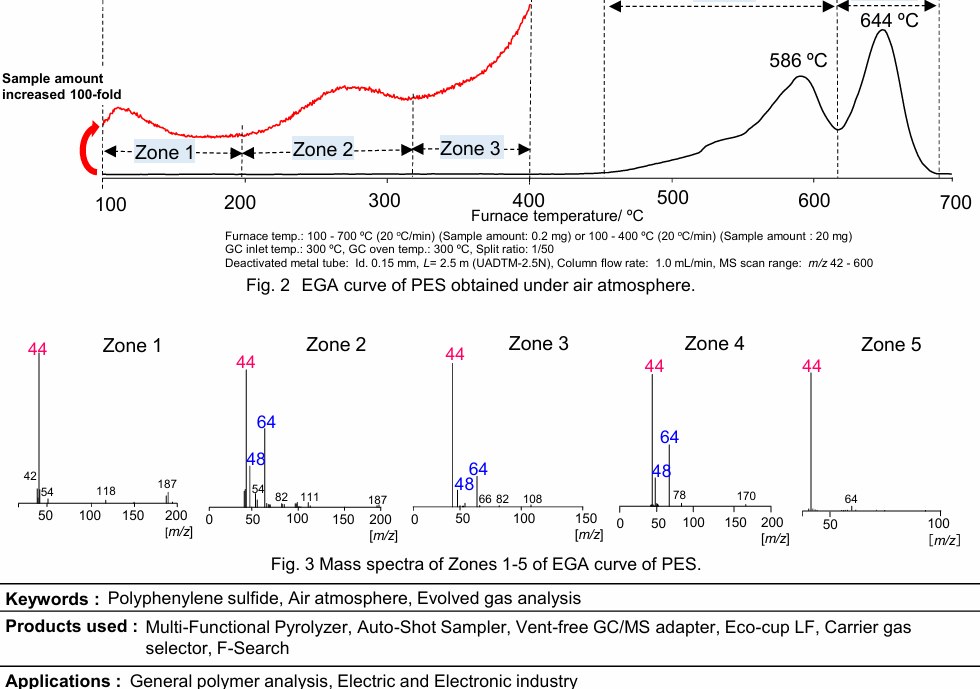
The initial EGA-MS measurement of the PES sample showed two major peaks at approximately 586 °C and 644 °C.
These peaks corresponded to the pyrolysis of PES.
However, no significant peaks were observed in the 100–400 °C range, which includes the typical molding temperature range considered in the study.
Because the low-temperature signals were relatively small, the sample amount was increased by 100-fold and the EGA measurement was repeated over the lower temperature range.
This approach provided additional information about gases evolved during the lower-temperature region.
Identification of Evolved Gas Components
The EGA curve was divided into five temperature zones, and the average mass spectrum from each zone was evaluated.
The analysis detected ions associated with:
- CO₂ — m/z 44
- SO₂-related ions — m/z 48 and 64
The detection of these ions indicated that carbon dioxide and sulfur dioxide-related products were generated through thermal desorption and pyrolysis of PES under the air atmosphere used in the study.
The zone-based approach demonstrates how EGA-MS can provide information about the chemical nature of evolved gases at different temperature ranges.
Why Temperature-Resolved Analysis Is Important
A conventional single-temperature analysis may not provide enough information about when different gaseous components are generated.
EGA-MS provides a temperature profile that can help researchers distinguish between:
- Low-temperature evolved gases
- Thermal desorption products
- Higher-temperature decomposition products
- Major polymer pyrolysis regions
This makes EGA-MS useful as a preliminary screening technique for determining appropriate conditions for subsequent analytical work.
EGA-MS for Polymer Molding Studies
For engineering polymers such as PES, processing conditions can be an important part of material characterization.
EGA-MS can support investigations into gases generated during heating by showing where gas evolution occurs across the temperature range.
In the PYA3-049E study, the analysis was specifically conducted as a preliminary investigation for the analysis of gases generated during PES molding.
The results can therefore help establish the basis for subsequent thermal desorption analysis at approximately 400 °C.
From EGA-MS to Thermal Desorption Analysis
EGA-MS can be used as an initial step to identify temperature regions requiring more detailed investigation.
In the PES study, the next stage involved thermal desorption analysis of the PES sample at 400 °C.
This illustrates an analytical workflow in which EGA-MS first establishes the temperature behavior, followed by targeted analysis at a relevant processing temperature.
EGA-MS → Identify temperature behavior → Select analytical temperature → Thermal desorption analysis → Detailed characterization
Applications of EGA-MS in Polymer Analysis
EGA-MS can be applied to a range of polymer-related investigations, including:
Polymer Thermal Behavior
Evaluate the temperature ranges where gases are evolved from polymer materials.
Molding Process Studies
Investigate gases generated during polymer processing and molding.
Engineering Plastics Analysis
Characterize thermal behavior of high-performance engineering polymers such as PES.
Electrical and Electronic Materials
Support analysis of polymers used in electrical and electronic components.
Evolved Gas Screening
Identify major gas components and their associated temperature regions.
Method Development
Use EGA-MS as a preliminary technique for selecting conditions for subsequent thermal desorption or pyrolysis analysis.
Frontier Laboratories Solutions for EGA-MS Analysis
Frontier Laboratories provides analytical solutions for evolved gas and polymer analysis.
The system used in the PYA3-049E study included the Multi-Shot Pyrolyzer EGA/PY-3030D, directly interfaced with GC/MS.
Other products identified in the technical note include:
- Multi-Functional Pyrolyzer
- Auto-Shot Sampler
- Vent-Free GC/MS Adapter
- Eco-cup LF
- Carrier Gas Selector
- F-Search
These components can support controlled thermal analysis, sample introduction, evolved gas analysis, and mass spectral interpretation.
Advantages of EGA-MS for PES Analysis
EGA-MS provides several useful capabilities for polymer investigations:
- Temperature-resolved evolved gas analysis
- Identification of major evolved gas components
- Preliminary screening before detailed analysis
- Evaluation of low- and high-temperature regions
- Support for molding-process investigations
- Flexible integration with GC/MS
- Useful information for selecting subsequent analytical conditions
Considerations for EGA-MS Analysis
The observed evolved gases can depend on several experimental factors, including:
- Sample amount
- Heating rate
- Temperature range
- Atmospheric conditions
- Carrier gas and flow conditions
- GC/MS configuration
- Sample composition
Therefore, analytical conditions should be selected according to the material and research objective.
The results from PYA3-049E specifically represent the reported PES sample and experimental conditions under an air atmosphere.
Related Frontier Laboratories Research
The PES investigation forms part of a broader analytical workflow.
The technical note references related work including PYA3-033E, PYA3-042E, PYA1-149E, and PYA1-176E (Part-2), with subsequent work identified as PYA1-177E (Part-3).
These technical notes can provide additional context for evolved gas, thermal desorption, and polymer analysis.
For further information on applied pyrolysis research, visit:
Contact Frontier Laboratories SEA
Conclusion
EGA-MS provides a temperature-resolved approach for investigating gases evolved from polyethersulfone (PES).
In Technical Note PYA3-049E, major PES pyrolysis peaks were observed at approximately 586 °C and 644 °C, while increased sample loading enabled the investigation of the lower 100–400 °C range relevant to molding conditions.
Mass spectral analysis of temperature zones identified ions associated with CO₂ and SO₂-related products, demonstrating the usefulness of EGA-MS for preliminary evolved gas investigations.
For polymer researchers, materials scientists, and laboratories studying engineering plastics, EGA-MS can serve as an important first step toward understanding thermal behavior and selecting conditions for more targeted analysis.
Frequently Asked Questions (FAQs)
Evolved Gas Analysis-Mass Spectrometry (EGA-MS) is a technique that monitors gases released from a sample as it is heated and uses mass spectrometry to characterize the evolved components.
Polyethersulfone (PES) is a high-performance engineering plastic with high mechanical strength and heat resistance.
The study investigated evolved gases from PES in an air atmosphere as a preliminary step toward understanding gases generated during the molding process.
The EGA curve showed two major peaks at approximately 586 °C and 644 °C under the reported experimental conditions.
The study detected ions associated with CO₂ and SO₂-related products, indicating their generation during thermal desorption and pyrolysis of PES in air.
Yes. EGA-MS can be used as a preliminary analytical approach for investigating thermal behavior and evolved gases from various polymer materials.