Pyrolysis-GC/MS Analysis of Tobacco in Air and Helium
When a material is heated, the surrounding atmosphere can significantly influence its thermal degradation behavior.
Comparing pyrolysis under an inert atmosphere such as helium (He) with pyrolysis under an oxidative atmosphere such as air can provide useful information about how sample components change during thermal degradation.
Frontier Laboratories Technical Note PYA1-062E demonstrates this approach through the analysis of tobacco using Pyrolysis-GC/MS (Py-GC/MS) at 600 °C and 800 °C.
The study compares pyrograms obtained in air and helium to investigate differences in tobacco degradation and the formation of pyrolysis products.
Why Compare Pyrolysis in Air and Helium?
Pyrolysis in helium and air can produce different chemical profiles.
In an inert helium atmosphere, thermal decomposition occurs without the same oxidative conditions present in air.
In an air atmosphere, oxidation can alter some of the compounds generated during heating.
Comparing the resulting pyrograms can therefore provide information about:
- Thermal degradation pathways
- Oxidative degradation
- Changes in specific organic compounds
- Temperature-dependent decomposition
- Compounds generated under combustion-like conditions
This type of comparison can be particularly relevant when studying materials whose emissions may be encountered during burning or thermal processing.
Tobacco as a Model for Oxidative Pyrolysis Analysis
Tobacco is a material of particular interest because temperatures reached during burning can exceed 700 °C.
Under these conditions, tobacco constituents can undergo thermal decomposition and oxidation, generating a complex mixture of volatile and semi-volatile compounds.
Py-GC/MS provides a way to examine these products under controlled laboratory conditions.
In Technical Note PYA1-062E, tobacco was analyzed at 600 °C and 800 °C in both helium and air.
Experimental Method
Pyrograms were obtained using Py-GC/MS under inert and oxidative conditions.
Analytical Conditions
Parameter | Condition |
Sample | Tobacco |
Pyrolysis temperatures | 600 °C and 800 °C |
Atmospheres | Helium and air |
GC injection port | 320 °C |
GC oven | 40 °C (2 min hold) → 320 °C |
GC temperature ramp | 20 °C/min |
Separation column | Ultra ALLOY-1 |
Column dimensions | 30 m × 0.25 mm i.d. |
Film thickness | 0.5 µm |
Column flow | 1.0 mL/min |
Split ratio | 1/50 |
Sample weight | Approx. 0.5 mg |
Identification | Based on MS data |
Additional devices used included the Carrier Gas Selector, Selective Sampler, and MicroJet Cryo-Trap.
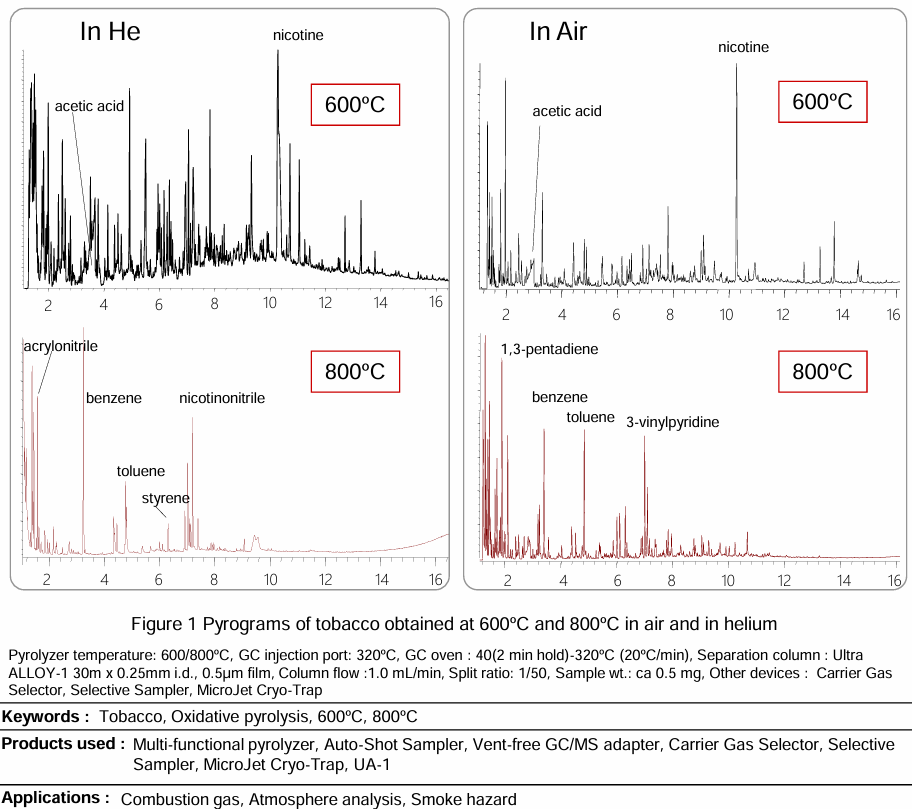
Tobacco Pyrograms at 600 °C and 800 °C
The study compared tobacco pyrograms generated under four conditions:
- 600 °C in helium
- 600 °C in air
- 800 °C in helium
- 800 °C in air
The resulting chromatograms showed significant differences between the inert and oxidative atmospheres.
These differences provide insight into how tobacco constituents respond to thermal and oxidative conditions.
Compounds Observed During Tobacco Pyrolysis
The pyrograms included a range of compounds, including:
- Nicotine
- Nicotinonitrile
- 3-Vinylpyridine
- Benzene
- Toluene
- Styrene
- Acrylonitrile
- Acetic acid
- 1,3-Pentadiene
The compounds identified demonstrate the complex chemical changes that occur when tobacco is exposed to high temperatures.
Effect of Temperature on Tobacco Pyrolysis
Temperature had a significant effect on the observed pyrolysis products.
At 600 °C, nicotine was detected under helium conditions.
At the higher temperature of 800 °C, nicotine underwent further thermal decomposition, resulting in the appearance of nicotinonitrile, while the acetic acid peak was greatly reduced.
This demonstrates that increasing pyrolysis temperature can alter the composition of the products generated from tobacco.
Effect of an Oxidative Atmosphere
The comparison between helium and air revealed additional differences.
Under oxidative conditions, nicotine was degraded to 3-vinylpyridine.
The formation of benzene was also evident at 800 °C in air.
These changes demonstrate how the atmosphere surrounding the sample can influence the degradation pathways of tobacco constituents.
Helium vs Air: What Does the Comparison Show?
The study illustrates the importance of considering atmosphere when investigating thermal degradation.
In Helium
The analysis primarily reflects thermal decomposition under inert conditions.
For example:
- Nicotine was observed at 600 °C.
- At higher temperature, nicotine underwent further decomposition.
- Nicotinonitrile was observed at 800 °C.
In Air
Oxidative reactions changed the resulting product profile.
For example:
- Nicotine was degraded to 3-vinylpyridine.
- Benzene formation became evident at 800 °C.
- The pyrogram differed significantly from the helium condition.
Therefore, comparing inert and oxidative pyrolysis can reveal chemical changes that may not be apparent from a single atmosphere alone.
What Is Oxidative Pyrolysis?
Oxidative pyrolysis refers to thermal decomposition that occurs in the presence of an oxidizing atmosphere.
During heating in air, sample components can undergo oxidation in addition to thermal decomposition.
This can produce a different set of chemical products compared with pyrolysis under an inert gas such as helium.
For complex organic materials, comparing both conditions can provide additional information about degradation behavior.
Applications of Tobacco Pyrolysis-GC/MS
The approach demonstrated in PYA1-062E can be relevant to several areas of research.
Tobacco Chemical Analysis
Py-GC/MS can help characterize compounds generated from tobacco during controlled thermal treatment.
Thermal Degradation Studies
Comparison of different temperatures can help researchers investigate temperature-dependent decomposition.
Oxidative Pyrolysis Research
Air-versus-helium comparisons can provide information about oxidation-related changes.
Combustion-Related Research
High-temperature analysis can provide laboratory insights into compounds generated under conditions relevant to burning.
Smoke and Emission Research
Characterization of pyrolysis products can support research into the chemical composition of emissions.
Importance of Atmosphere Analysis
The atmosphere used during pyrolysis is an important experimental parameter.
For materials containing complex organic compounds, an inert atmosphere and an oxidative atmosphere can produce substantially different chemical profiles.
Therefore, researchers may compare conditions to better understand:
Material → Thermal treatment → Atmosphere → Degradation pathway → Pyrolysis products
This provides a broader understanding of the material’s thermal behavior.
Frontier Laboratories Solutions for Tobacco Py-GC/MS
The technical note used a Frontier Laboratories Multi-functional Pyrolyzer system with supporting analytical components.
Products identified in the technical note include:
- Multi-functional Pyrolyzer
- Auto-Shot Sampler
- Vent-free GC/MS Adapter
- Carrier Gas Selector
- Selective Sampler
- MicroJet Cryo-Trap
- Ultra ALLOY-1 column
These components support controlled pyrolysis, sample introduction, gas-flow selection, trapping, and GC/MS analysis.
For broader information about applied pyrolysis research:
Advantages of Comparing Pyrolysis Atmospheres
Comparing Py-GC/MS results in air and helium can help researchers:
- Identify atmosphere-dependent degradation products
- Examine oxidative changes
- Compare thermal and oxidative decomposition
- Study temperature-dependent chemical changes
- Investigate complex organic materials
- Understand degradation pathways
The approach can be adapted to research applications where atmosphere plays an important role in thermal decomposition.
Conclusion
Technical Note PYA1-062E demonstrates how Pyrolysis-GC/MS can be used to compare tobacco pyrolysis under helium and air atmospheres at 600 °C and 800 °C.
The results showed clear differences between inert and oxidative conditions.
Under helium, nicotine was observed at 600 °C and underwent further thermal decomposition at higher temperature, producing nicotinonitrile. Under air, nicotine was degraded to 3-vinylpyridine, while benzene formation became evident at 800 °C.
These findings demonstrate how temperature and atmosphere can influence the chemical products generated during tobacco pyrolysis.
Comparative Py-GC/MS analysis can therefore provide useful information for investigating thermal degradation, oxidative pyrolysis, combustion-related chemistry, and complex organic material analysis.
Frequently Asked Questions (FAQs)
Tobacco pyrolysis-GC/MS is an analytical approach in which tobacco is thermally decomposed under controlled conditions and the resulting products are separated by GC and identified using MS.
Helium provides an inert atmosphere, while air introduces oxidative conditions. Comparing both can reveal differences in thermal and oxidative degradation pathways.
Tobacco was analyzed at 600 °C and 800 °C.
Under helium, nicotine underwent thermal decomposition to form nicotinonitrile. Under oxidative conditions, nicotine was degraded to 3-vinylpyridine.
The pyrograms included nicotine, nicotinonitrile, 3-vinylpyridine, benzene, toluene, styrene, acrylonitrile, acetic acid, and 1,3-pentadiene, among others.
Benzene formation was evident at 800 °C under air conditions, demonstrating the effect of an oxidative atmosphere on tobacco pyrolysis products.