Polyvinyl chloride (PVC) is one of the most widely used polymers in construction, automotive, medical, electrical, and consumer product applications. Despite its versatility and durability, PVC can undergo degradation during processing, storage, and service life, leading to changes in appearance and performance.
One of the most common signs of PVC degradation is yellowing, which can indicate chemical changes within the material. Understanding the causes of discoloration is essential for maintaining product quality, extending service life, and improving material formulations. Advanced analytical techniques such as EGA-MS analysis provide valuable insights into the thermal behavior and degradation mechanisms of polymers.
This study investigates a PVC sheet with one white surface and one yellowed surface using Evolved Gas Analysis-Mass Spectrometry (EGA-MS) to determine whether significant chemical differences exist between the two sides.
Table of Contents
Introduction to PVC Degradation
Why PVC Yellowing Occurs
What is EGA-MS?
Study Objective
Experimental Setup
Materials and Instrumentation
EGA-MS Measurement Conditions
Results of EGA-MS Analysis
Hydrogen Chloride Evolution in PVC
Comparison of White and Yellowed Surfaces
Understanding Thermal Stability Changes
Importance of Degradation Analysis
Applications of EGA-MS in Polymer Studies
Conclusion
Introduction to PVC Degradation
Polyvinyl chloride is a thermoplastic polymer known for its excellent chemical resistance, mechanical strength, and cost-effectiveness.
However, prolonged exposure to:
Heat
Ultraviolet radiation
Oxygen
Environmental conditions
Processing stress
can initiate degradation reactions that negatively affect material properties.
Common signs of PVC degradation include:
Yellowing or discoloration
Loss of flexibility
Brittleness
Reduced impact resistance
Surface defects
Monitoring these changes is essential for ensuring long-term product performance.
Why PVC Yellowing Occurs
PVC yellowing is often associated with thermal degradation and dehydrochlorination reactions.
During degradation:
Hydrogen chloride (HCl) is released.
The polymer structure changes.
Conjugated double bonds form within the polymer chain.
The material gradually changes color from white to yellow and eventually brown.
The release of HCl is therefore an important indicator of PVC degradation.
Analyzing HCl evolution can provide valuable information regarding the thermal stability and condition of PVC materials.
What is EGA-MS?
Evolved Gas Analysis-Mass Spectrometry (EGA-MS) is a thermal analytical technique used to monitor gases released from materials during controlled heating.
The technique provides information about:
Thermal decomposition behavior
Volatile compounds
Polymer degradation pathways
Material stability
Additive behavior
Because EGA-MS directly analyzes evolved gases without chromatographic separation, it is highly effective for rapid screening of polymer degradation processes.
Study Objective
The objective of this study was to investigate whether a visible color difference between two surfaces of a PVC sheet corresponded to measurable differences in thermal behavior.
The analysis focused on:
Comparing white and yellowed PVC surfaces
Monitoring hydrogen chloride evolution
Evaluating thermal stability
Identifying degradation-related changes
Assessing overall decomposition behavior
Experimental Setup
A Multi-Shot Pyrolyzer directly connected to a GC/MS system was used for the analysis.
Samples from both the white and yellowed surfaces of the PVC sheet were:
Collected separately.
Pulverized into fine particles.
Placed into sample cups.
Introduced into the pyrolyzer furnace.
During heating, evolved gases were transferred through a heated deactivated EGA tube directly to the mass spectrometer for analysis.
This setup enabled real-time monitoring of decomposition products released from the PVC samples.
Materials and Instrumentation
The analysis utilized the following equipment:
Sample Material
Polyvinyl Chloride (PVC) Sheet
White Surface Sample
Yellowed Surface Sample
Analytical Instruments
Multi-Functional Pyrolyzer
Auto-Shot Sampler
Eco-Cup LF
Vent-Free GC/MS Adapter
F-Search Software
EGA Tube
GC/MS System
These components provided precise thermal control and efficient transfer of evolved gases for accurate characterization.
EGA-MS Measurement Conditions
The analysis was conducted under the following conditions:
Parameter | Condition |
Sample Weight | 0.2 mg |
Furnace Temperature | 100–600°C |
Heating Rate | 20°C/min |
EGA Tube | UAD™-2.5N |
Tube Length | 2.5 m |
Tube Inner Diameter | 0.15 mm |
Carrier Gas Flow Rate | 1 mL/min |
Split Ratio | 1:50 |
GC Oven Temperature | 300°C |
These conditions enabled detailed evaluation of PVC thermal decomposition behavior.
Results of EGA-MS Analysis
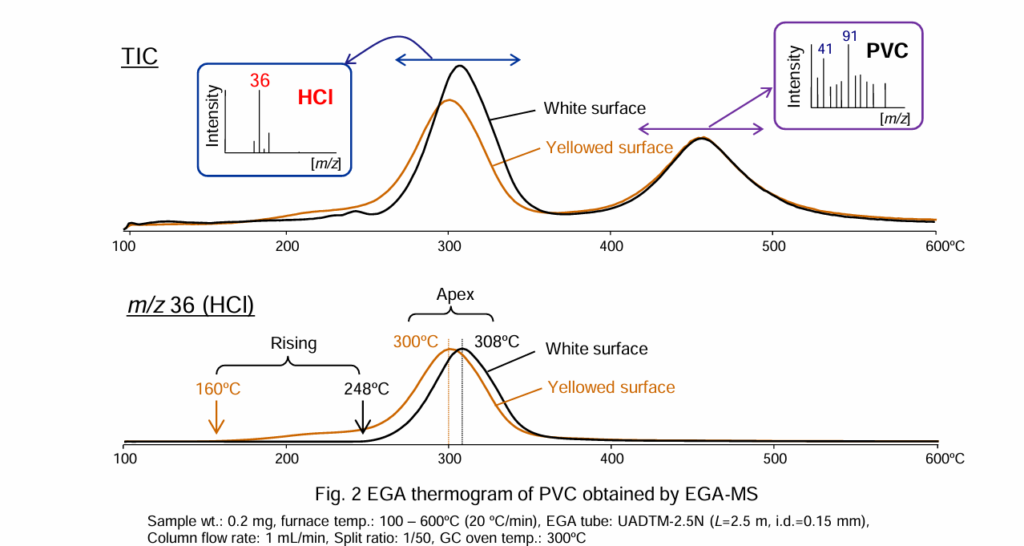
The EGA thermograms obtained from the white and yellowed PVC surfaces revealed two major thermal events.
Event 1: Hydrogen Chloride Evolution
A broad peak appeared around 300°C.
Mass spectral analysis identified this peak as:
Hydrogen Chloride (HCl)
Event 2: PVC Polymer Decomposition
A second major peak appeared around:
450°C
This peak was attributed to the thermal degradation of the PVC polymer backbone.
Hydrogen Chloride Evolution in PVC
The average mass spectrum of the first decomposition event showed a dominant signal corresponding to:
HCl
Characteristic Ion: m/z 36
Hydrogen chloride release is a well-known indicator of PVC degradation.
As PVC degrades:
HCl is eliminated from the polymer chain.
Structural changes occur.
Thermal stability decreases.
Discoloration develops.
Monitoring HCl evolution provides valuable information about the condition of the material.
Comparison of White and Yellowed Surfaces
The extracted ion chromatograms for m/z 36 revealed significant differences between the two surfaces.
White Surface
Parameter | Temperature |
Rising Temperature | 248°C |
Peak Apex Temperature | 308°C |
Yellowed Surface
Parameter | Temperature |
Rising Temperature | 160°C |
Peak Apex Temperature | 300°C |
Key Observation
The yellowed surface released HCl at a significantly lower temperature than the white surface.
This indicates that the yellowed region exhibits reduced thermal stability.
The earlier release of HCl suggests that degradation has already progressed within the yellowed material.
Understanding Thermal Stability Changes
The lower HCl evolution temperature observed for the yellowed PVC surface suggests a reduction in heat resistance.
Possible causes include:
Thermal Aging
Extended exposure to elevated temperatures may accelerate degradation reactions.
Environmental Exposure
Ultraviolet radiation and atmospheric oxygen can initiate chemical changes within the polymer.
Processing Effects
Excessive processing temperatures may partially degrade PVC during manufacturing.
Additive Depletion
Stabilizer consumption can reduce resistance to further degradation.
These factors contribute to premature HCl evolution and visible discoloration.
Importance of Degradation Analysis
Understanding polymer degradation is essential for:
Product Quality Control
Detecting early degradation
Ensuring manufacturing consistency
Failure Analysis
Investigating product defects
Identifying degradation mechanisms
Material Development
Improving formulations
Enhancing thermal stability
Lifetime Assessment
Predicting service life
Monitoring aging behavior
Analytical techniques such as EGA-MS allow researchers to evaluate degradation before severe performance loss occurs.
Applications of EGA-MS in Polymer Studies
EGA-MS is widely used across polymer research and industrial applications.
Polymer Characterization
Material identification
Additive evaluation
Stability assessment
Degradation Studies
Thermal aging analysis
Oxidation studies
Weathering investigations
Quality Assurance
Batch consistency verification
Manufacturing control
Failure Investigations
Root cause analysis
Product reliability evaluation
The ability to rapidly detect degradation products makes EGA-MS a valuable analytical tool for polymer science.
Conclusion
The EGA-MS analysis revealed clear differences between the white and yellowed surfaces of the PVC sheet. While both samples exhibited similar overall decomposition behavior, the yellowed surface released hydrogen chloride at significantly lower temperatures, indicating reduced thermal stability and increased susceptibility to degradation.
The extracted ion chromatograms demonstrated that HCl evolution began at approximately 160°C for the yellowed surface compared with 248°C for the white surface. This finding suggests that the yellowing is associated with chemical changes affecting the heat resistance of the material.
Advanced analytical techniques such as Pyrolysis-GC/MS and EGA-MS for polymer degradation analysis enable researchers to investigate thermal stability, identify degradation pathways, and improve the long-term performance of polymer materials.
References: This technical note was developed by Frontier Laboratories Ltd. 4-16-20 Saikon, Koriyama, Fukushima, 963-8862 JAPAN. www.frontier-lab.com