Introduction
Phthalates are widely used as plasticizers in polyvinyl chloride (PVC) products to improve flexibility, durability, and performance. As a result, they are commonly found in toys, cables, flooring, medical devices, and many other consumer products. However, several phthalates have been linked to adverse health effects, leading to stricter regulations worldwide.
Traditional methods for analyzing phthalates involve solvent extraction, filtration, and concentration, which are often labor-intensive and time-consuming. An advanced alternative is Thermal Desorption Gas Chromatography-Mass Spectrometry (TD-GC/MS) combined with Evolved Gas Analysis (EGA)-MS, providing rapid and accurate screening without extensive sample preparation.
This article explains how EGA-MS is used to determine the ideal thermal desorption temperature for analyzing restricted phthalates in PVC materials.
Why Are Phthalates Regulated?
Research has shown that certain phthalates may affect:
- Hormonal balance
- Reproductive health
- Child development
- Endocrine system function
Due to these concerns, regulations such as:
- European Union Directive 2005/84/EC
- US Consumer Product Safety Improvement Act (CPSIA Section 108)
limit the concentration of specific phthalates to 0.1% (1000 ppm) in many consumer products.
Restricted Phthalates
The commonly regulated phthalates include:
Phthalate | Full Name |
DEHP | Di(2-ethylhexyl) phthalate |
DBP | Dibutyl phthalate |
BBP | Butyl benzyl phthalate |
DINP | Diisononyl phthalate |
DIDP | Diisodecyl phthalate |
DNOP | Di(n-octyl) phthalate |
These compounds are commonly monitored in PVC products, especially children’s toys and consumer goods.
Challenges with Conventional Analysis
Most laboratories still use solvent-based extraction techniques, which involve:
- Solvent extraction
- Sample filtration
- Concentration
- Long preparation time
- High solvent consumption
- Risk of contamination
- Lower productivity
These methods can be cumbersome and may not always provide reliable quantitative results.
Thermal Desorption GC/MS: A Modern Alternative
Thermal Desorption GC/MS significantly simplifies phthalate analysis by heating the sample directly and analyzing the released compounds.
Advantages include:
- Minimal sample preparation
- Faster analysis
- High sensitivity
- Reduced solvent use
- Better reproducibility
- Lower operating costs
- Environmentally friendly workflow
Role of Evolved Gas Analysis (EGA)-MS
Before performing thermal desorption, it is important to determine the temperature range where target compounds are released.
This is achieved using Evolved Gas Analysis (EGA)-MS.
During EGA:
- The sample is gradually heated.
- Released gases are continuously monitored.
- A thermogram is generated.
- The ideal desorption temperature is identified.
This ensures only the desired analytes enter the GC/MS system while avoiding unnecessary decomposition products.
Experimental Procedure
Sample Preparation
The study analyzed small PVC toy samples collected from multiple locations.
Procedure:
- Small PVC pieces were punched using a 2 mm Harris Micropuncher.
- Samples were dissolved in tetrahydrofuran (THF).
- Six regulated phthalates were added.
- A small aliquot was placed into a sample cup.
- After solvent evaporation, approximately 0.5 mg of sample remained for analysis.
Instrument Conditions
Typical operating conditions included:
Parameter | Condition |
Pyrolyzer | 100–600°C |
Heating Rate | 20°C/min |
GC Oven | 300°C |
Carrier Gas | Helium |
Flow Rate | 1 mL/min |
Split Ratio | 1:20 |
Injector Temperature | 320°C |
Determining the Thermal Desorption Zone
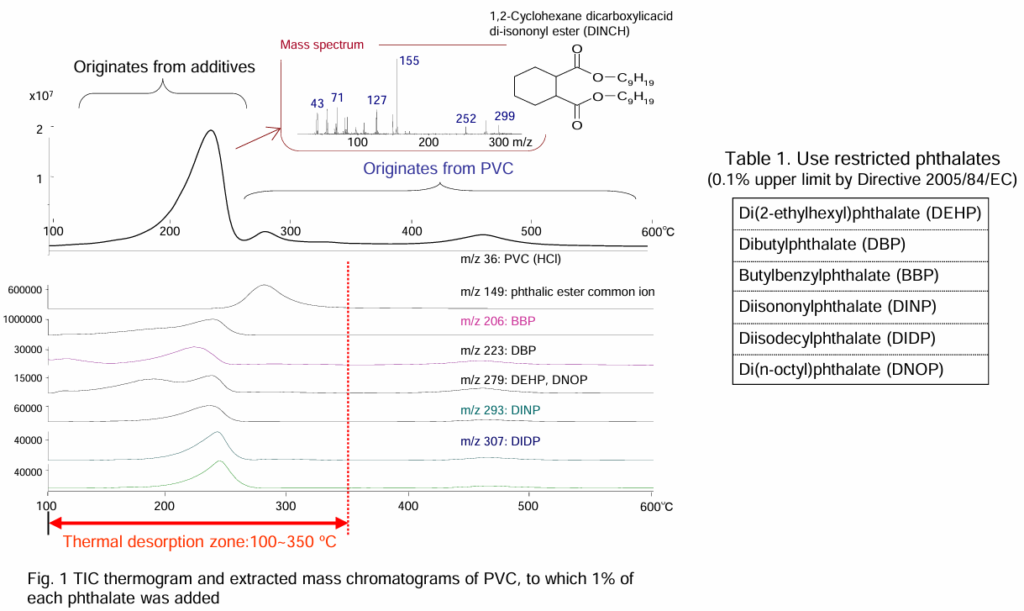
The EGA thermogram showed that:
- PVC begins releasing hydrogen chloride (HCl) during heating.
- Plasticizers evolve before the polymer matrix fully decomposes.
- The six regulated phthalates are released within a specific temperature window.
The optimal thermal desorption range was found to be:
100°C to 350°C
Within this range:
- Target phthalates are efficiently desorbed.
- Polymer degradation is minimized.
- Cleaner chromatograms are obtained.
- Analytical accuracy improves significantly.
Identification Using Extracted Ion Chromatograms
Extracted Ion Chromatograms (EICs) help distinguish different compounds by monitoring characteristic mass fragments.
Examples include:
Ion (m/z) | Compound |
36 | Hydrogen chloride (PVC degradation) |
149 | Common phthalate ion |
206 | BBP |
223 | DBP |
279 | DEHP, DNOP |
293 | DINP |
307 | DIDP |
This selective monitoring allows accurate identification even in complex PVC formulations.
Importance of Differentiating Other Plasticizers
PVC products often contain non-regulated plasticizers such as:
DINCH (1,2-Cyclohexane dicarboxylic acid di-isononyl ester)
Without proper mass spectral identification, these compounds may interfere with phthalate analysis.
Using EGA-MS and extracted ion chromatograms ensures that regulated phthalates are accurately distinguished from other additives.
Benefits of TD-GC/MS for PVC Analysis
Compared to traditional extraction methods, TD-GC/MS offers several advantages:
- Rapid screening
- Minimal sample handling
- Reduced solvent usage
- Lower contamination risk
- High analytical sensitivity
- Excellent reproducibility
- Accurate identification of regulated compounds
- Suitable for routine quality control
- Ideal for regulatory compliance testing
Applications
Thermal Desorption GC/MS can be used in:
- PVC toys
- Medical-grade plastics
- Packaging materials
- Automotive components
- Electrical cables
- Consumer goods
- Plastic manufacturing quality control
- Regulatory compliance laboratories
- Research and development
Regulatory Compliance
Manufacturers exporting PVC products must ensure compliance with:
- EU Directive 2005/84/EC
- CPSIA Section 108 (USA)
- REACH regulations
- RoHS-related material screening
- International product safety standards
Reliable phthalate testing helps manufacturers avoid product recalls and maintain consumer safety.
Conclusion
Thermal Desorption GC/MS combined with Evolved Gas Analysis provides a faster, cleaner, and more efficient method for analyzing regulated phthalates in PVC materials. By first identifying the optimal thermal desorption zone (100–350°C), laboratories can accurately detect restricted phthalates while minimizing interference from the PVC matrix and other additives.
Compared to conventional solvent extraction techniques, this approach reduces analysis time, lowers solvent consumption, and improves data quality, making it an excellent choice for quality control, regulatory compliance, and research laboratories involved in plastic material testing.
References: This technical note was developed by Frontier Laboratories Ltd. 4-16-20 Saikon, Koriyama, Fukushima, 963-8862 JAPAN. www.frontier-lab.com