Introduction
Phthalates are widely used as plasticizers in polyvinyl chloride (PVC) products to improve flexibility, durability, and processability. They are commonly found in children’s toys, medical devices, packaging materials, cables, flooring, and other plastic products. However, certain phthalates have been identified as harmful to human health, leading to strict international regulations on their use.
Traditional analytical methods for phthalate determination often require complex solvent extraction procedures that are time-consuming and susceptible to variability. An advanced alternative is Thermal Desorption Gas Chromatography-Mass Spectrometry (TD-GC/MS) combined with Evolved Gas Analysis (EGA)-MS, which enables rapid, accurate, and solvent-free analysis of restricted phthalates in PVC materials.
Why Is Phthalate Analysis Important?
Several phthalates have been associated with endocrine disruption, reproductive toxicity, and developmental health concerns. As a result, governments worldwide have established regulations limiting their concentration in consumer products, particularly those intended for children.
Major regulations include:
- European Union Directive 2005/84/EC
- US Consumer Product Safety Improvement Act (CPSIA)
- Japan Ministry of Health, Labour and Welfare Guideline No. 336
These regulations restrict the concentration of six phthalates to 0.1% (1000 ppm) in toys and childcare products.
Restricted Phthalates in PVC
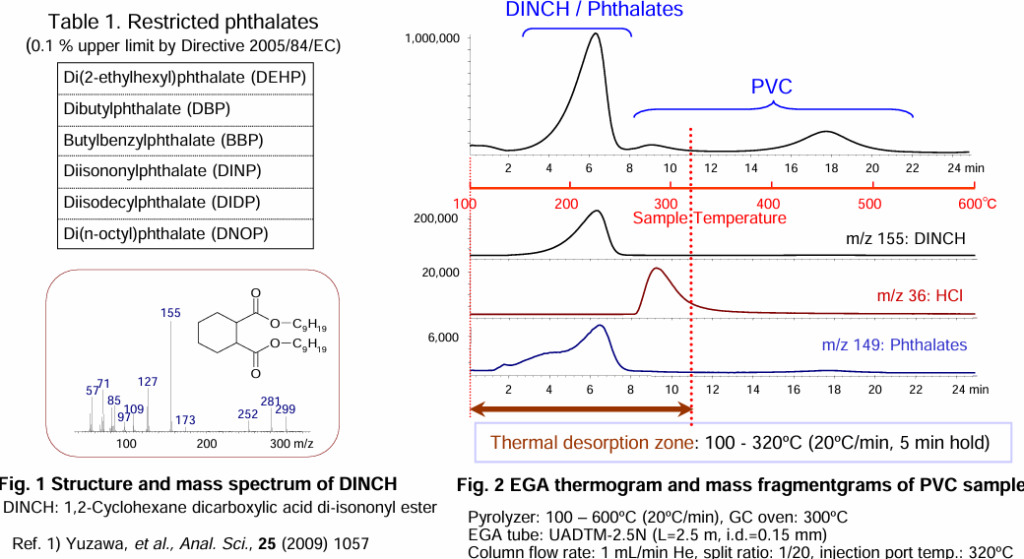
The six regulated phthalates include:
Phthalate | Full Name |
DEHP | Di(2-ethylhexyl) phthalate |
DBP | Dibutyl phthalate |
BBP | Butyl benzyl phthalate |
DINP | Diisononyl phthalate |
DIDP | Diisodecyl phthalate |
DNOP | Di(n-octyl) phthalate |
Accurate detection of these compounds is essential for product safety and regulatory compliance.
Limitations of Conventional Testing Methods
Traditional phthalate analysis generally involves:
- Solvent extraction
- Filtration
- Concentration
- Sample cleanup
- Lengthy preparation procedures
These methods have several drawbacks:
- Time-consuming workflow
- High solvent consumption
- Increased laboratory costs
- Analyst-to-analyst variability
- Greater risk of contamination
- Reduced productivity
Why Choose Thermal Desorption GC/MS?
Thermal Desorption GC/MS provides a simple one-step analytical approach by directly heating the sample to release volatile compounds for analysis.
Key advantages include:
- Minimal sample preparation
- No complex extraction procedures
- Faster turnaround time
- Excellent sensitivity
- High reproducibility
- Reduced solvent usage
- Lower operating costs
This makes TD-GC/MS highly suitable for routine PVC quality control and regulatory testing.
Understanding Evolved Gas Analysis (EGA)-MS
Before performing thermal desorption, analysts must determine the temperature range where the target compounds evolve from the sample.
EGA-MS gradually heats the sample while continuously monitoring released gases, producing a thermogram that helps identify the optimal desorption temperature.
This approach improves analytical accuracy by separating target compounds from decomposition products generated by the PVC matrix.
Experimental Overview
A PVC sheet containing:
- 40% DINCH (1,2-Cyclohexane dicarboxylic acid di-isononyl ester)
- 0.1% each of six restricted phthalates
was analyzed.
Sample Preparation
- Small PVC pieces (approximately 20 mg) were collected.
- Samples were dissolved in tetrahydrofuran (THF).
- A 10 µL aliquot was placed into a sample cup.
- The solvent was evaporated to leave a thin sample film.
- Analysis was performed using a Multi-Shot Pyrolyzer coupled with GC/MS.
Instrument Conditions
Typical analytical conditions included:
Parameter | Setting |
Pyrolyzer Temperature | 100–600°C |
Heating Rate | 20°C/min |
GC Oven | 300°C |
Carrier Gas | Helium |
Flow Rate | 1 mL/min |
Split Ratio | 1:20 |
Injection Port | 320°C |
Identifying the Optimal Thermal Desorption Zone
The EGA thermogram revealed several evolved components:
- Plasticizers
- Hydrogen chloride (HCl) from PVC degradation
- Aromatic compounds generated during polymer decomposition
By monitoring characteristic mass fragments, researchers identified the ideal thermal desorption range as:
100°C–320°C
This temperature window allows efficient desorption of regulated phthalates while minimizing interference from PVC decomposition products.
Importance of Monitoring DINCH
Many PVC formulations contain DINCH, a non-phthalate plasticizer widely used as a safer alternative.
However, DINCH can create matrix interference during analysis because it may co-elute with target compounds.
Using EGA-MS allows analysts to distinguish DINCH from regulated phthalates through characteristic mass fragments, improving analytical reliability.
Common monitored ions include:
Compound | Characteristic Ion (m/z) |
DINCH | 155 |
HCl | 36 |
Phthalates | 149 |
This selective monitoring reduces false positives and false negatives.
Advantages of TD-GC/MS with EGA-MS
Compared with conventional solvent extraction methods, TD-GC/MS offers:
- Faster analysis
- Simplified workflow
- Minimal sample preparation
- Lower solvent consumption
- Reduced matrix interference
- Higher analytical precision
- Excellent reproducibility
- Improved laboratory efficiency
- Reliable regulatory compliance
Applications
This analytical technique is suitable for:
- PVC toy testing
- Childcare product safety
- Medical device analysis
- Plastic manufacturing
- Polymer research
- Environmental laboratories
- Quality control laboratories
- Regulatory compliance testing
- Consumer product safety evaluation
Supporting Global Compliance
Manufacturers exporting PVC products must comply with international regulations such as:
- EU Directive 2005/84/EC
- CPSIA (United States)
- REACH
- Japanese Ministry of Health Guidelines
- International toy safety standards
Accurate phthalate analysis helps manufacturers ensure product safety, reduce compliance risks, and maintain consumer confidence.
Conclusion
Thermal Desorption GC/MS combined with Evolved Gas Analysis (EGA)-MS offers a fast, reliable, and efficient solution for determining restricted phthalates in PVC materials. By identifying the optimal thermal desorption temperature range of 100°C to 320°C, laboratories can accurately analyze regulated phthalates while minimizing interference from PVC degradation products and alternative plasticizers such as DINCH.
Compared to traditional solvent extraction methods, TD-GC/MS significantly reduces sample preparation time, improves analytical reproducibility, and supports compliance with global safety regulations. As industries continue to demand faster and more sustainable testing methods, TD-GC/MS with EGA-MS is becoming an essential technology for modern plastic analysis and quality assurance.
References: This technical note was developed by Frontier Laboratories Ltd. 4-16-20 Saikon, Koriyama, Fukushima, 963-8862 JAPAN. www.frontier-lab.com