Improved Polystyrene Detection and Quantification Using F-Splitless Py-GC/MS
Introduction
Polystyrene (PS) is a widely used synthetic polymer found in packaging, consumer products, and many other applications. Detecting and quantifying very small amounts of polystyrene can be challenging when conventional analytical methods do not provide sufficient sensitivity.
Pyrolysis-Gas Chromatography/Mass Spectrometry (Py-GC/MS) provides a chemical approach for polymer identification by analyzing characteristic pyrolysis products. However, conventional split injection can limit sensitivity when only trace amounts of polymer are available.
The F-Splitless injection method, developed for the Multi-Functional Splitless Sampler, addresses this challenge by rapidly transferring pyrolyzates from the pyrolysis furnace and cryo-trapping them before GC/MS analysis. This approach helps suppress secondary reactions and improves the sensitivity of trace polymer detection.
F-Splitless Py-GC/MS for Polystyrene Analysis
The F-Splitless method was developed to overcome potential problems associated with conventional splitless injection.
During conventional splitless analysis, the low carrier-gas flow rate can increase the residence time of pyrolyzates in the heated furnace. This may promote secondary reactions and decomposition, particularly for larger pyrolysis products such as the polystyrene trimer.
The F-Splitless method uses forced venting of the carrier gas and cryo-trapping of pyrolyzates, allowing pyrolysis products to be rapidly transferred from the furnace.
This helps preserve the pyrolysis profile of polystyrene while enabling high-sensitivity analysis.
Experimental Approach
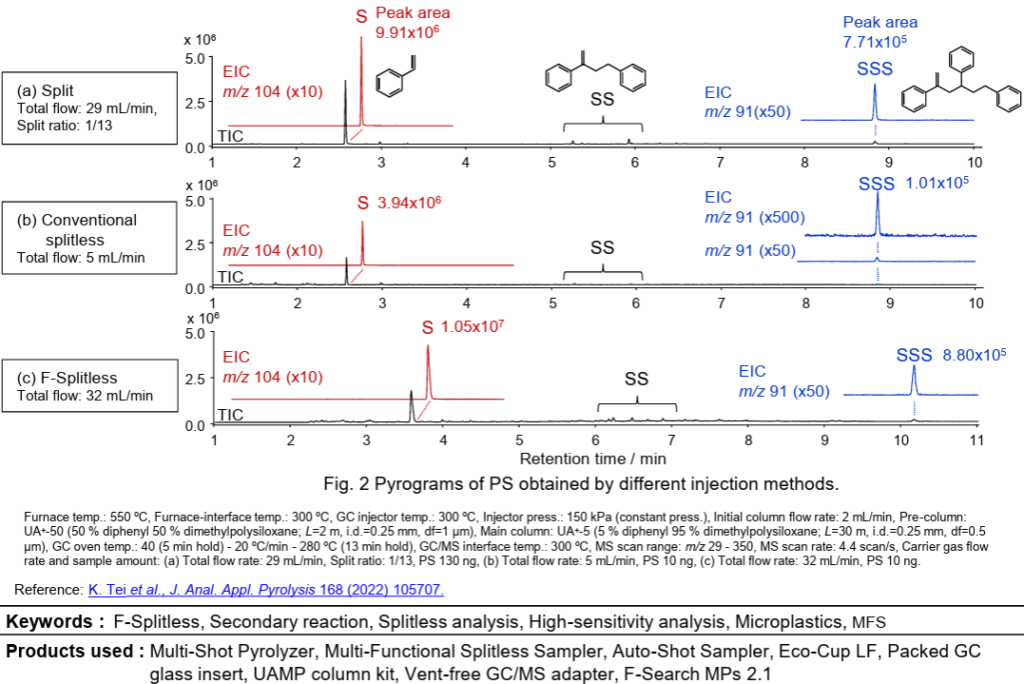
Polystyrene samples were analyzed using Py-GC/MS with different injection methods, including conventional split, conventional splitless, and F-Splitless injection.
The pyrolysis temperature was set to 550°C, and the resulting pyrolyzates were analyzed by GC/MS.
Characteristic polystyrene pyrolysis products included:
- Styrene monomer (S)
- Styrene dimer (SS)
- Styrene trimer (SSS)
The styrene monomer was monitored at m/z 104, while the styrene trimer was monitored at m/z 91.
For sensitivity evaluation, extracted ion chromatograms (EICs) were used to determine peak areas, signal-to-noise ratios, limits of detection (LOD), and limits of quantification (LOQ).
Suppression of Secondary Reactions
The comparison of injection methods demonstrated an important advantage of F-Splitless injection.
With conventional splitless injection, the lower carrier-gas flow rate promoted decomposition of the styrene trimer (SSS), resulting in reduced SSS peak areas and a pyrolysis profile that differed from the conventional split method.
In contrast, the F-Splitless method suppressed the decomposition of SSS and produced a pyrolysis behavior similar to that observed with split injection.
This makes the method particularly useful when accurate characterization of polystyrene pyrolysis products is required.
High-Sensitivity Detection of Polystyrene
The F-Splitless method demonstrated substantially improved sensitivity compared with conventional split injection.
In scan mode, the calculated LOD and LOQ values for polystyrene based on the styrene monomer and styrene trimer were:
Injection Method | Indicator | LOD (ng) | LOQ (ng) |
Split, Scan | S | 175 | 582 |
Split, Scan | SSS | 2100 | 6990 |
F-Splitless, Scan | S | 17.6 | 58.8 |
F-Splitless, Scan | SSS | 65.4 | 218 |
F-Splitless, SIM | S | 16.7 | 55.5 |
F-Splitless, SIM | SSS | 33.6 | 112 |
The results show that F-Splitless injection provides considerably lower detection and quantification limits than conventional split injection.
Signal-to-Noise Performance
Signal-to-noise (S/N) measurements further demonstrated the sensitivity advantage of the F-Splitless method.
Using 100 pg of polystyrene, the S/N values for the styrene monomer and styrene trimer were:
- F-Splitless, SIM mode: S/N = 570 for styrene
- F-Splitless, SIM mode: S/N = 22 for styrene trimer
- F-Splitless, Scan mode: S/N = 80 for styrene
- F-Splitless, Scan mode: S/N = 3.3 for styrene trimer
The styrene monomer showed a particularly strong signal in SIM mode, demonstrating the potential of F-Splitless Py-GC/MS for trace-level polystyrene analysis.
Based on an LOQ criterion of S/N = 10, approximately 1.8 pg of polystyrene could be quantified using the styrene monomer signal with the F-Splitless method in SIM mode.
Distinguishing Polystyrene from Other Styrene-Containing Polymers
Styrene is not exclusive to polystyrene. Other styrene-containing polymers, such as acrylonitrile butadiene styrene (ABS) and styrene-butadiene rubber (SBR), can also generate styrene during pyrolysis.
Therefore, relying only on the styrene monomer signal may not always be sufficient for polymer identification.
The styrene trimer (SSS) can be used as an indicator compound for distinguishing polystyrene from other styrene-containing polymers.
The combination of characteristic pyrolyzates provides more reliable chemical identification of polystyrene in complex samples.
Advantages of F-Splitless Py-GC/MS
The F-Splitless injection method provides several advantages for trace polymer analysis:
- High-sensitivity detection of polystyrene
- Lower LOD and LOQ compared with conventional split injection
- Improved signal-to-noise ratios
- Suppression of secondary reactions
- Preservation of characteristic pyrolysis behavior
- Effective analysis of very small polymer quantities
- Compatibility with scan and SIM modes
- Improved detection of characteristic pyrolyzates
Applications of High-Sensitivity Polymer Analysis
F-Splitless Py-GC/MS can support several areas of polymer and microplastics research.
Microplastics Analysis
The high sensitivity of the method can be useful when analyzing samples containing very small quantities of polymer materials.
Environmental Analysis
Py-GC/MS can support polymer identification in environmental samples such as water, sediment, soil, and other complex matrices.
Trace Polymer Analysis
The improved LOD and LOQ make F-Splitless injection suitable for applications where only trace amounts of polymer are available.
General Polymer Analysis
Characteristic pyrolysis products can be used to identify and differentiate polymer materials based on their chemical composition.
Research and Material Characterization
The method can support investigations of polymer composition, degradation behavior, and pyrolysis characteristics.
Conclusion
High-sensitivity polymer detection is important when only very small quantities of material are available for analysis. The F-Splitless injection method combined with Py-GC/MS provides an effective approach for sensitive polystyrene analysis.
The method helps suppress secondary reactions, preserve characteristic pyrolysis behavior, and improve detection limits compared with conventional split injection.
The reported results demonstrate that F-Splitless Py-GC/MS can achieve low-picogram-level detection of polystyrene, with an LOD of approximately 17 pg based on the styrene monomer signal and strong signal-to-noise performance in SIM mode.
Using characteristic compounds such as styrene monomer and styrene trimer also provides valuable information for distinguishing polystyrene from other styrene-containing polymers.
Overall, F-Splitless Py-GC/MS offers a high-sensitivity analytical approach for trace polymer analysis, microplastics research, environmental analysis, and general polymer characterization.
Contact Us:
Frequently Asked Questions (FAQs)
F-Splitless Py-GC/MS is an injection approach that rapidly transfers pyrolyzates from the pyrolysis furnace and cryo-traps them before GC/MS analysis to improve sensitivity and reduce secondary reactions.
It helps improve sensitivity when analyzing very small amounts of polystyrene while suppressing decomposition of pyrolysis products such as styrene trimer.
Important polystyrene pyrolysis products include styrene monomer (S), styrene dimer (SS), and styrene trimer (SSS).
The styrene monomer is monitored at m/z 104, while styrene trimer is monitored at m/z 91.
In SIM mode, the reported LOD based on the styrene monomer peak area was approximately 17 pg of polystyrene.
The reported LOQ based on the styrene monomer was approximately 56 pg using the F-Splitless method in SIM mode.
Styrene can be generated from PS, ABS, and SBR. Therefore, the styrene trimer (SSS) can be used as an additional indicator to help distinguish polystyrene from other styrene-containing polymers.
SIM mode provides improved signal-to-noise performance for selected ions and can provide higher sensitivity than scan mode for trace-level detection.