Quantitative Analysis of DEHP in Heat-Resistant PVC Using ASTM D7823-14
Introduction to DEHP Analysis in PVC
Phthalate esters are commonly used as plasticizers in polyvinyl chloride (PVC) formulations to improve flexibility, processability, and performance.
However, several phthalates have been identified as substances of concern, resulting in restrictions or regulatory controls in different regions. Bis(2-ethylhexyl) phthalate (DEHP) is one of the regulated phthalates that may need to be monitored in PVC products.
Quantitative analysis of DEHP is therefore important for laboratories involved in PVC characterization, plasticizer analysis, product compliance, and materials testing.
This application demonstrates the quantitative determination of DEHP in the outside sheath of a commercial-grade heat-resistant PVC cable using thermal desorption-gas chromatography/mass spectrometry (TD-GC/MS) according to ASTM D7823-14.
What Is DEHP?
Bis(2-ethylhexyl) phthalate (DEHP) is a phthalate ester widely used as a plasticizer in PVC materials.
Its function is to improve the flexibility and processability of PVC. However, regulatory restrictions on certain phthalates have increased the need for reliable analytical methods to determine their concentration in plastic products.
DEHP analysis can be particularly relevant for PVC products containing plasticizers, including:
- PVC cables and wire sheaths
- Flexible PVC materials
- Plastic components
- PVC films
- Consumer products
- Other plasticized PVC formulations
Why Analyze DEHP in PVC?
The concentration of restricted phthalates such as DEHP can be important for material quality control and regulatory compliance.
Traditional approaches often use solvent extraction before chromatographic analysis. These procedures can require multiple sample-preparation steps and considerable analysis time.
The ASTM D7823-14 method provides an alternative approach using thermal desorption-GC/MS, allowing DEHP to be analyzed directly from a PVC sample with limited sample preparation.
ASTM D7823-14 for DEHP Analysis
ASTM D7823-14 is a method for determining phthalates in PVC using thermal desorption coupled with GC/MS.
Instead of extracting the plasticizer into a solvent, the PVC sample is heated under controlled conditions. The volatile and semi-volatile compounds released from the sample are transferred to the GC/MS system for separation and detection.
This approach can simplify the analytical workflow and reduce the need for conventional liquid/ liquid extraction.
Thermal Desorption-GC/MS for PVC Analysis
Thermal Desorption-GC/MS (TD-GC/MS) combines controlled thermal desorption with gas chromatography and mass spectrometry.
In this application, a small PVC sample is placed directly into an inert stainless-steel sample cup.
The sample is then heated according to the ASTM method. DEHP and other thermally desorbed compounds are transferred into the GC/MS system.
A simplified workflow is:
PVC sample → thermal desorption → GC separation → MS detection → DEHP identification and quantification
This approach enables quantitative analysis of plasticizers directly from the PVC material.
Experimental Setup for DEHP Quantification
The TD-GC/MS system used in this application consisted of a Multi-Shot Pyrolyzer (EGA/PY-3030D, Frontier Laboratories) directly interfaced with the GC/MS split injection port.
Approximately 500 µg of heat-resistant PVC thin film was placed into an inert stainless-steel sample cup.
The analysis used the following configuration:
- Multi-functional Pyrolyzer
- Auto-Shot Sampler
- Vent-free GC/MS adapter
- UA+-5 separation column
- GC/MS system
The thermal desorption conditions followed the ASTM D7823-14 method.
TD-GC/MS Measurement Conditions
The reported analytical conditions included:
| Parameter | Condition |
|---|---|
| Sample weight | Approximately 500 µg |
| TD temperature | 100–320°C |
| Heating rate | 20°C/min |
| Hold time | 1 min |
| GC oven | 80°C → 200°C → 320°C |
| Carrier gas | Helium |
| Column flow | 1.2 mL/min |
| Split ratio | 1:50 |
| Separation column | Ultra ALLOY+-5 |
| Column length | 30 m |
| Inner diameter | 0.25 mm |
| Film thickness | 0.25 µm |
These conditions were used to thermally desorb DEHP and separate the resulting compounds using GC before MS detection.
Identification of DEHP by GC/MS
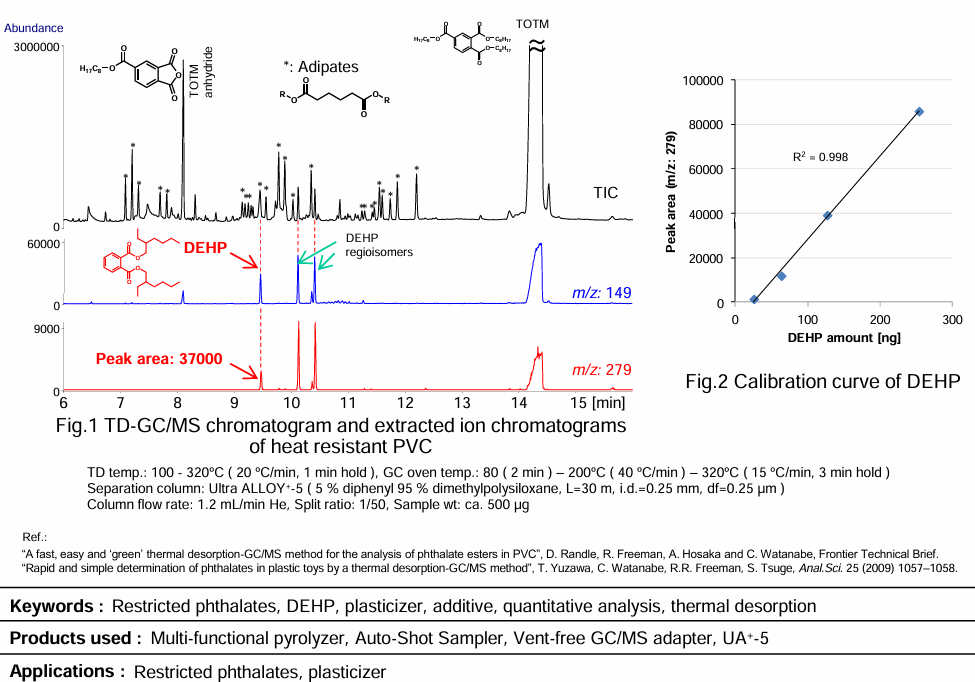
The presence of DEHP was confirmed using characteristic mass-to-charge ratios.
The application used:
- m/z 149
- m/z 279
for identification and confirmation of DEHP.
The total ion chromatogram (TIC) and extracted ion chromatograms (EICs) showed the DEHP peak along with other compounds present in the heat-resistant PVC sample.
The analysis also detected two positional isomers of DEHP (regioisomers), tris(2-ethylhexyl) trimellitate (TOTM), and TOTM anhydride.
Quantitative Analysis of DEHP
Quantification was performed using an absolute area calibration curve based on m/z 279.
The calibration curve showed good linearity:
y = 376.15x − 9553.5
with:
R² = 0.9979
The ASTM method recommends standard addition for quantification when other plasticizers may interfere with the DEHP measurement.
In the sample analyzed in this application, the plasticizers were trimellitates and adipates, and no interference with the selected DEHP ions was observed.
DEHP Concentration in Heat-Resistant PVC
The concentration of DEHP determined in the heat-resistant PVC sample was:
245 ppm
The measurement was performed with:
- n = 3
- RSD = 0.7%
The low relative standard deviation demonstrates the repeatability obtained for the quantitative TD-GC/MS measurement in this application.
Advantages of Thermal Desorption for Phthalate Analysis
Conventional phthalate analysis can involve solvent extraction and additional sample-preparation steps.
Thermal desorption-GC/MS offers an alternative by introducing the PVC sample directly into a controlled heating process.
Potential advantages include:
- Minimal sample preparation
- Direct analysis of the PVC material
- Reduced solvent requirements
- Efficient analysis of plasticizers
- GC separation of thermally desorbed compounds
- Mass spectrometric identification
- Quantitative determination of DEHP
For laboratories analyzing PVC materials, this can provide a streamlined approach to phthalate analysis.
Other Phthalates and Plasticizers in PVC
PVC formulations may contain different plasticizers depending on the required material properties.
Examples of phthalates commonly monitored in PVC analysis include:
- DEHP – Di(2-ethylhexyl) phthalate
- DBP – Dibutyl phthalate
- BBP – Butyl benzyl phthalate
- DINP – Diisononyl phthalate
- DIDP – Diisodecyl phthalate
- DNOP – Di(n-octyl) phthalate
Other plasticizers may also be present and can potentially affect quantitative analysis.
Therefore, appropriate identification and quantification conditions are important when analyzing complex PVC formulations.
Multi-functional Pyrolyzer for DEHP Analysis
The EGA/PY-3030D Multi-functional Pyrolyzer was used as the thermal desorption unit in this application.
The pyrolyzer was directly interfaced with the GC/MS system, enabling the PVC sample to be thermally desorbed before GC/MS analysis.
The system configuration included:
- EGA/PY-3030D Multi-functional Pyrolyzer
- Auto-Shot Sampler
- Vent-free GC/MS adapter
- UA+-5 separation column
This configuration can be used for applications involving thermal desorption, evolved gas analysis, analytical pyrolysis, and polymer characterization.
Applications of TD-GC/MS for PVC and Polymer Analysis
TD-GC/MS can be useful for laboratories studying plasticizers and additives in polymer materials.
Potential applications include:
- DEHP analysis in PVC
- Restricted phthalate analysis
- Plasticizer characterization
- PVC additive analysis
- Polymer quality control
- Cable and wire material analysis
- Thermal desorption studies
- Polymer characterization
The technique can be particularly useful when laboratories need to analyze small quantities of polymer material while reducing conventional extraction steps.
Why This Application Matters for PVC Analysis
Reliable determination of restricted phthalates is important when evaluating PVC materials.
The ASTM D7823-14 approach demonstrated in this application combines thermal desorption, GC separation, and MS detection to quantify DEHP in a heat-resistant PVC cable sheath.
The analysis achieved a measured DEHP concentration of 245 ppm with an RSD of 0.7%, demonstrating the quantitative capability of the described TD-GC/MS workflow.
Conclusion
Quantitative DEHP analysis in PVC is important for studying plasticizer content and supporting material quality and regulatory assessment.
The Frontier Laboratories application demonstrates the use of ASTM D7823-14 thermal desorption-GC/MS for determining DEHP in the outside sheath of a commercial-grade heat-resistant PVC cable.
Using approximately 500 µg of PVC sample, the analysis identified DEHP using characteristic ions at m/z 149 and 279 and quantified the compound using an absolute area calibration curve.
The measured DEHP concentration was 245 ppm (n=3, RSD=0.7%).
The EGA/PY-3030D Multi-functional Pyrolyzer, together with the Auto-Shot Sampler, Vent-free GC/MS adapter, and UA+-5 column, provides a GC/MS-based configuration for thermal desorption analysis of PVC materials.
For laboratories working on PVC characterization, phthalate analysis, plasticizer determination, and polymer analysis, TD-GC/MS provides a useful analytical approach with minimal sample preparation.
Contact
Frequently Asked Questions (FAQs)
DEHP, or bis(2-ethylhexyl) phthalate, is a phthalate ester used as a plasticizer in PVC formulations. Its presence in materials may be subject to regulatory restrictions.
DEHP can be analyzed using thermal desorption-GC/MS, where the PVC sample is heated and the released compounds are separated by GC and detected using MS.
This application uses ASTM D7823-14 for thermal desorption-GC/MS analysis of phthalates in PVC.
Approximately 500 µg of PVC thin film was placed in an inert stainless-steel sample cup.
The application used m/z 149 and m/z 279 for DEHP identification and confirmation.
The DEHP concentration was measured at 245 ppm, with n=3 and an RSD of 0.7%.
The analysis used the EGA/PY-3030D Multi-functional Pyrolyzer interfaced directly with the GC/MS system.
TD-GC/MS can reduce sample-preparation requirements by thermally desorbing compounds directly from the PVC sample, reducing the need for conventional solvent extraction.
Yes. TD-GC/MS can be used to investigate plasticizers and other thermally desorbed compounds in polymer materials, including PVC.
Applications can include PVC cable sheaths, films, flexible PVC products, plastic components, and other plasticized PVC materials, depending on the analytical objective.