Correlation Between Evolved Gas Analysis (EGA) and Thermogravimetric Analysis (TGA)
Introduction to EGA and TGA Analysis
Understanding the thermal behaviour of polymers is essential for characterizing their composition and decomposition properties. Evolved Gas Analysis (EGA) and Thermogravimetric Analysis (TGA) are two analytical approaches that provide complementary information about how materials respond to increasing temperatures.
EGA uses a pyrolyzer coupled with gas chromatography and mass spectrometry (GC/MS) to monitor gases released from a sample during controlled heating. TGA measures changes in sample mass as the temperature increases.
Comparing these techniques helps researchers understand the relationship between gas evolution and weight-loss behaviour during polymer decomposition.
What Is Evolved Gas Analysis (EGA)?
Evolved Gas Analysis is a thermal analytical technique in which a sample is heated continuously while the gases released during heating are detected and analysed in real time.
When EGA is performed using a Multi-functional Pyrolyzer coupled with GC/MS, the resulting EGA curve provides information about volatile components and the temperatures at which thermal decomposition begins and ends.
The mass spectrometer also enables identification of evolved compounds. Selected Ion Monitoring (SIM) can be used to follow the evolution profile of individual compounds, providing additional information beyond the overall thermal response.
Key Benefits of EGA
Monitors gases released during continuous heating.
Helps identify the temperature ranges associated with thermal decomposition.
Enables identification of evolved materials using mass spectrometry.
Supports monitoring of selected compounds using SIM.
Allows high-boiling materials to be cleaned from the analytical system after measurement.
What Is Thermogravimetric Analysis (TGA)?
Thermogravimetric Analysis measures changes in a sample’s mass as a function of temperature during a controlled heating programme.
For polymer analysis, TGA provides information about weight-loss behaviour and the temperature ranges in which mass changes occur. This information can be compared with EGA results to understand how gas evolution relates to the thermal decomposition process.
Although EGA and TGA provide different types of measurements, their results can show a useful correlation when evaluating polymer thermal behaviour.
Correlating EGA and TGA Results for Polymer Analysis
Combining EGA and TGA data provides complementary perspectives on polymer decomposition.
TGA records changes in sample mass, while EGA monitors the gases released as the sample is heated. Comparing the resulting curves helps researchers relate mass-loss events to evolved-gas profiles.
This correlation is useful for investigating the thermal behaviour of polymer materials and identifying temperature ranges associated with decomposition.
Case Study: Polyvinyl Acetate (PVAc)
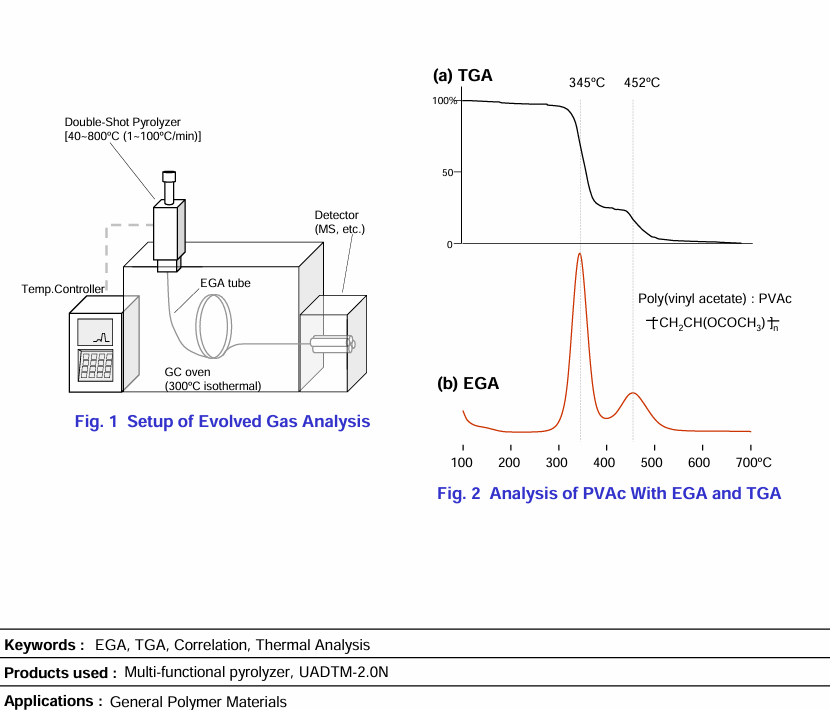
Polyvinyl acetate (PVAc) was used to demonstrate the correlation between EGA and TGA results.
The EGA curve obtained for PVAc showed good correlation with the corresponding TGA data. The comparison demonstrated that the two techniques can provide consistent information about the material’s thermal behaviour.
The results illustrate how EGA can complement conventional thermogravimetric measurements by adding information about the gases evolved during heating.
EGA-GC/MS Instrument Configuration
The EGA system uses a Multi-functional Pyrolyzer coupled with a GC/MS system.
In the described configuration, the GC injection port and detector are connected through a deactivated metal capillary tube. The tube is 2.5 m long, has an internal diameter of 0.15 mm, and is maintained isothermally at 300°C inside the GC oven.
During analysis, the sample temperature is increased continuously, and the evolved gases pass through the analytical system for detection.
This configuration enables the measurement of an EGA profile while using mass spectrometry to identify evolved materials.
EGA vs. TGA: Understanding the Difference
EGA and TGA measure different aspects of a material’s response to heat.
| Feature | EGA | TGA |
|---|---|---|
| Primary measurement | Gases evolved during heating | Changes in sample mass |
| Main information | Evolved compounds and their temperature profiles | Weight-loss behaviour |
| Compound identification | Possible using mass spectrometry | Not provided directly by mass measurement alone |
| Selected compound monitoring | Possible using SIM | Not provided directly |
| Application | Investigating evolved gases and thermal decomposition | Evaluating thermal mass changes |
Using both approaches can provide a more complete understanding of polymer thermal behaviour than relying on weight-loss data alone.
Applications of EGA in Polymer Thermal Characterization
EGA-GC/MS can support polymer research by providing information about volatile components and thermal decomposition behaviour.
Potential applications include:
Polymer characterization: Investigating evolved gases released during heating.
Thermal decomposition studies: Identifying temperature ranges associated with gas evolution.
Material comparison: Comparing EGA profiles with thermogravimetric data.
Compound identification: Using mass spectrometry to identify evolved materials.
Targeted analysis: Applying SIM to monitor the evolution profile of selected compounds.
For laboratories in India working with polymer materials, EGA-GC/MS can complement conventional thermal analysis by combining temperature-dependent gas monitoring with compound identification.
Multi-functional Pyrolyzer for EGA-GC/MS Analysis
The Frontier Laboratories Multi-functional Pyrolyzer can be used to perform Evolved Gas Analysis in combination with GC/MS.
This approach provides information about evolved gases during controlled heating and supports the identification of volatile components through mass spectrometry.
Compared with conventional TGA measurements alone, the EGA-GC/MS configuration offers additional information about the chemical identity of evolved materials, along with the option to monitor selected compounds and clean high-boiling residues from the system after analysis.
Conclusion
EGA and TGA provide complementary information for understanding polymer thermal behaviour. While TGA measures changes in sample mass during heating, EGA monitors the gases released and helps identify evolved compounds.
The good correlation observed between EGA and TGA results for polyvinyl acetate demonstrates the value of comparing these analytical approaches. When coupled with GC/MS, EGA provides additional insight into volatile components and thermal decomposition, making it a useful technique for polymer characterization and thermal analysis research.
Contact
Frequently Asked Questions (FAQs)
Evolved Gas Analysis (EGA) is a thermal analytical technique that monitors gases released from a sample during continuous heating. When coupled with GC/MS, it can also help identify the evolved compounds.
EGA monitors gases released during heating, whereas TGA measures changes in sample mass. Comparing the results helps researchers understand the relationship between gas evolution and weight-loss behaviour.
Yes. EGA can be performed using a pyrolyzer coupled with GC/MS. Mass spectrometry helps identify evolved materials, and Selected Ion Monitoring can be used to follow individual compounds.
Polyvinyl acetate (PVAc) was used to demonstrate the correlation between the EGA curve and TGA data.
EGA-GC/MS provides information about evolved gases and can identify compounds using mass spectrometry. It can also monitor selected compounds and allows high-boiling materials to be cleaned from the analytical system after analysis.