Advanced Polyethylene Analysis Using Py-GC/MS for Trace-Level Detection
Introduction
Polyethylene (PE) is one of the most widely used polymers and is commonly found in packaging, consumer products, industrial materials, and environmental samples. As concerns surrounding microplastics and trace polymer contamination continue to increase, highly sensitive analytical methods are essential for detecting small quantities of polyethylene.
Pyrolysis-Gas Chromatography/Mass Spectrometry (Py-GC/MS) is an effective technique for polymer identification and analysis. However, trace-level polyethylene analysis can be challenging because PE is difficult to dissolve at room temperature and produces numerous pyrolysis products, including high-boiling-point compounds.
A F-Splitless Injection method using a Multi-Functional Splitless Sampler (MFS) provides a solution by allowing a high proportion of the pyrolyzates generated from polyethylene to be introduced into the GC/MS system.
The results demonstrate the potential of F-Splitless Injection for high-sensitivity detection of trace amounts of polyethylene.
Why Is Trace Polyethylene Detection Challenging?
Polyethylene presents several challenges during conventional analytical workflows.
First, PE is insoluble in solvents at room temperature, making traditional extraction and concentration procedures difficult.
Second, pyrolysis of polyethylene generates many pyrolyzates with relatively high boiling points. These compounds can increase analysis time and potentially affect the performance of the analytical system.
Another important consideration is sample introduction efficiency. In conventional split injection, only a fraction of the generated pyrolyzates is transferred to the GC column. For trace-level analysis, this can significantly reduce the amount of analyte reaching the detector.
F-Splitless Injection addresses this limitation by introducing a much larger proportion of the pyrolyzates into the separation column.
What Is F-Splitless Injection?
F-Splitless Injection is an injection approach designed for highly efficient introduction of pyrolyzates into the GC/MS system.
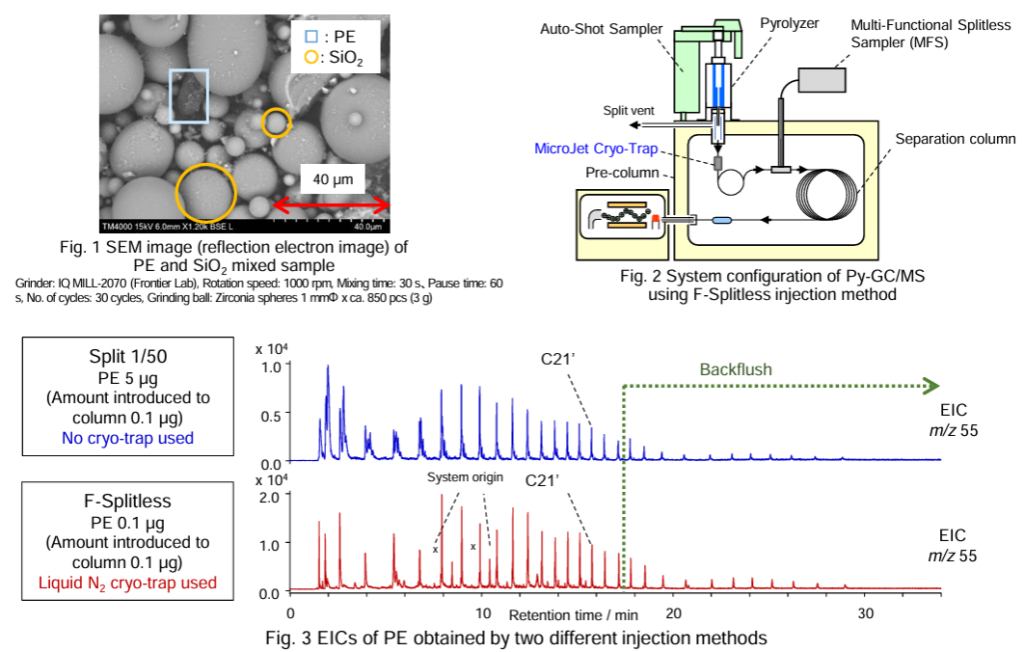
In the reported study, a Multi-Functional Splitless Sampler (MFS) was integrated with a Multi-Shot Pyrolyzer and GC/MS system.
The approach allows the pyrolyzates generated from a PE sample to be transferred efficiently to the separation column rather than being substantially reduced through conventional split injection.
The system can also use a backflush function to purge high-boiling-point compounds, helping to reduce the impact of these compounds on the analytical workflow.
Experimental Approach
For the experiment, polyethylene particles with a particle size of approximately 10 µm were homogeneously mixed with silicon dioxide (SiO₂).
Approximately:
- 1 mg of PE
- 999 mg of SiO₂
were mixed together, resulting in a 1,000-fold dilution of polyethylene.
The mixture was prepared using a grinder and subsequently analyzed using a Py-GC/MS system equipped with the Multi-Functional Splitless Sampler.
The performance of F-Splitless Injection was compared with conventional split injection at a 1/50 split ratio.
Comparing Split and F-Splitless Injection
The study compared the extracted ion chromatograms (EICs) of polyethylene pyrolyzates using m/z 55, focusing on the characteristic pyrolyzate C21′ (monoene).
With conventional split injection:
- 5 µg of PE was used.
- A 1/50 split ratio was applied.
- Approximately 0.1 µg was introduced to the separation column.
With F-Splitless Injection:
- 0.1 µg of PE was used.
- Approximately 0.1 µg was introduced to the separation column.
Despite using a substantially smaller initial PE amount, the F-Splitless method produced peak intensities that were equal to or greater than those obtained with split injection.
This indicates that almost the full amount of the generated pyrolyzates could be introduced into the GC column using F-Splitless Injection.
C21′ as a Characteristic Polyethylene Pyrolyzate
To evaluate polyethylene detection, C21′ (monoene) was selected as a characteristic pyrolyzate.
The target compound was monitored at m/z 55 using extracted ion chromatograms.
C21′ provides a useful analytical indicator for polyethylene because the pyrolysis of PE generates a series of characteristic hydrocarbon products.
Monitoring a specific pyrolyzate can improve the ability to evaluate PE at low concentrations, particularly when combined with Selected Ion Monitoring (SIM).
Improved Signal-to-Noise Ratio
The signal-to-noise ratio (S/N) is particularly important when detecting trace amounts of polymer.
The study evaluated the S/N of the C21′ peak under three different conditions:
Method / MS Mode | PE Amount | S/N of C21′ |
Split 1/50 / Scan | 0.1 µg | 1.8 |
F-Splitless / Scan | 0.01 µg | 12 |
F-Splitless / SIM | 0.01 µg | 188 |
The results demonstrate a substantial improvement in sensitivity with F-Splitless Injection.
When F-Splitless Injection was combined with SIM, the C21′ peak showed an S/N of 188, compared with an S/N of only 1.8 for the split injection and scan condition.
Considering both the sample amount and S/N, the study indicates that F-Splitless Injection with SIM can provide approximately 1,000 times greater sensitivity than split injection with scan mode under the tested conditions.
Calibration Curves and Linearity
Calibration curves were prepared by measuring the C21′ peak area at different polyethylene concentrations.
The results showed good linear responses over approximately three orders of concentration for the F-Splitless Injection methods.
The reported coefficients of determination were:
Method | MS Mode | R² |
Split 1/50 | Scan | 0.9907 |
F-Splitless | Scan | 0.9987 |
F-Splitless | SIM | 0.9891 |
These results demonstrate that F-Splitless Injection can provide a strong analytical response across a broad concentration range while offering improved sensitivity for low-level PE detection.
Reproducibility of Polyethylene Detection
The reproducibility of C21′ peak area was evaluated using the relative standard deviation (RSD) from five measurements.
The reported results were:
Injection Method | MS Mode | PE Amount | RSD |
Split 1/50 | Scan | 0.1 µg | 3.3% |
F-Splitless | Scan | 0.1 µg | 20.0% |
F-Splitless | SIM | 0.1 µg | 10.7% |
Although conventional split injection demonstrated better reproducibility in this evaluation, the F-Splitless method provided a significant advantage in analytical sensitivity.
For trace polyethylene and microplastics applications, the increased sensitivity can be particularly valuable when the available sample amount is extremely small.
Role of the Multi-Functional Splitless Sampler
The Multi-Functional Splitless Sampler (MFS) plays an important role in the F-Splitless workflow.
The system can support efficient transfer of pyrolyzates from the pyrolyzer to the GC separation column.
Another useful feature is the backflush function, which can help remove high-boiling-point compounds from the system.
This can contribute to:
- Efficient sample introduction
- Improved detection sensitivity
- Reduced influence of high-boiling compounds
- More efficient analytical workflows
- Trace-level polymer analysis
F-Splitless Injection for Microplastics Analysis
Microplastics analysis often requires the detection of very small quantities of polymers in complex samples.
Because Py-GC/MS identifies polymers through their characteristic pyrolysis products, it can provide chemical information that complements particle-based analytical techniques.
The improved sample introduction efficiency of F-Splitless Injection makes it particularly relevant for applications involving trace amounts of polyethylene.
Potential applications include:
Environmental Analysis
Detection and characterization of polyethylene in environmental samples such as water, sediment, and soil.
Microplastics Research
High-sensitivity analysis of polyethylene particles in microplastics investigations.
Trace Polymer Analysis
Detection of very small quantities of PE where conventional injection methods may not provide sufficient sensitivity.
General Polymer Analysis
Identification and characterization of polyethylene-containing materials.
Key Advantages of F-Splitless Injection
The study highlights several important benefits of the F-Splitless approach.
1. High Sensitivity
A larger proportion of pyrolyzates can reach the GC column, improving the ability to detect trace amounts of PE.
2. Efficient Sample Introduction
The results indicate that nearly the full amount of pyrolyzates can be introduced into the separation column.
3. Strong S/N Performance
F-Splitless Injection combined with SIM produced a significantly higher S/N for the characteristic C21′ pyrolyzate.
4. Broad Calibration Response
The F-Splitless method demonstrated good linearity over approximately three orders of concentration.
5. Suitable for Trace Analysis
The method can be useful when only very small quantities of polyethylene are available for analysis.
Py-GC/MS Conditions Used in the Study
The representative analytical conditions included:
Parameter | Condition |
Furnace temperature | 600 °C |
Furnace-interface temperature | 300 °C |
GC injector temperature | 300 °C |
Injector pressure | 150 kPa |
Initial column flow | 2 mL/min |
Pre-column | UA+-50 |
Main column | UA+-5 |
GC/MS interface temperature | 300 °C |
MS scan range | m/z 29–550 |
SIM dwell time | 200 ms |
Backflush start time | 17.5 min |
A Multi-Shot Pyrolyzer, Multi-Functional Splitless Sampler, Auto-Shot Sampler, cryo-trap, pre-column, and separation column were used as part of the analytical configuration.
Applications of High-Sensitivity PE Detection
The combination of Py-GC/MS and F-Splitless Injection can support several areas of research and analysis, including:
- Microplastics analysis
- Environmental analysis
- Trace polyethylene detection
- Polymer identification
- General polymer analysis
- Polymer mixture characterization
- Environmental contamination research
- Analytical research involving low sample quantities
The method is particularly useful when sensitivity is a priority and only trace quantities of polyethylene are available.
Conclusion
Detecting trace amounts of polyethylene can be challenging with conventional analytical methods. Py-GC/MS combined with F-Splitless Injection provides an effective approach for improving sample introduction efficiency and enhancing the detection of characteristic PE pyrolyzates.
The study demonstrated that F-Splitless Injection could achieve peak intensities equal to or greater than conventional split injection even when using a substantially smaller amount of polyethylene.
The combination of F-Splitless Injection and SIM provided particularly strong performance, with an S/N of 188 for the C21′ peak compared with 1.8 using split injection with scan mode. Considering both sample amount and S/N, the reported results indicate approximately 1,000-fold higher sensitivity under the tested conditions.
Overall, F-Splitless Injection offers a valuable approach for high-sensitivity polyethylene detection, trace polymer analysis, and microplastics research using Py-GC/MS.
Contact Us:
Frequently Asked Questions (FAQs)
F-Splitless Injection is an injection approach designed to efficiently introduce pyrolyzates into a GC/MS system, allowing a high proportion of the generated compounds to reach the separation column.
Polyethylene is insoluble in many solvents at room temperature and produces numerous pyrolyzates, including high-boiling-point compounds, during pyrolysis.
C21′ (monoene) is a characteristic pyrolyzate of polyethylene and was used as an indicator compound in the reported Py-GC/MS analysis.
F-Splitless Injection can introduce a much larger proportion of the pyrolyzates into the GC column, improving sensitivity for trace-level PE detection.
PE was mixed with SiO₂ at a 1:999 ratio, resulting in a 1,000-fold dilution.
An S/N of 188 was reported for the C21′ peak when 0.01 µg of PE was analyzed using F-Splitless Injection with SIM.
Considering the sample amount and S/N values, the study indicated approximately 1,000-fold greater sensitivity compared with split injection using scan mode.
Yes. The method is applicable to trace polymer analysis and can support microplastics research where high-sensitivity polyethylene detection is required.