Microplastics Analysis in Sediment Samples Using Py-GC/MS: Qualitative and Quantitative Results
Microplastics in environmental samples can consist of different polymer types and may be present at trace levels within complex matrices such as sediment. Identifying and quantifying these polymers requires an analytical approach capable of providing both qualitative and quantitative information.
In this application, pyrolysis gas chromatography/mass spectrometry (Py-GC/MS) combined with the F-Splitless injection method was used to analyze microplastics in a sediment sample.
Using an MP calibration standard and F-Search MPs software, multiple polymer types were qualitatively identified and quantitatively determined.
Analysis of Microplastics in Sediment Samples
Sediment samples can contain different types of microplastics originating from various sources. For environmental analysis, determining the polymer composition of these particles is important for understanding the characteristics of the sample.
The PYA1-151E study focuses on the qualitative and quantitative analysis of microplastics in sediment samples using Py-GC/MS.
Approximately 4 mg of sediment sample was analyzed using the analytical system described in the technical note.
Py-GC/MS for Microplastics Analysis
Py-GC/MS provides a way to characterize polymer materials by thermally decomposing them and analyzing the resulting products by GC/MS.
In this study, the sediment sample was analyzed at a pyrolysis temperature of 600 °C using the F-Splitless injection method.
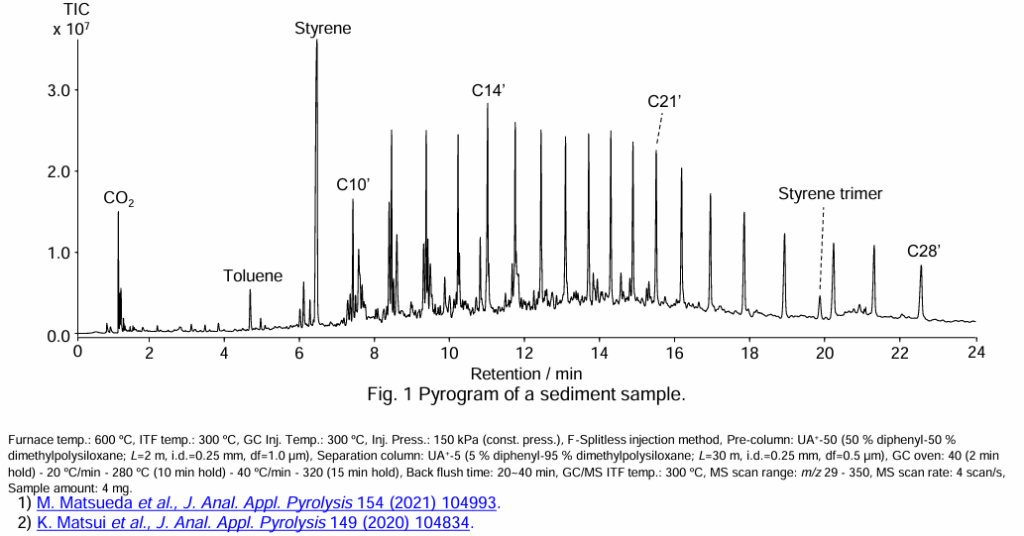
The resulting pyrogram contained characteristic compounds that could be used for polymer identification.
Among the compounds detected in the pyrogram were:
- Styrene monomer
- Toluene
- Styrene trimer
- Linear hydrocarbons
- CO₂
These pyrolysis products provided information used for the qualitative analysis of polymers in the sediment sample.
F-Splitless Injection Method for Trace Microplastics
The PYA1-151E technical note follows the previous investigation described in PYA1-150E.
In the previous study, offshore sediment samples were analyzed using Py-GC/MS, and the F-Splitless injection method demonstrated higher sensitivity for microplastic detection than the split injection method.
Based on this previous result, the F-Splitless method was applied in PYA1-151E for the qualitative and quantitative analysis of microplastics in sediment.
Combining Py-GC/MS with F-Search MPs
The analysis used F-Search MPs software for qualitative and quantitative determination of the microplastics.
An MP calibration standard, consisting of a polymer-silica mixture with known polymer contents, was used to generate calibration curves for the polymer components.
This approach enabled the researchers to obtain both:
- Qualitative information — identification of polymer types
- Quantitative information — determination of polymer quantities
Qualitative Identification of Microplastics
Several polymer types were identified in the sediment sample.
The analysis detected:
Polymer | Full Name | Matching Probability |
PE | Polyethylene | 98.6% |
PP | Polypropylene | 90.4% |
PS | Polystyrene | 99.0% |
PMMA | Polymethylmethacrylate | 99.9% |
PET | Polyethylene terephthalate | 90.8% |
N66 | Nylon 6,6 | 87.1% |
According to the technical note, PE was the most abundant polymer detected in the sediment sample.
Quantitative Analysis of Microplastics
The MP calibration standard was used to establish calibration curves for polymer quantification.
The quantitative results obtained from the 4.047 mg sediment sample were:
Polymer | Quantitative Value |
PE | 10.22 µg |
PP | 0.23 µg |
PS | 1.12 µg |
PMMA | 0.15 µg |
PET | 0.12 µg |
N66 | 0.25 µg |
The results demonstrate that the analytical method was able to provide quantitative information for multiple polymer types within the sediment sample.
What the Pyrogram Reveals
The pyrogram of the sediment sample showed several characteristic peaks.
Styrene was one of the major compounds detected, together with toluene, styrene trimer, linear hydrocarbons, and CO₂.
These characteristic pyrolysis products contribute to the identification of polymer components in the sample.
Suggested visual:
Use Figure 1 — Pyrogram of a sediment sample from PYA1-151E here.
This section would also be a good opportunity to explain the relationship between pyrolysis products and polymer identification without overcomplicating the analytical principle.
Qualitative and Quantitative Microplastics Analysis in One Workflow
One of the key aspects of the PYA1-151E application is the combination of qualitative and quantitative analysis.
The workflow can be summarized as:
Sediment Sample
↓
Pyrolysis at 600 °C
↓
F-Splitless Injection
↓
GC/MS Analysis
↓
Pyrogram Generation
↓
F-Search MPs
↓
Polymer Identification
↓
Quantitative Determination
This workflow allows different polymer types to be identified and their quantities to be determined using the MP calibration standard.
Applications of Microplastics Analysis
The analytical approach demonstrated in this technical note is relevant to:
- Environmental sample analysis
- Sediment sample analysis
- Seabed sample analysis
- Trace microplastics analysis
- General polymer analysis
The technical note specifically lists Environmental analysis, Trace analysis, and General polymer analysis as applications.
Analytical System Used
The technical note used the following Frontier Laboratories products:
- Multi-Shot Pyrolyzer
- Multi-Functional Splitless Sampler
- Auto-Shot Sampler
- MicroJet Cryo-Trap
- Eco-Cup LF
- GC glass insert with filler
- UAMP column kit
- Vent-free GC/MS adapter
- F-Search MPs 2.1
These components were used as part of the Py-GC/MS analytical system for sediment microplastics analysis.
Key Findings from PYA1-151E
The study demonstrated that microplastics in a sediment sample could be qualitatively and quantitatively determined using the F-Splitless injection method, an MP calibration standard, and F-Search MPs.
The main findings include:
- Multiple polymer types were identified.
- PE was the most abundant polymer in the analyzed sample.
- PP, PS, PMMA, PET, and N66 were also detected.
- The method provided quantitative values for the identified polymers.
- F-Search MPs was used for both qualitative and quantitative analysis.
- The analyzed sediment sample weighed approximately 4.047 mg.
Frequently Asked Questions
Microplastics analysis involves identifying and, where applicable, quantifying polymer materials present as microplastics in samples such as sediment.
Py-GC/MS thermally decomposes polymer materials and analyzes the resulting pyrolysis products by GC/MS. These products can provide information useful for polymer identification.
PE, PP, PS, PMMA, PET, and N66 were identified in the analyzed sediment sample.
F-Search MPs is software used to support polymer identification from pyrolysis data. In PYA1-167E, it was combined with a Microplastics Analysis Library to analyze the complex pyrogram of a multilayer film.
PE was the most abundant polymer reported in the sediment sample.
Yes. In this application, an MP calibration standard was used to create calibration curves, allowing quantitative values to be determined for the identified polymers.
The application analyzed a sediment sample containing trace microplastics.
Need to Analyze Microplastics in Sediment Samples?
Explore Frontier Laboratories’ Py-GC/MS solutions for microplastics and polymer analysis to support qualitative and quantitative characterization of environmental samples.
Learn more about Frontier Laboratories’ microplastics analysis solutions or contact Frontier Lab SEA to discuss your analytical requirements.
[F-Search MPs →]
[Microplastics Analysis Applications →]
[Related Microplastics & Polymer Analysis Blogs →]
[PYA1-150E — Part 1Technical Note →]