Introduction
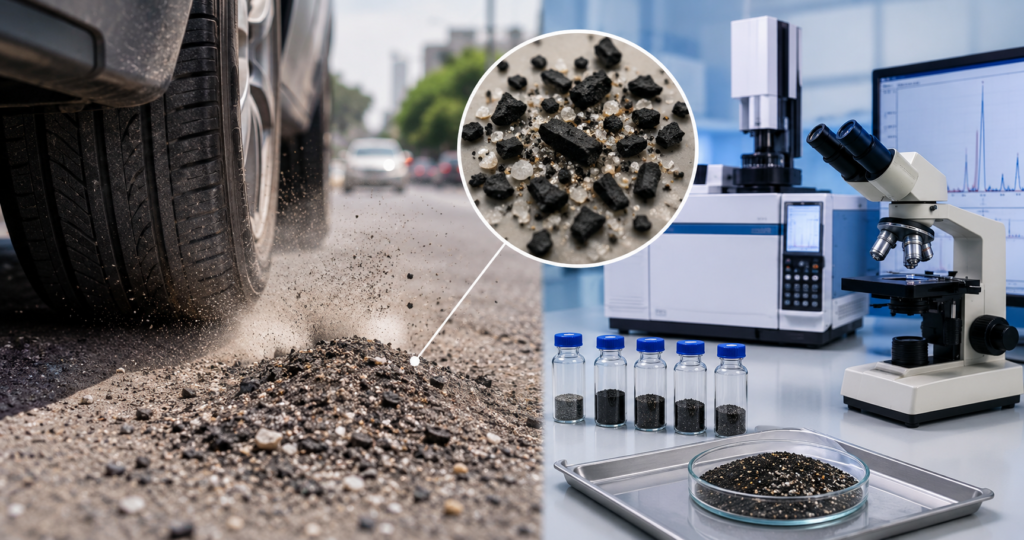
Microplastic pollution has become one of the most pressing environmental challenges worldwide. Tiny plastic particles, known as microplastics (MPs), are now found in oceans, rivers, soil, and even the food chain, raising concerns about their impact on ecosystems and human health.
Accurate identification of these plastic fragments is essential for environmental monitoring and pollution control. Pyrolysis-Gas Chromatography/Mass Spectrometry (Py-GC/MS) has emerged as a powerful analytical technique that enables rapid and reliable identification of different polymer types without extensive sample preparation.
This article explores how Frontier Laboratories’ Multi-Shot Pyrolyzer® was used to identify marine microplastics collected from Osaka Bay, demonstrating the effectiveness of Py-GC/MS in environmental research.
What Are Microplastics?
Microplastics are plastic particles measuring less than 5 mm in size. They originate from the breakdown of larger plastic waste through:
- Ocean wave action
- Sunlight (photo-oxidation)
- Mechanical abrasion
- Weathering
- Environmental degradation
Once released into the environment, these tiny particles are extremely difficult to remove and can be ingested by marine organisms, eventually entering the human food chain.
Why Identifying Microplastics Matters
Different plastic polymers behave differently in the environment. Identifying their composition helps researchers:
- Track pollution sources
- Study degradation patterns
- Assess ecological risks
- Support environmental regulations
- Develop recycling and waste management strategies
Fast and accurate polymer identification is therefore essential for environmental laboratories worldwide.
Why Use Pyrolysis-GC/MS?
Pyrolysis-GC/MS is considered one of the most effective techniques for polymer identification.
During analysis:
- A tiny plastic sample is heated rapidly.
- The polymer decomposes into characteristic chemical fragments.
- These fragments are separated using Gas Chromatography (GC).
- A Mass Spectrometer (MS) identifies the compounds.
- Software compares the results with spectral libraries for polymer identification.
Each polymer produces a unique chemical fingerprint, making identification highly reliable.
Instrumentation Used
The analysis was performed using Frontier Laboratories’ Multi-Shot Pyrolyzer® (EGA/PY-3030D) directly connected to a GC/MS system.
Products Used
- Multi-Shot Pyrolyzer® (EGA/PY-3030D)
- Auto-Shot Sampler
- Eco-Cup LF (80 µL)
- UA+-5 GC Column
- Vent-Free GC/MS Adapter
- F-Search Polymer Library
This integrated setup enables rapid and automated polymer analysis with excellent reproducibility.
Experimental Procedure
Researchers collected three different white microplastic samples from the surface waters of Osaka Bay, Japan.
Sample Preparation
- White marine microplastics were selected.
- Samples were cut into approximately 1 mm squares.
- Each sample was placed inside an Eco-Cup LF.
- The cup was automatically dropped into the pyrolyzer.
Pyrolysis Conditions
- Pyrolysis Temperature: 600°C
- GC Injector Temperature: 300°C
- Helium Carrier Gas: 1 mL/min
- Split Ratio: 1:16
- GC Column: UA+-5
- Mass Scan Range: m/z 29–350
The high pyrolysis temperature rapidly decomposed the polymers into characteristic pyrolysis products for GC/MS analysis.
Results
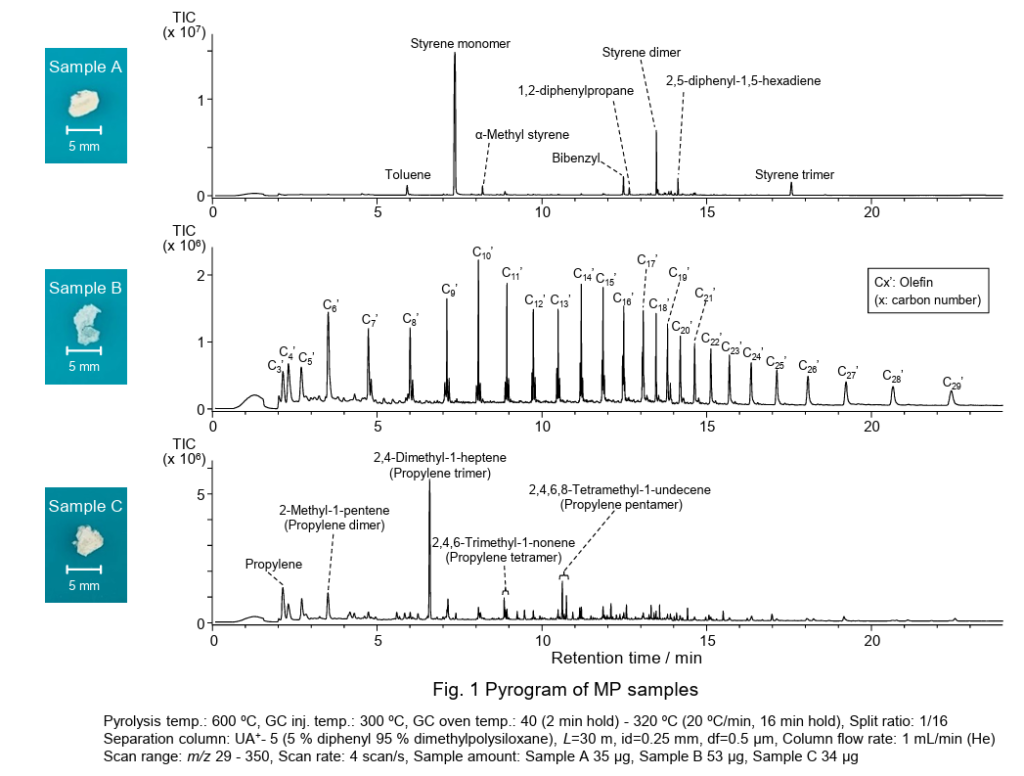
The pyrograms produced distinct chemical fingerprints for each sample.
Using the F-Search “All-In-One” polymer library, researchers successfully identified the polymer types.
Sample Identification
Sample | Polymer Identified |
Sample A | Polystyrene (PS) |
Sample B | Polyethylene (PE) |
Sample C | Polypropylene (PP) |
The analysis clearly distinguished between three visually similar white plastic fragments.
Characteristic Pyrolysis Products
Each polymer generated unique marker compounds.
Polystyrene (PS)
Characteristic compounds included:
- Styrene Monomer
- α-Methyl Styrene
- Styrene Dimer
- Styrene Trimer
- Bibenzyl
- 1,2-Diphenylpropane
These compounds are well-known indicators of polystyrene.
Polypropylene (PP)
Characteristic products included:
- Propylene
- Propylene Dimer
- Propylene Trimer
- Propylene Tetramer
- Propylene Pentamer
These olefin compounds confirm polypropylene.
Polyethylene (PE)
Polyethylene generated a homologous series of linear olefins, another distinctive polymer fingerprint.
Advantages of Pyrolysis-GC/MS for Microplastic Analysis
Minimal Sample Preparation
Only tiny plastic fragments are required, eliminating complex preparation steps.
Rapid Identification
Polymer types can be identified within a single analytical run.
High Sensitivity
Suitable for analyzing very small environmental samples.
Reliable Polymer Fingerprinting
Each plastic produces a unique chromatographic profile for accurate identification.
Library-Based Identification
The F-Search polymer library allows automated comparison and confident material identification.
Broad Polymer Coverage
Suitable for identifying common polymers such as:
- Polyethylene (PE)
- Polypropylene (PP)
- Polystyrene (PS)
- PET
- PVC
- Nylon
- ABS
- Polycarbonate
Applications
Pyrolysis-GC/MS is widely used in:
- Marine pollution studies
- Environmental monitoring
- Waste management research
- Plastic recycling
- Academic research
- Regulatory laboratories
- Forensic investigations
- Industrial quality control
- Polymer failure analysis
Why Frontier Laboratories?
Frontier Laboratories is a global leader in pyrolysis technology. Its Multi-Shot Pyrolyzer® provides:
- Automated operation
- Excellent reproducibility
- Fast polymer identification
- Seamless GC/MS integration
- High analytical accuracy
- Comprehensive polymer library support
These capabilities make it a preferred solution for laboratories analyzing environmental microplastics.
Conclusion
As microplastic pollution continues to threaten marine ecosystems and human health, reliable analytical techniques are essential for understanding and addressing this global challenge.
The study conducted using Frontier Laboratories’ Multi-Shot Pyrolyzer® demonstrated that Pyrolysis-GC/MS can accurately identify visually similar microplastics such as polystyrene, polyethylene, and polypropylene through their unique chemical fingerprints.
With minimal sample preparation, rapid analysis, and high confidence in polymer identification, Py-GC/MS is an indispensable tool for environmental scientists, research institutions, and analytical laboratories committed to monitoring and mitigating plastic pollution.
References: This technical note was developed by Frontier Laboratories Ltd. 4-16-20 Saikon, Koriyama, Fukushima, 963-8862 JAPAN. www.frontier-lab.com