Introduction
Brominated flame retardants (BFRs) are widely used in electrical and electronic products to improve fire safety. However, several brominated compounds, including Decabromodiphenyl Ether (DeBDE), are regulated under the Restriction of Hazardous Substances (RoHS) Directive because of their environmental persistence and potential health risks.
For manufacturers and testing laboratories, accurate detection and quantification of these compounds are essential for regulatory compliance and quality assurance. Modern Thermal Desorption GC/MS (TD-GC/MS) and Pyrolysis-GC/MS solutions enable reliable brominated flame retardant analysis while minimizing sample preparation and improving analytical efficiency.
This study evaluates how optimizing the Pyrolyzer-GC Injector Interface (PY/GC-ITF) and GC injector temperatures in the latest Multi-Shot Pyrolyzer (EGA/PY-3030D) improves analytical performance compared with the previous-generation system.
Understanding Brominated Flame Retardants
Brominated flame retardants are additives incorporated into polymers to reduce flammability. They are commonly found in:
- Electrical equipment
- Consumer electronics
- Printed circuit boards
- Plastic housings
- Automotive components
- Industrial polymers
Among these, Decabromodiphenyl Ether (DeBDE) has historically been one of the most widely used flame retardants and is frequently monitored during RoHS compliance testing.
Why Temperature Optimization Matters
In Thermal Desorption GC/MS, analytical accuracy depends on maintaining the appropriate temperatures throughout the sample introduction pathway.
Incorrect temperatures may cause:
- Thermal decomposition of target compounds
- Adsorption losses within the interface
- Reduced detector sensitivity
- Poor reproducibility
- Shortened injector septum life
Optimizing these temperatures ensures reliable quantitative analysis while protecting instrument components.
Objective of the Study
The study compared two analytical configurations for DeBDE analysis.
Previous System (PY-2020iD)
- PY/GC Interface: 340°C
- GC Injector: 320°C
New Multi-Shot Pyrolyzer (EGA/PY-3030D)
- PY/GC Interface: 300°C
- GC Injector: 300°C
The objective was to determine whether the improved interface design of the EGA/PY-3030D could maintain analytical performance at lower operating temperatures.
Experimental Method
Researchers analyzed a certified polystyrene (PS) reference material containing:
- 317 ppm Decabromodiphenyl Ether (DeBDE)
Thermal desorption GC/MS measurements were performed under identical analytical conditions except for the interface and injector temperatures.
Instrumentation
The study utilized:
- Multi-Shot Pyrolyzer (EGA/PY-3030D)
- Auto-Shot Sampler
- Vent-Free GC/MS Adapter
- Ultra ALLOY-PBDE Separation Column
- GC/MS System
Measurement Conditions
Parameter | Condition |
Pyrolyzer Temperature | 200–340°C |
Heating Rate | 20°C/min |
Carrier Gas | Helium |
Flow Rate | 1 mL/min |
Split Ratio | 1:20 |
GC Oven | 80–300°C |
Sample Amount | 500 µg |
Chromatographic Results
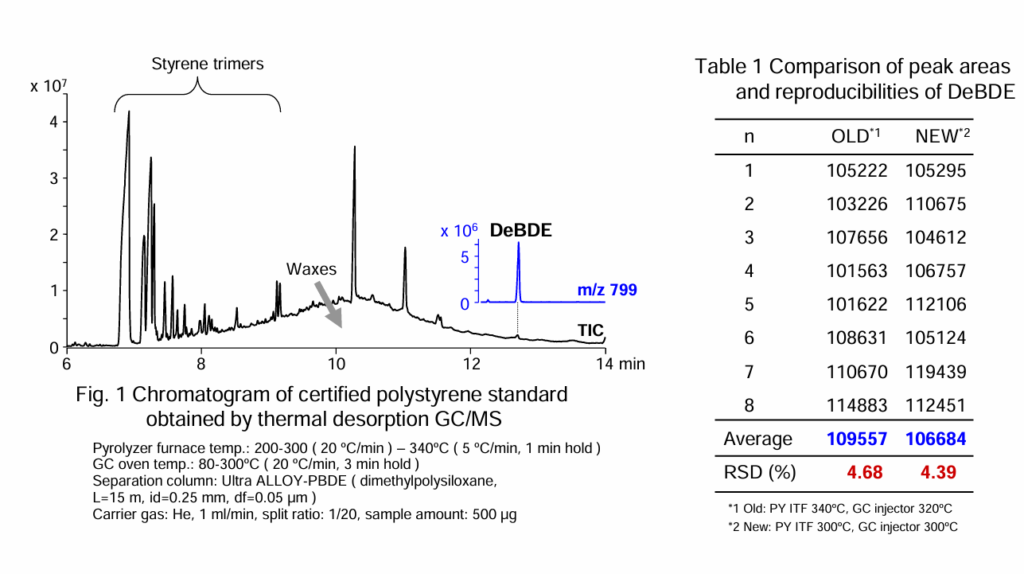
The Thermal Desorption GC/MS chromatogram clearly detected the characteristic ion of Decabromodiphenyl Ether (m/z 799).
Additional components identified included:
- Styrene trimers
- Wax compounds
- Polymer-related constituents
The optimized method produced excellent peak resolution and reliable detection of DeBDE.
Reproducibility Comparison
Eight repeated analyses were performed using both temperature settings.
Previous Conditions
- PY/GC Interface: 340°C
- GC Injector: 320°C
Relative Standard Deviation (RSD): 4.68%
Optimized Conditions
- PY/GC Interface: 300°C
- GC Injector: 300°C
Relative Standard Deviation (RSD): 4.39%
The results demonstrate that lowering the interface temperatures did not compromise analytical precision.
Benefits of Lower Operating Temperatures
The improved interface design of the EGA/PY-3030D provides several advantages:
Reduced Thermal Decomposition
Lower temperatures minimize degradation of sensitive brominated flame retardants.
Improved Instrument Lifetime
Operating at 300°C helps extend GC injector septum life.
Excellent Reproducibility
The optimized method achieved less than 5% RSD across repeated analyses.
Reliable Quantitative Performance
Lower temperatures maintained peak intensity and analytical accuracy while improving operational efficiency.
Applications
Optimized TD-GC/MS is valuable for:
- RoHS compliance testing
- Electrical and electronics manufacturing
- Environmental laboratories
- Polymer quality control
- Flame retardant research
- Material characterization
- Failure analysis
Why Choose TD-GC/MS for Brominated Flame Retardant Analysis?
Compared with conventional analytical methods, TD-GC/MS offers:
- Minimal sample preparation
- Rapid analysis
- Excellent reproducibility
- High sensitivity
- Reliable quantitative performance
- Reduced risk of thermal degradation
These advantages make TD-GC/MS an ideal solution for routine brominated flame retardant analysis.
Conclusion
The study demonstrates that the improved design of the Multi-Shot Pyrolyzer (EGA/PY-3030D) enables accurate brominated flame retardant analysis at lower PY/GC interface and GC injector temperatures than previous-generation systems.
By reducing operating temperatures to 300°C, laboratories can maintain excellent reproducibility while minimizing thermal decomposition and extending instrument component life.
For laboratories involved in Pyrolysis-GC/MS, Thermal Desorption GC/MS, and environmental polymer analysis, optimized analytical conditions provide a reliable approach for accurate RoHS compliance testing and advanced material characterization.
References: This technical note was developed by Frontier Laboratories Ltd. 4-16-20 Saikon, Koriyama, Fukushima, 963-8862 JAPAN. www.frontier-lab.com