Introduction
Polyacrylonitrile (PAN)-based carbon fibers are widely used in high-performance industries due to their exceptional strength, heat resistance, and conductivity. However, the stabilization process plays a crucial role in determining the final material properties. Advanced techniques like carbon fiber thermal analysis systems help researchers understand the complex reactions involved during heat treatment.
In this blog, we explore how Evolved Gas Analysis (EGA)-MS using a Multi-functional Pyrolyzer® helps uncover the stabilization mechanism of PAN-based carbon fiber precursors.
Table of Contents
- Importance of PAN-Based Carbon Fiber
- Understanding Stabilization Mechanism
- EGA-MS Analysis Method
- Experimental Process
- Key Findings and Thermogram Insights
- Reaction Mechanism of PAN
- Advantages of EGA-MS Technique
- Industrial Applications
- Conclusion
Importance of PAN-Based Carbon Fiber
PAN-based carbon fiber is known for:
- High rigidity and mechanical strength
- Low thermal expansion
- Excellent heat resistance
- Superior electrical and thermal conductivity
These properties make it ideal for:
- Aerospace structures
- Automotive components
- Electronics
- Advanced structural materials
The performance of these fibers depends heavily on the stabilization phase, where chemical transformations occur.
Understanding Stabilization Mechanism
Stabilization is a heat-treatment process performed in air, where PAN fibers undergo:
- Cyclization
- Dehydrogenation
- Oxidation
This process converts linear PAN chains into ladder-like structures, improving thermal stability and preparing the material for carbonization.
EGA-MS Analysis Method
To analyze these transformations, Evolved Gas Analysis (EGA)-MS is used. This technique:
- Detects gases released during heating
- Provides insights into chemical reactions
- Helps track structural changes in materials
Using advanced pyrolyzer GC/MS technology, researchers can directly connect thermal decomposition behavior with molecular evolution.
Experimental Process
The experiment involved:
- PAN precursors containing small amounts of comonomers
- Initial heat treatment at 215°C for 20 minutes
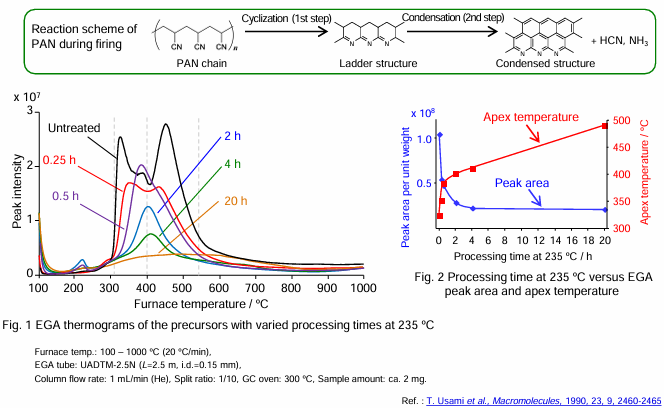
- Further heating at 235°C for varying durations (0.25 to 20 hours)
Samples analyzed:
- Untreated fiber
- Fibers treated for different time intervals
EGA-MS Conditions:
- Temperature range: 100°C to 1000°C
- Heating rate: 20°C/min
- Carrier gas: Helium
- Sample size: ~2 mg
Key Findings and Thermogram Insights
1. Two-Peak Behavior (Early Stage)
Untreated and short-duration samples (15 minutes) showed:
- Low-temperature peak (<250°C):
- PAN chain cleavage
- Dehydrogenation
- HCN elimination
- High-temperature peak:
- Further dehydrogenation
- Ladder structure reactions
2. Single-Peak Behavior (Advanced Stage)
Samples treated for 2 hours or more showed:
- A single thermogram peak
- Reduced peak intensity
- Improved thermal stability
3. Long Duration Effects (20 Hours)
- Lower peak intensity
- Extended thermal profile up to 900°C
- Indicates formation of highly stable condensed structures
Reaction Mechanism of PAN
The stabilization involves two major steps:
1. Cyclization
- Formation of ladder structures
- Release of gases like HCN and NH₃
2. Condensation
- Development of condensed structures
- Increased thermal resistance
This transformation significantly enhances the material’s ability to withstand extreme temperatures.
Advantages of EGA-MS Technique
Using EGA-MS with a pyrolyzer offers:
- Real-time monitoring of gas evolution
- High sensitivity for detecting chemical reactions
- Minimal sample preparation
- Accurate thermal stability assessment
It is a powerful tool for polymer and material characterization.
Industrial Applications
This analysis is highly valuable in:
- Aerospace engineering
- Carbon fiber manufacturing
- Electronics and semiconductor industries
- Advanced material research
Understanding stabilization helps improve:
- Product quality
- Material consistency
- Performance reliability
Conclusion
The stabilization of PAN-based carbon fiber is a complex yet critical process that determines final material performance. By using carbon fiber analysis solutions, researchers can gain deep insights into thermal behavior and chemical transformations.
EGA-MS combined with a Multi-functional Pyrolyzer® provides a reliable and efficient method to study these changes, enabling industries to develop stronger, more durable, and high-performance carbon fiber materials.
To learn more about how EGA-MS combined with a multi-functional pyrolyzer can be used to study the stabilization mechanism of PAN-based carbon fibers through detailed thermal decomposition analysis, simply connect with us.
References: This technical note was developed by Frontier Laboratories Ltd. 4-16-20 Saikon, Koriyama, Fukushima, 963-8862 JAPAN. www.frontier-lab.com