Table of Contents
- Introduction
- What is PPS and Its Importance
- Why Thermal Analysis of PPS Matters
- EGA-MS Technique Overview
- Experimental Method
- Results: Air vs Helium Atmosphere
- Gas Emission Insights
- Industrial Applications
- Conclusion
Introduction
Polyphenylene sulfide (PPS) is widely recognized as a high-performance engineering thermoplastic, extensively used in industries that demand durability, chemical resistance, and thermal stability. However, during high-temperature processing, PPS can release gases that may affect both product quality and manufacturing safety.
To address these challenges, advanced PPS polymer analysis solutions are used to understand thermal degradation and gas evolution behavior. One of the most effective methods is Evolved Gas Analysis (EGA)-MS, which provides detailed insights into decomposition patterns under different atmospheric conditions.
What is PPS and Its Importance
PPS is a semi-crystalline polymer known for:
- Excellent heat resistance
- High chemical stability
- Strong mechanical properties
- Resistance to corrosion
Because of these characteristics, PPS is commonly used in:
- Electrical and electronic components
- Automotive systems
- Industrial machinery
- Aerospace materials
Its ability to withstand extreme conditions makes it valuable, but also requires precise thermal analysis to ensure safe processing.
Why Thermal Analysis of PPS Matters
During molding processes (typically around 320°C), PPS can undergo thermal decomposition. This can result in:
- Release of corrosive gases
- Material degradation
- Reduced product lifespan
Understanding these reactions helps manufacturers:
- Optimize processing temperatures
- Prevent equipment damage
- Improve final product performance
This is where EGA-MS analysis becomes essential.
EGA-MS Technique Overview
Evolved Gas Analysis (EGA)-MS is a powerful analytical method that:
- Monitors gases released during heating
- Identifies chemical compounds via mass spectrometry
- Provides thermal decomposition profiles
Using advanced GC/MS pyrolyzer systems, this technique delivers highly accurate and real-time data for polymer analysis.
Experimental Method
The analysis of PPS was performed using a Multi-Shot Pyrolyzer® (EGA/PY-3030D) connected directly to a GC/MS system.
Key Conditions:
- Sample size: ~0.2 mg
- Temperature range: 100°C to 700°C
- Heating rate: 20°C/min
- GC injector temperature: 300°C
- Carrier gas: Helium
- Split ratio: 1/50
Two atmospheric conditions were tested:
- Air atmosphere
- Helium (inert) atmosphere
This comparison helps identify how oxygen influences PPS decomposition.
Results: Air vs Helium Atmosphere
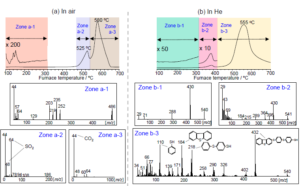
Air Atmosphere Findings
The thermogram revealed two प्रमुख peaks at:
- 525°C
- 580°C
These peaks indicate oxidative degradation of PPS.
Detected Gases:
- Carbon dioxide (CO₂)
- Sulfur dioxide (SO₂)
SO₂ is particularly important, as it is a corrosive gas that can damage processing equipment.
Helium Atmosphere Findings
In contrast, helium atmosphere showed:
- A single peak at 555°C
- Absence of oxidation
- Formation of pyrolysis fragments
Detected Compounds:
- m/z 110
- m/z 184
- m/z 218
- m/z 432
These represent typical PPS decomposition products under inert conditions.
Gas Emission Insights
The study clearly demonstrates that:
- Air atmosphere → Oxidation + corrosive gases (SO₂, CO₂)
- Helium atmosphere → Pure thermal decomposition
This distinction is critical for industries where gas emissions impact:
- Worker safety
- Equipment lifespan
- Environmental compliance
Using polymer thermal analysis technology, manufacturers can predict and control these emissions effectively.
Industrial Applications
EGA-MS analysis of PPS is highly beneficial in:
1. Electronics Industry
Ensures material stability in high-temperature circuits
2. Automotive Sector
Improves durability of under-the-hood components
3. Aerospace Engineering
Supports development of lightweight, heat-resistant materials
4. Polymer Research
Enables innovation in advanced materials
Conclusion
Understanding the thermal decomposition behavior of PPS is essential for improving product quality and ensuring safe manufacturing processes. This study shows that atmospheric conditions significantly influence gas evolution, with air promoting oxidation and helium enabling pure pyrolysis.
By leveraging advanced PPS polymer analysis solutions, industries can gain deeper insights into material behavior, optimize processing conditions, and reduce risks associated with gas emissions.
EGA-MS combined with a Multi-functional Pyrolyzer® stands out as a reliable and efficient method for analyzing high-performance polymers like PPS, making it an essential tool for modern material science and industrial applications.
References: This technical note was developed by Frontier Laboratories Ltd. 4-16-20 Saikon, Koriyama, Fukushima, 963-8862 JAPAN. www.frontier-lab.com