What Is Hidden Inside a Ceramic Composite? Analysis Using EGA-MS and Polymer Library Search
Introduction: Can You Identify Unknown Materials Inside a Ceramic Composite?
A ceramic composite may appear to be a simple inorganic material. But what if it contains several polymer additives introduced during manufacturing?
Identifying these additional components can be challenging, particularly when the sample contains materials with different thermal properties and unknown chemical compositions.
This creates an important analytical question: How can you investigate an unknown composite material when you do not know exactly what is present in the sample?
Evolved Gas Analysis–Mass Spectrometry (EGA-MS) offers a useful starting point.
By monitoring compounds released as a sample is heated, EGA-MS provides information about its thermal behaviour. The resulting mass spectra can then be compared against reference libraries to help identify possible material components.
In one application involving a ceramic composite containing aluminium oxide and manufacturing additives, EGA-MS combined with mass spectral library searching helped identify poly(n-butyl methacrylate) (PBMA) and polystyrene (PS).
The approach also provided clues about other lower-boiling components, demonstrating how thermal analysis and library searching can support the initial investigation of unknown materials.
Why Is Unknown Ceramic Composite Analysis Challenging?
Ceramic composites can contain more than the primary inorganic material. Depending on the manufacturing process, different additives and polymeric materials may be incorporated into the formulation.
When the composition is unknown, identifying these components can be difficult.
Some common analytical challenges include:
1. Multiple components in one sample
A composite material may contain inorganic constituents, polymeric materials and other additives. Their combined signals can make interpretation difficult.
2. Unknown polymer components
The sample may contain polymers that cannot be identified from its appearance or manufacturing description alone.
3. Different thermal behaviours
Different components evolve or decompose at different temperatures. Understanding these temperature-dependent changes can help distinguish the materials present.
4. Similar mass spectral patterns
Some polymers and related materials may produce similar mass spectral information. Using a single identification approach may not provide enough confidence to estimate the sample composition.
An analytical method that combines thermal behaviour with mass spectral library searching can therefore be useful as an initial screening approach.
What Is EGA-MS and How Does It Help Identify Unknown Materials?
Evolved Gas Analysis–Mass Spectrometry (EGA-MS) combines a thermal analysis technique with mass spectrometric detection.
The sample is heated under controlled conditions in a pyrolyzer. Compounds released during heating are transferred to the mass spectrometer, where their mass spectra are recorded.
The resulting EGA curve shows how the evolved compounds change with temperature.
This provides two important types of information:
Thermal behaviour: The temperature regions in which compounds evolve from the sample.
Mass spectral information: The mass-to-charge patterns of the compounds detected in those regions.
By examining the EGA curve and the average mass spectra of individual peaks, analysts can investigate the possible components of an unknown sample.
Why combine EGA-MS with a mass spectral library?
An EGA-MS spectrum can be compared against reference spectra in a library to find possible material matches.
In the reported application, Frontier’s EGA-MS polymer library was used alongside a conventional mass spectral library.
This combined approach helped estimate the composition of an unknown ceramic composite material.
A similar library-search approach is also useful for investigating unknown components in other materials. Explore our application on printer toner analysis using EGA-MS and mass spectral library search.
Case Study: Investigating a Ceramic Composite Containing Aluminium Oxide
The application examined a ceramic composite material in which various additives had been introduced to aluminium oxide during manufacturing.
The objective was to investigate the unknown components using EGA-MS and mass spectral library searching.
The analysis was performed using a Double-Shot Pyrolyzer coupled to a mass spectrometer.
1. EGA-MS analysis of the ceramic composite
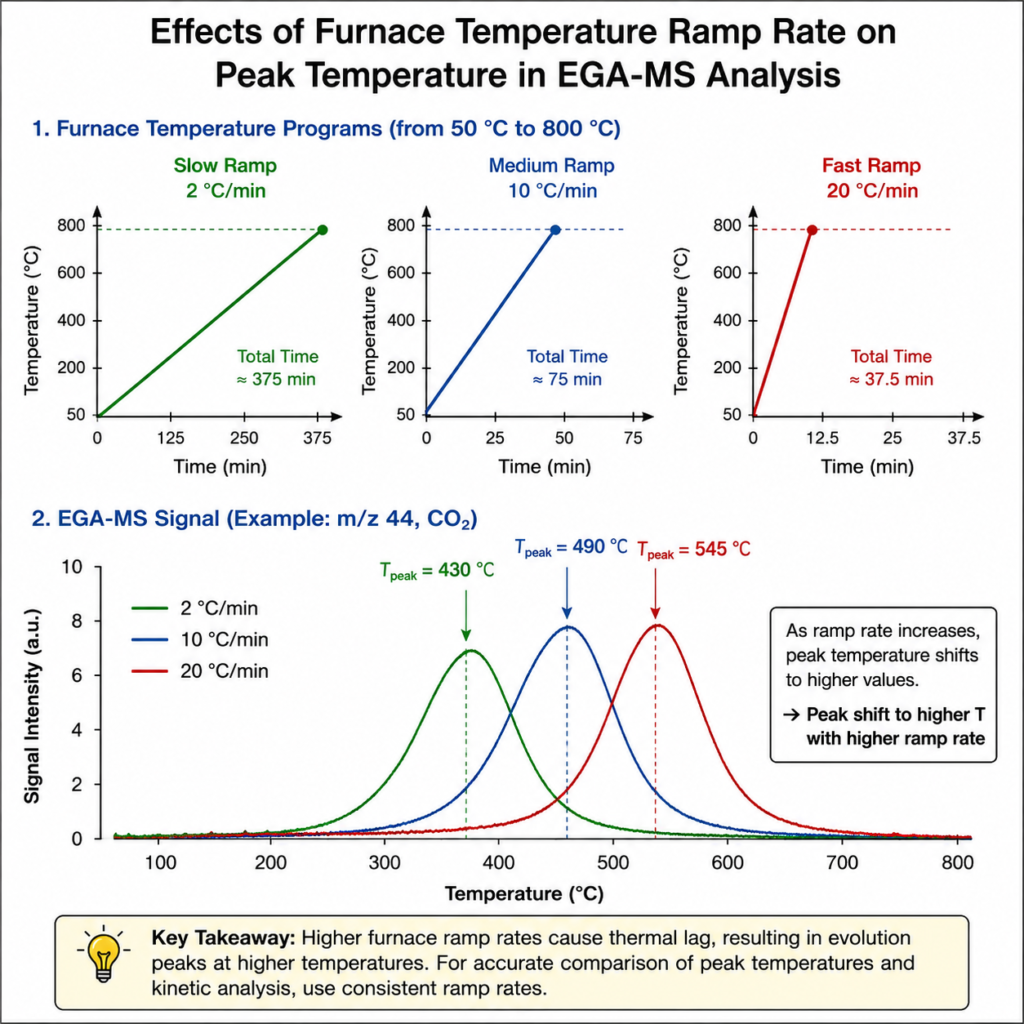
The sample was heated from 100°C to 500°C at a heating rate of 20°C/min.
The resulting EGA curve showed four characteristic regions, identified as peaks A, B, C and D.
Average mass spectra were obtained from these regions, with background noise subtracted before library searching.
The four regions provided different information about the components present in the composite.
2. Identifying peaks C and D using the EGA-MS polymer library
The mass spectra from peaks C and D were searched against Frontier’s EGA-MS polymer library.
The library search produced the following leading matches:
Peak C: Poly(n-butyl methacrylate) (PBMA)
Leading library match: Poly(n-butyl methacrylate) (PBMA)
Reported hit quality: 72
Other listed matches included poly(2-hydroxyethyl methacrylate) and a higher methacrylate copolymer.
Peak D: Polystyrene (PS)
Leading library match: Polystyrene (PS)
Reported hit quality: 90
Other listed matches included styrene-ethylene-butadiene-styrene block copolymer and modified poly(phenylene oxide).
These results indicated that PBMA and PS were likely components of the ceramic composite.
The reported library search values are matching-quality scores, not measured concentrations or percentages of the polymers in the sample.
For more insights into identifying styrenic materials, read our application on styrenic polymer differentiation using EGA-MS.
3. Investigating peaks A and B
Peaks A and B appeared at lower elution temperatures and were considered to originate from lower-boiling compounds.
The spectra were also investigated using a conventional mass spectral library, Wiley 275.
The resulting interpretations were:
Peak A: Considered to be a phthalate ester.
Peak B: Considered to be saturated hydrocarbons.
These assignments were based on the conventional library search and were presented as interpretations of the observed spectra.
4. Combining EGA-MS and conventional library searching
The application demonstrates the value of combining two types of library information.
Frontier’s EGA-MS polymer library helped identify the likely polymer components in peaks C and D, while the conventional Wiley 275 library helped interpret the lower-temperature peaks A and B.
Together, these results provided an initial estimate of the composition of the unknown ceramic composite.
This is particularly useful when investigating materials for which the complete formulation is not available.
Understanding the EGA Curve and Library Search Results
The EGA curve in the reported application showed four regions across the temperature range of 100–500°C.
Each region was investigated using its average mass spectrum.
| EGA peak | Interpretation | Library used |
|---|---|---|
| Peak A | Considered to be a phthalate ester | Wiley 275 conventional MS library |
| Peak B | Considered to be saturated hydrocarbons | Wiley 275 conventional MS library |
| Peak C | Poly(n-butyl methacrylate) (PBMA), leading match | Frontier EGA-MS polymer library |
| Peak D | Polystyrene (PS), leading match | Frontier EGA-MS polymer library |
The results illustrate how temperature-dependent information can help organize the investigation of an unknown material into individual regions for mass spectral interpretation.
Important: These are library-based identifications and interpretations. The reported application does not provide quantitative percentages of PBMA, PS, phthalate ester or saturated hydrocarbons in the composite.
Why Use EGA-MS as a Primary Screening Method?
When analysing an unknown polymer-containing material, the first challenge is often determining which components may be present.
EGA-MS can support this initial investigation by providing information about thermal behaviour and evolved compounds.
The reported application highlights several advantages.
1. Initial investigation of unknown samples
EGA-MS provides a temperature-resolved view of compounds released from an unknown sample, helping analysts identify regions of interest.
2. Library-assisted polymer identification
The mass spectra obtained from individual EGA regions can be compared with an EGA-MS polymer library to identify possible polymer components.
3. Complementary library searching
Combining an EGA-MS library with a conventional mass spectral library can provide additional information when investigating unknown materials.
4. Estimating material composition
The combination of thermal and mass spectral information can help estimate the types of components present in an unknown polymer-containing sample.
5. Supporting further analytical investigation
The initial screening results can help guide subsequent analysis by identifying possible material families and components that may require more targeted investigation.
Thermal analysis techniques also play an important role in understanding polymer behaviour. Read more about EGA-TGA analysis for polymer thermal characterization.
Experimental Conditions and Instrumentation
The following table summarizes the analytical conditions reported for the ceramic composite application.
| Parameter | Experimental condition |
|---|---|
| Sample | Ceramic composite material containing additives in aluminium oxide |
| Instrument | Double-Shot Multi-functional Pyrolyzer |
| Analytical technique | EGA-MS |
| Furnace temperature range | 100–500°C |
| Heating rate | 20°C/min |
| Carrier gas | Helium |
| Carrier gas pressure | 50 kPa |
| Split ratio | Approximately 1/50 |
| EGA capillary tube | UADTM-2.5N |
| EGA tube length | 2.5 m |
| EGA tube internal diameter | 0.15 mm |
| GC oven temperature | 300°C |
| Injection port temperature | 320°C |
| Sample amount | Approximately 0.5 mg |
| MS scan range | m/z 29–400 |
| Scan speed | 0.1 scan/sec |
| Py-GC interface temperature | 320°C (AUTO mode) |
Products and components used:
Multi-functional Pyrolyzer
F-Search
UA-DTM-2.5N EGA capillary tube
Broader Applications in Advanced Materials and Polymer Characterization
The combination of EGA-MS and mass spectral library searching is relevant to the investigation of complex materials containing unknown polymeric components.
Related areas of interest include:
Ceramic composite materials: Investigation of polymer additives and other components incorporated during manufacturing.
Advanced materials: Initial characterization of materials with complex or partially unknown compositions.
Polymer identification: Screening of unknown polymer components using thermal behaviour and mass spectral information.
Additive investigation: Identification of possible low-boiling compounds and polymer-related components.
Material research and development: Supporting initial investigations when the complete sample formulation is unavailable.
Explore related analytical applications from Frontier Lab SEA:
Advanced Materials Analysis – Explore analytical approaches for advanced and functional materials.
Applied Pyrolysis Research – Learn about pyrolysis-based analytical techniques and applications.
Plastics and Rubber Analysis – Explore polymer and rubber characterization applications.
Analytical Products – Discover Frontier Laboratories’ analytical instrumentation and solutions.
Conclusion: Turning an Unknown Composite into an Analytical Starting Point
Identifying the components of an unknown ceramic composite can be challenging, particularly when the sample contains inorganic materials, polymers and manufacturing additives.
The reported application demonstrates how EGA-MS and mass spectral library searching can help investigate these complex materials.
By examining four regions of the EGA curve and comparing their average mass spectra with reference libraries, the analysis identified PBMA and polystyrene as leading matches for two of the peaks. The remaining lower-temperature peaks were interpreted as a possible phthalate ester and saturated hydrocarbons using a conventional mass spectral library.
The combination of thermal behaviour and library searching provides a useful primary screening approach for estimating the composition of unknown polymer-containing materials.
For researchers working with ceramic composites, advanced materials and unknown polymer formulations, EGA-MS can provide valuable information to guide further material characterization.
Want to investigate an unknown material or polymer-containing composite? Explore Frontier Lab SEA’s analytical products and application solutions.
Frequently Asked Questions (FAQs)
EGA-MS stands for Evolved Gas Analysis–Mass Spectrometry. It is a thermal analytical technique that monitors compounds released from a sample as it is heated and identifies them using mass spectrometry.
EGA-MS provides temperature-resolved information about compounds released from a ceramic composite. By examining the average mass spectra of different temperature regions, analysts can investigate possible polymeric components and additives.
The leading library matches for two EGA peaks were poly(n-butyl methacrylate) (PBMA) for peak C and polystyrene (PS) for peak D.
The lower-temperature peaks A and B were investigated using a conventional Wiley 275 mass spectral library. Peak A was interpreted as a phthalate ester, while peak B was interpreted as saturated hydrocarbons.
An EGA-MS polymer library is a reference collection of mass spectral information used to compare spectra obtained from thermal analysis. It helps identify possible polymer components in unknown samples.
F-Search is used for mass spectral library searching and data processing. In this application, it was used to compare the spectra from the ceramic composite against reference library information.
Different libraries can provide complementary identification information. In the reported application, the EGA-MS polymer library helped identify PBMA and PS, while the conventional Wiley 275 library helped interpret the lower-temperature peaks.
The reported application demonstrates library-based identification and initial composition estimation. It does not report quantitative percentages of the identified polymer components.
The sample was heated from 100°C to 500°C at a rate of 20°C/min during EGA-MS analysis.
The analysis used a Double-Shot Multi-functional Pyrolyzer coupled to a mass spectrometer, along with F-Search and a UA-DTM-2.5N EGA capillary tube.