Analysis of Printer Toner Using EGA-MS and Library Search
Introduction to Printer Toner Analysis
Printer toner is a complex material containing polymeric components and other chemical compounds. Identifying its polymer composition can be challenging when the material contains multiple components with different thermal properties.
Evolved Gas Analysis coupled with Mass Spectrometry (EGA-MS) offers an approach for investigating unknown polymer materials by monitoring the compounds released as a sample is heated. By examining the resulting temperature profile and mass spectra, researchers can distinguish between low-molecular-weight compounds and products associated with polymer thermal decomposition.
When combined with a dedicated EGA-MS library search, this technique can help identify possible polymer types in printer toner as an initial step in material characterization.
What Is EGA-MS Analysis?
Evolved Gas Analysis (EGA) is a thermal analysis technique in which a sample is heated continuously while the evolved compounds are detected.
When EGA is coupled with mass spectrometry, the compounds released at different temperature regions can be investigated using their mass spectra. This helps researchers understand the thermal behaviour of a sample and obtain preliminary information about its composition.
For unknown polymer samples, EGA-MS can provide useful information before conducting more detailed analytical investigations.
Key Benefits of EGA-MS
Monitors compounds released during controlled heating.
Helps distinguish low-molecular-weight compounds from polymer decomposition products.
Provides mass spectra for different temperature regions.
Supports preliminary identification of unknown polymers through library searching.
Helps guide subsequent, more detailed GC/MS analysis.
How EGA-MS Library Search Helps Identify Unknown Polymers
A library search compares an acquired mass spectrum with reference spectra in a database to identify possible matches.
In EGA-MS analysis, the temperature region selected for the library search is important. Compounds released at lower temperatures may represent desorbed, low-molecular-weight components, whereas higher-temperature regions may contain products formed through polymer thermal decomposition.
By selecting the mass spectrum associated with polymer decomposition, researchers can search for possible polymer types while reducing the risk of basing the identification solely on volatile components.
The results provide candidate materials for further investigation rather than an unconditional confirmation of the complete sample composition.
Case Study: EGA-MS Analysis of Printer Toner
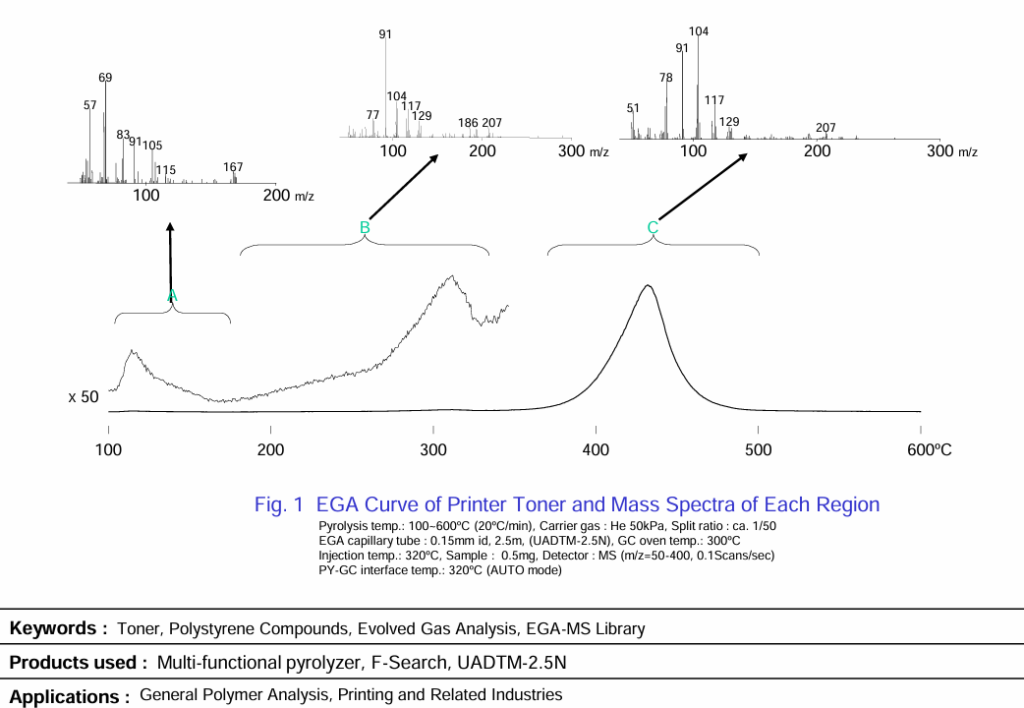
Printer toner was analysed using a Double-Shot Pyrolyzer coupled with GC/MS. The EGA curve was divided into three temperature regions, labelled A, B and C, and the average mass spectra from each region were examined.
The observed temperature regions provided information about the different components released during heating.
Region A and Region B: Low-Molecular-Weight Compounds
The compounds detected in regions A and B were attributed to the desorption of low-molecular-weight components.
Examining these regions helps distinguish compounds released from the sample without requiring the initial interpretation to treat every detected component as part of the polymer structure.
Region C: Polymer Thermal Decomposition
Region C was considered to originate from the thermal decomposition of polymers.
The mass spectrum from this region was selected for an EGA-MS library search to investigate the likely polymer composition of the printer toner.
This temperature-based approach helps focus the search on compounds associated with polymer decomposition.
Results of the EGA-MS Library Search
The library search identified several plausible styrene-based copolymers in the printer toner sample.
| Candidate polymer | Library match quality |
|---|---|
| Methyl methacrylate-butadiene-styrene copolymer | 90 |
| Styrene-ethylene-butadiene-styrene-block copolymer | 86 |
| Styrene-divinylbenzene copolymer | 80 |
These results indicate that the printer toner may contain polymeric materials related to the listed styrene copolymers.
The match quality values represent the library search results; they should not be interpreted as measured concentrations or definitive proof that all listed polymers are present. Further analysis may be required to confirm the composition and distinguish between candidate materials.
Analytical Conditions for Printer Toner Analysis
The printer toner sample was analysed using a Double-Shot Pyrolyzer coupled with GC/MS.
The main analytical conditions were:
| Parameter | Condition |
|---|---|
| Pyrolysis temperature | 100–600°C |
| Heating rate | 20°C/min |
| Carrier gas | Helium, 50 kPa |
| Sample weight | 0.5 mg |
| Split ratio | Approximately 1:50 |
| EGA capillary tube | 0.15 mm internal diameter, 2.5 m length |
| GC oven temperature | 300°C |
| Injection temperature | 320°C |
| Mass spectrometry scan range | m/z 50–400 |
| Pyrolyzer–GC interface temperature | 320°C, AUTO mode |
These conditions were used to obtain the EGA curve and mass spectra for the library search.
Why Use EGA-MS for Unknown Polymer Analysis?
Conventional approaches may require additional analytical steps to investigate the composition of complex polymer materials. EGA-MS provides a useful initial screening approach by combining temperature-dependent evolved-gas analysis with mass spectral information.
For materials such as printer toner, the ability to examine separate temperature regions is particularly useful. It allows researchers to distinguish between desorbed compounds and products associated with polymer decomposition before selecting the appropriate next analytical step.
Main Advantages
1. Temperature-resolved information
The EGA curve helps show how the compounds released from the sample change as the temperature increases.
2. Mass spectral identification
Mass spectra from selected temperature regions can be compared with reference libraries to identify possible compounds or polymer types.
3. Preliminary polymer identification
Library searching can narrow down possible polymer compositions in unknown samples.
4. Support for further analysis
The candidate polymers identified through EGA-MS can guide more detailed GC/MS investigations when confirmation or additional compositional information is needed.
Applications in Polymer and Printing Industries
EGA-MS and library searching can support material characterization in applications involving unknown polymers and complex formulations.
Potential areas of application include:
Printer toner characterization: Investigating polymeric components in toner formulations.
Polymer identification: Screening unknown polymer materials using evolved-gas profiles and mass spectra.
Printing-related materials: Supporting the investigation of polymer-based materials used in printing applications.
Material research and development: Obtaining preliminary compositional information to guide further analytical work.
Quality investigation: Comparing thermal and mass spectral profiles when examining polymer materials.
The specific conclusions depend on the sample composition, analytical conditions and quality of the available reference spectra.
Multi-functional Pyrolyzer for EGA-MS Analysis
The Frontier Laboratories Multi-functional Pyrolyzer can be coupled with GC/MS to perform Evolved Gas Analysis of polymer materials.
When combined with an appropriate mass spectral library, the system enables researchers to investigate temperature-dependent evolved compounds and screen unknown polymer compositions.
This approach is useful for preliminary identification of polymeric components in complex samples such as printer toner. More detailed GC/MS analysis can then be considered when additional confirmation or compositional information is required.
Conclusion
EGA-MS combined with library searching provides a useful approach for the preliminary identification of unknown polymers in printer toner.
By examining the EGA curve and comparing mass spectra from different temperature regions, researchers can distinguish low-molecular-weight compounds from products associated with polymer thermal decomposition. In the printer toner example, the library search identified three plausible styrene-based copolymers for further investigation.
For polymer laboratories and printing-related industries, EGA-MS can support initial material screening and help guide more detailed analytical studies.
Contact
Frequently Asked Questions (FAQs)
EGA-MS is used to monitor and analyse compounds released from a sample during controlled heating. It combines evolved-gas analysis with mass spectrometry to provide information about thermal behaviour and chemical composition.
EGA-MS separates the sample’s evolved compounds into temperature-dependent regions. Researchers can examine the mass spectra from these regions and use library searching to identify possible polymer types.
An EGA-MS library search compares an acquired mass spectrum with reference spectra in a database. The results provide candidate identifications that can guide further investigation.
The library search suggested methyl methacrylate-butadiene-styrene copolymer, styrene-ethylene-butadiene-styrene-block copolymer and styrene-divinylbenzene copolymer as plausible candidates.
No. A library match provides a candidate identification, not necessarily definitive confirmation. Additional analysis may be needed to verify the polymer identity and determine the composition of the sample.