EGA-MS in Air Atmosphere for Thermo-Oxidative Polymer Analysis
Introduction to EGA-MS in Air Atmosphere
Understanding how polymers behave during heating is important for polymer characterization, material research, and thermal degradation studies.
Evolved Gas Analysis-Mass Spectrometry (EGA-MS) is used to monitor gases released from a material as it is heated. Conventional EGA-MS analysis is commonly performed under an inert helium atmosphere. However, researchers may also need to study polymer behavior in the presence of oxygen.
EGA-MS in an air atmosphere can help investigate thermo-oxidative decomposition and provide information about polymer behavior under oxidative heating conditions.
Frontier Laboratories has developed a new flow system that allows air-atmosphere EGA-MS analysis while reducing the amount of air entering the mass spectrometer.
What Is EGA-MS?
Evolved Gas Analysis-Mass Spectrometry (EGA-MS) monitors gases evolved from a sample during controlled heating.
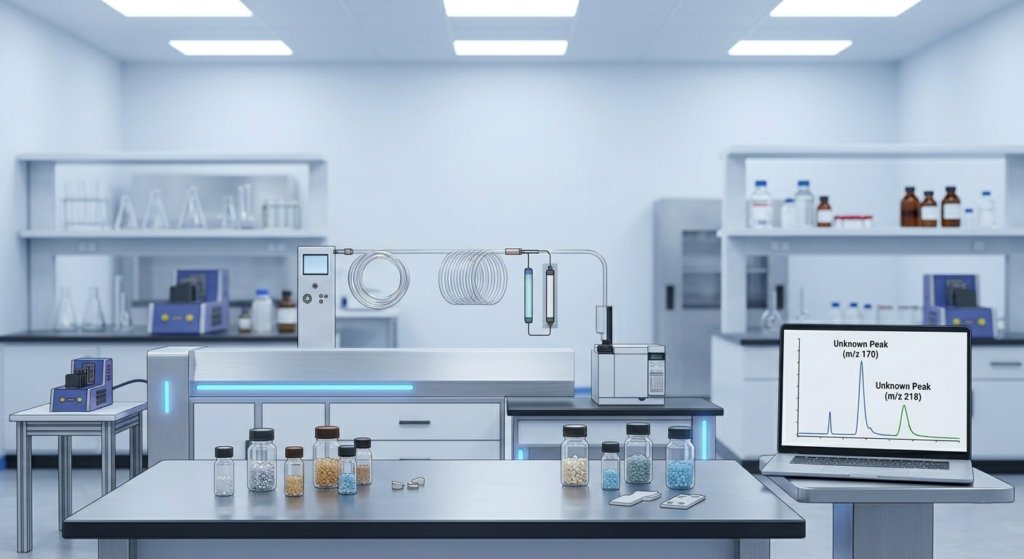
For polymer analysis, the sample is heated in a pyrolyzer furnace. The gases released during heating are transferred through the GC/MS system and detected by the mass spectrometer.
A simplified EGA-MS workflow is:
Polymer sample → controlled heating → evolved gases → GC/MS → MS detection → thermal behavior analysis
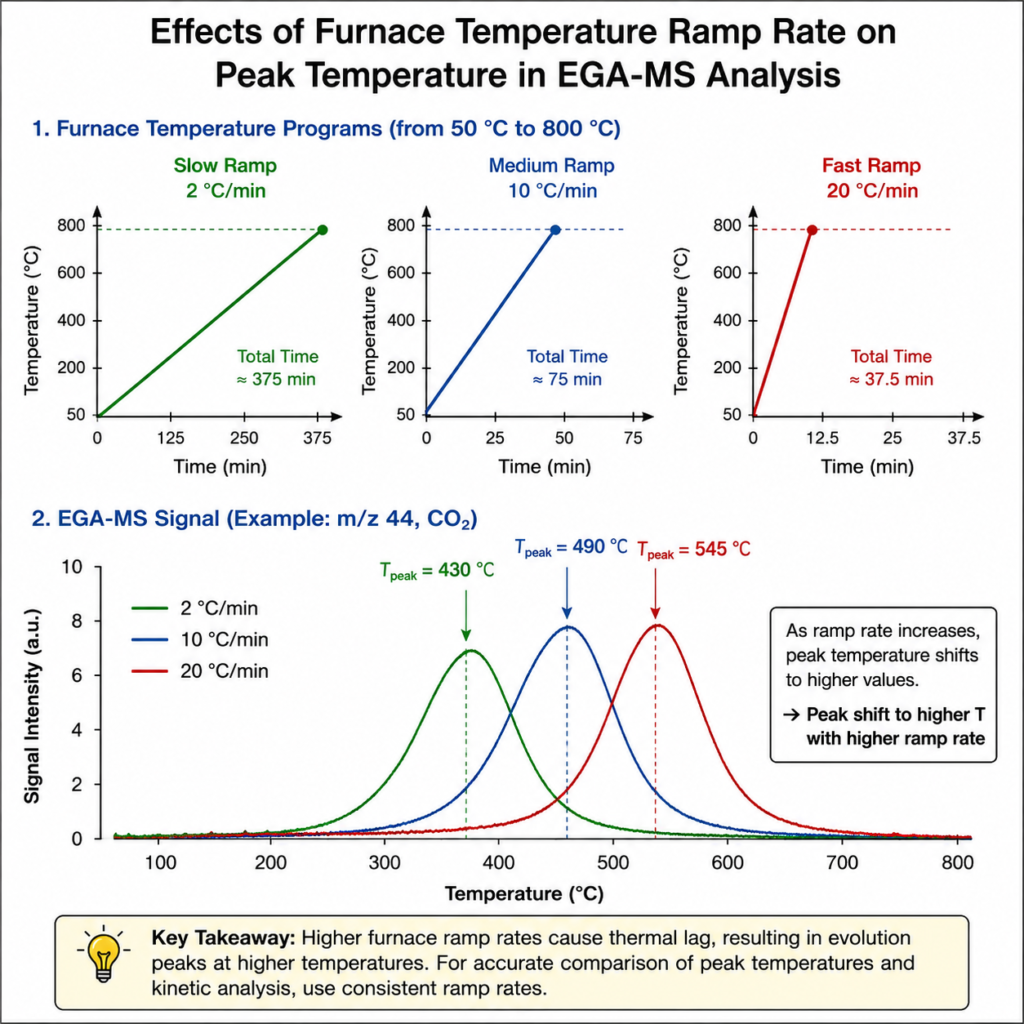
As the temperature increases, the resulting EGA-MS profile provides information about the thermal behavior of the polymer.
Why Perform EGA-MS in an Air Atmosphere?
The surrounding atmosphere can influence polymer decomposition.
An inert helium atmosphere is useful for studying thermal degradation without an oxidative environment. In contrast, an air atmosphere introduces oxygen and can be used to investigate thermo-oxidative behavior.
This makes air-atmosphere EGA-MS useful for research involving:
- Polymer thermal behavior
- Thermo-oxidative decomposition
- Polymer degradation
- Material characterization
- Comparison of inert and oxidative conditions
The Frontier Laboratories application specifically examines the use of an air atmosphere for thermal oxidative decomposition analysis using EGA-MS.
Challenges of Using Air in EGA-MS
Although an air atmosphere can provide useful information, directly introducing air into a mass spectrometer can create analytical challenges.
The technical note identifies several potential issues:
- Reduced sensitivity of the mass detector
- Air entering the mass spectrometer
- Oxidation of the ion-source filament, potentially shortening its lifetime
Therefore, a suitable gas-flow configuration is important when performing EGA-MS in an air atmosphere.
Frontier Laboratories’ New Flow System
Frontier Laboratories presents a new flow configuration designed to support thermo-oxidative EGA-MS analysis.
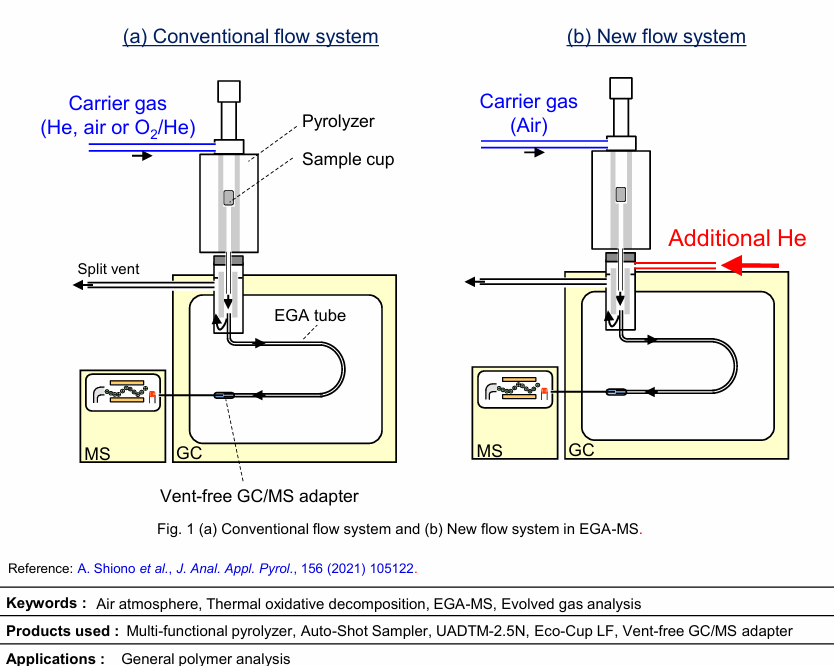
In the configuration, the Multi-functional Pyrolyzer is connected directly to the GC injector. An EGA tube connects the injector to the quadrupole mass spectrometer.
During analysis, the polymer sample is heated while the selected atmosphere flows through the pyrolyzer.
For air-atmosphere analysis, additional helium gas is introduced at the GC injector. This helium dilutes the air carrier gas before the gas mixture reaches the mass spectrometer.
The configuration helps reduce the amount of air introduced into the MSD while maintaining the required atmosphere around the heated polymer sample.
How the Air-Atmosphere EGA-MS System Works
The basic flow can be summarized as:
Sample heating → air atmosphere → GC injector → helium dilution → split flow → EGA tube → MSD
The air flow is controlled using a mass flow controller, while the additional helium flow is controlled through the GC instrument’s flow controller.
The resulting gas mixture is then split before entering the mass spectrometer through the EGA tube.
This configuration enables researchers to investigate polymer behavior under oxidative conditions while addressing the challenges associated with introducing air directly into the MSD.
Carrier Gas Conditions
The technical note describes experiments using different atmospheric conditions, including:
Helium
Helium provides an inert atmosphere commonly used for conventional EGA-MS analysis.
Synthetic Air
Synthetic air provides an oxygen-containing environment for investigating thermo-oxidative polymer behavior.
The synthetic air described in the application was prepared using a nitrogen-to-oxygen ratio of 4:1.
Helium/Oxygen Mixture
A helium and oxygen mixture can provide another controlled oxygen-containing atmosphere.
The technical note describes a helium-to-oxygen ratio of 4:1 for the mixed gas condition.
Using different atmospheric conditions allows researchers to compare polymer thermal behavior under inert and oxidative environments.
EGA/PY-3030D Multi-functional Pyrolyzer
The application uses a Multi-functional Pyrolyzer as part of the EGA-MS configuration.
The equipment listed in the technical note includes:
- Multi-functional Pyrolyzer
- Auto-Shot Sampler
- UAD™-2.5N
- Eco-Cup LF
- Vent-free GC/MS adapter
The Multi-functional Pyrolyzer can be integrated with GC/MS for EGA-MS and analytical pyrolysis applications.
For laboratories working on polymer characterization, thermal degradation, and thermo-oxidative analysis, the EGA/PY-3030D Multi-functional Pyrolyzer can form part of a GC/MS-based analytical workflow.
EGA-MS for Thermo-Oxidative Polymer Analysis
Thermo-oxidative decomposition occurs when a material undergoes thermal degradation in the presence of oxygen.
Studying this behavior can help researchers understand how polymer materials respond to elevated temperatures under oxidative conditions.
EGA-MS provides a way to monitor the gases evolved during heating. Comparing EGA-MS profiles under helium, air, and controlled helium/oxygen conditions can help researchers evaluate differences in polymer thermal behavior.
This approach can be relevant to polymer research, material development, and degradation studies.
EGA-MS Workflow for Polymer Analysis
A typical workflow for thermo-oxidative EGA-MS analysis includes the following steps:
1. Prepare the Polymer Sample
The polymer sample is placed into the appropriate sample cup for analysis.
2. Select the Atmosphere
The required atmosphere is selected according to the research objective. The application describes helium, synthetic air, and helium/oxygen conditions.
3. Heat the Sample
The sample is gradually heated inside the pyrolyzer furnace.
4. Monitor Evolved Gases
As the polymer is heated, gases released from the sample travel through the GC/MS system.
5. Dilute Air with Helium
For air-atmosphere measurements, additional helium is introduced at the GC injector to dilute the air before it reaches the MSD.
6. Detect the Evolved Gases
The gas flow is split and transferred to the mass spectrometer through the EGA tube.
7. Evaluate Polymer Thermal Behavior
The resulting EGA-MS data can be evaluated to understand the thermal and thermo-oxidative behavior of the polymer.
Applications of EGA-MS for Polymer Research
EGA-MS can support a range of polymer and material analysis studies, including:
- Polymer thermal characterization
- Thermal decomposition analysis
- Thermo-oxidative degradation studies
- Polymer degradation research
- Evolved gas analysis
- Comparison of different atmospheric conditions
- Material characterization
The Frontier Laboratories technical note identifies this application under general polymer analysis.
Benefits of Studying Polymers Under Different Atmospheres
Using different atmospheric conditions can provide complementary information about polymer behavior.
Helium can be used to study thermal behavior under an inert environment, while air or oxygen-containing atmospheres can be used to investigate oxidative effects.
This comparison can help researchers study:
- The temperature range where thermal changes occur
- Gases evolved during polymer heating
- Differences between thermal and thermo-oxidative decomposition
- The influence of oxygen on polymer degradation
- Changes in evolved-gas profiles under different atmospheres
Polymer Analysis Solutions for Laboratories in India
Polymer manufacturers, material research laboratories, universities, and analytical testing facilities in India may need to evaluate polymer behavior under different thermal conditions.
For laboratories studying polymer degradation, thermal decomposition, and thermo-oxidative behavior, EGA-MS provides an analytical approach for monitoring evolved gases during controlled heating.
The Frontier Laboratories air-atmosphere flow-system application demonstrates how EGA-MS can be adapted for thermo-oxidative polymer analysis.
The EGA/PY-3030D Multi-functional Pyrolyzer can be considered as part of a GC/MS analytical workflow for laboratories involved in polymer and material characterization.
Frontier Laboratories EGA/PY-3030D
The EGA/PY-3030D Multi-functional Pyrolyzer is designed for applications including evolved gas analysis and analytical pyrolysis when coupled with GC/MS.
In this application, the Multi-functional Pyrolyzer is connected to the GC injector, while an EGA tube provides the connection between the injector and the quadrupole MSD.
Additional helium dilution is used at the GC injector for air-atmosphere analysis.
This configuration provides a practical approach for researchers investigating polymer thermal behavior and thermo-oxidative decomposition using EGA-MS.
Explore EGA/PY-3030D
The system may be relevant for laboratories working on:
- Polymer characterization
- EGA-MS
- Thermal decomposition
- Thermo-oxidative analysis
- Polymer degradation
- Evolved gas analysis
- Analytical pyrolysis
Related Frontier Laboratories Applications
This application is part of a technical series covering EGA-MS under an air atmosphere and polymer degradation.
Related technical notes include:
- PYA4-002E
- PYA3-034E
- PYA3-035E
- PYA3-036E
- PYA3-037E
- PYA3-038E
These applications can provide additional references for researchers studying EGA-MS, polymer degradation, and thermo-oxidative decomposition.
Conclusion
EGA-MS in an air atmosphere provides an approach for investigating polymer thermal behavior under oxidative conditions.
While conventional EGA-MS commonly uses helium as an inert atmosphere, air-atmosphere analysis can be useful when researchers need to investigate thermo-oxidative polymer decomposition.
Introducing air into a mass spectrometer can affect detector sensitivity and may contribute to oxidation of the ion-source filament. Frontier Laboratories’ new flow configuration addresses this challenge by introducing additional helium at the GC injector to dilute the air before the gas reaches the MSD.
The configuration uses a Multi-functional Pyrolyzer, Auto-Shot Sampler, UAD™-2.5N, Eco-Cup LF, and Vent-free GC/MS adapter as part of the analytical setup.
For polymer research and analytical laboratories in India, this approach can be relevant for studying polymer degradation, thermal behavior, and thermo-oxidative decomposition using EGA-MS.
Contact
Frequently Asked Questions (FAQs)
EGA-MS, or Evolved Gas Analysis-Mass Spectrometry, is an analytical technique used to monitor gases released from a sample during controlled heating.
EGA-MS in an air atmosphere can be used to investigate thermo-oxidative decomposition and understand polymer behavior in the presence of oxygen.
Air entering the mass spectrometer can reduce detector sensitivity and may shorten the ion-source filament lifetime due to oxidation.
Additional helium is introduced at the GC injector to dilute the air carrier gas before the gas mixture reaches the mass spectrometer.
The application describes helium, synthetic air, and a helium/oxygen mixture as carrier-gas conditions.
Thermo-oxidative decomposition is the thermal degradation of a material in an atmosphere containing oxygen.
The application uses a Multi-functional Pyrolyzer, specifically as part of an EGA-MS configuration with GC/MS.
The EGA tube provides the gas-transfer path between the GC injector and the quadrupole mass spectrometer.
Yes. EGA-MS can be used to investigate polymer thermal behavior, evolved gases, thermal decomposition, and thermo-oxidative degradation.
Yes. Polymer manufacturers, universities, research institutions, and analytical laboratories in India can consider EGA-MS for polymer thermal and thermo-oxidative characterization.