Understanding Tire Wear Particles in the Environment
The increasing use of automobiles has brought a growing environmental concern: tire wear particles (TWPs). As vehicle tires continuously come into contact with road surfaces, their tread gradually wears down and releases tiny particles into the surrounding environment.
These particles, commonly referred to as tire and road wear microparticles (TRWMPs), can accumulate in road dust and contribute significantly to environmental microplastic pollution. Understanding their concentration in road dust is therefore important for assessing potential environmental impacts.
Pyrolysis-GC/MS (Py-GC/MS) provides a powerful analytical approach for identifying and quantifying tire-derived particles in complex environmental samples.
What Are Tire Wear Particles?
Automobile tires contain a combination of rubber polymers and other additives designed to provide durability, flexibility, and resistance to wear.
The major rubber components include:
- Natural Rubber (NR)
- Styrene-Butadiene Rubber (SBR)
- Butadiene Rubber (BR)
During driving, mechanical abrasion causes small fragments of these materials to detach from the tire surface. These particles accumulate in road dust and may eventually be transported into soil, water bodies, and other environmental compartments.
Because tire wear particles can be difficult to distinguish from other types of microplastics using conventional techniques, reliable analytical methods are required for accurate quantification.
Why Quantify Tire Wear Particles in Road Dust?
Road dust can act as a reservoir for tire-derived microparticles. Measuring their concentration helps researchers understand the extent of tire-related pollution and compare contamination levels between different environments.
Quantification can provide useful information for:
- Environmental pollution assessment
- Microplastic monitoring
- Urban and industrial environmental studies
- Road dust characterization
- Research into tire-related emissions
- Development of environmental management strategies
Analytical Approach: Py-GC/MS
Pyrolysis-Gas Chromatography/Mass Spectrometry (Py-GC/MS) is a useful technique for analyzing complex polymeric materials.
In this approach, a sample is thermally decomposed at a controlled temperature. The resulting pyrolysis products are separated using gas chromatography and identified using mass spectrometry.
For tire wear particle analysis, characteristic pyrolysis products generated from different rubber polymers can be used as indicators of their presence.
The analysis described in this technical note used a Multi-Shot Pyrolyzer (EGA/PY-3030D, Frontier Laboratories) directly interfaced with a GC/MS system.
Sample Preparation and Experimental Procedure
Road dust samples were collected using the vacuum sweep method from industrial and residential areas of Seoul.
The samples were:
- Dried at 120°C.
- Sieved to obtain particles smaller than 75 μm.
- Analyzed using EGA-MS and Py-GC/MS.
- Compared with tire rubber reference materials.
Natural rubber and SBR1502, containing 23.5% styrene, were used as standard materials for the analysis.
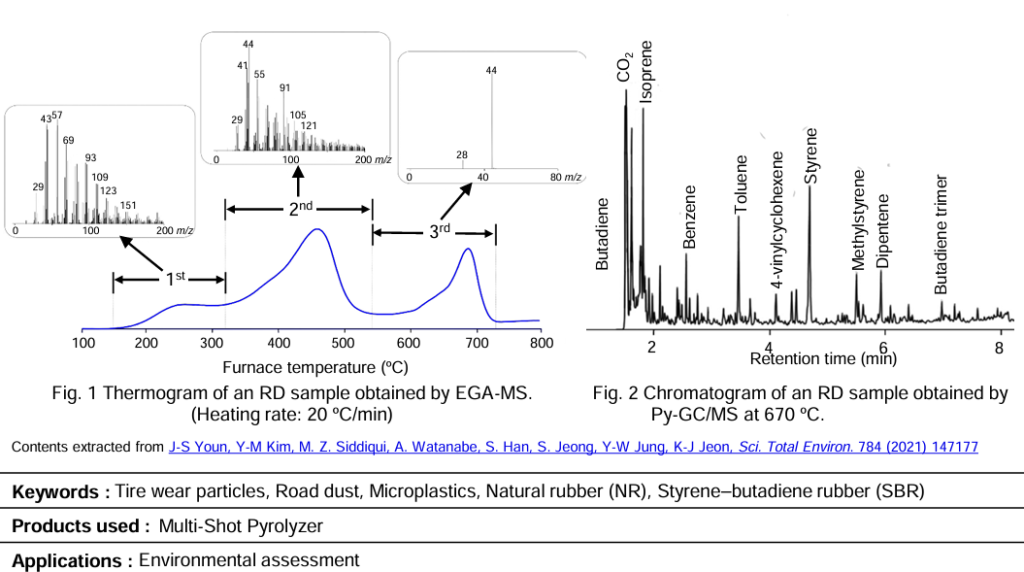
For flash pyrolysis, a road dust sample was introduced into the pyrolyzer at 670°C. The generated pyrolyzates were then separated by GC and detected by MS.
Quantification of tire and road wear microparticles was performed according to the ISO/TS 20539 method.
Identifying Tire Rubber Through Characteristic Pyrolysis Products
When tire rubber undergoes thermal decomposition, it produces characteristic compounds that can help identify the different rubber components.
The analysis detected pyrolysis products such as:
- Butadiene
- Isoprene
- Benzene
- Toluene
- Styrene
- 4-Vinylcyclohexene
- Methylstyrene
- Dipentene
These compounds provide useful chemical fingerprints for identifying tire-derived rubber in road dust.
For example, butadiene and 4-vinylcyclohexene can indicate the presence of butadiene rubber, while butadiene and styrene are characteristic of styrene-butadiene rubber.
For natural rubber, isoprene and dipentene are important pyrolysis products. In this analysis, dipentene was used as an indicator for the quantification of natural rubber.
Quantification of Tire and Road Wear Microparticles
The analysis revealed a significant difference between the industrial and residential areas studied.
The average concentration of tire and road wear microparticles was reported as:
Industrial area: 22,581 μg/g
Residential area: 9,818 μg/g
The concentration in the industrial area was approximately 2.5 times higher than that observed in the residential area.
This difference demonstrates how environmental conditions and human activity can influence the accumulation of tire-derived particles in road dust.
Role of EGA-MS in the Analysis
Evolved Gas Analysis Mass Spectrometry (EGA-MS) was used to examine the thermal behavior of the road dust samples.
In EGA-MS, the sample is heated progressively while the evolved gases are monitored by mass spectrometry. This helps identify temperature ranges where different materials undergo thermal decomposition.
The thermogram of the road dust sample showed signals associated with rubber components, supporting the presence of SBR, BR, and NR.
This information can be useful for determining suitable conditions for subsequent pyrolysis-GC/MS analysis.
Advantages of Py-GC/MS for Tire Wear Particle Analysis
Py-GC/MS offers several advantages when analyzing polymer-based environmental contaminants.
1. Polymer-Specific Identification
Characteristic pyrolysis products can help distinguish different rubber polymers within complex samples.
2. Analysis of Complex Environmental Samples
Road dust contains a mixture of organic and inorganic materials. Py-GC/MS can analyze polymeric components within this complex matrix.
3. Qualitative and Quantitative Analysis
The technique can be used not only to identify tire-derived materials but also to estimate their concentration using appropriate standards and analytical procedures.
4. Small Particle Analysis
Because the method analyzes the chemical composition of the material rather than relying solely on particle size or visual characteristics, it can be useful for investigating small tire-derived particles.
Environmental Significance
The findings highlight the importance of monitoring tire wear particles as part of broader environmental microplastic research.
Tire and road wear particles can accumulate in urban environments and may be transported through rainwater runoff, drainage systems, soil, and waterways. Quantifying these particles can therefore contribute to a better understanding of their environmental distribution.
Analytical techniques such as Py-GC/MS can support researchers in developing reliable monitoring methods and evaluating the contribution of tire wear to overall microplastic contamination.
[Microplastics Analysis Applications →]
[Related Microplastics & Polymer Analysis Blogs →]
Conclusion
Tire wear particles are an important source of particulate pollution associated with modern transportation. Their accumulation in road dust makes road dust analysis a valuable approach for assessing tire-derived environmental contamination.
The application of Py-GC/MS enables the identification of characteristic pyrolysis products from natural rubber, styrene-butadiene rubber, and butadiene rubber, providing a practical approach for the quantification of tire and road wear microparticles.
The reported concentrations of 22,581 μg/g in an industrial area and 9,818 μg/g in a residential area demonstrate the significant presence of tire-derived particles in road dust and the importance of continued environmental monitoring.
With advanced pyrolysis technology and GC/MS analysis, researchers can obtain valuable chemical information about tire wear particles and better understand their contribution to environmental microplastic pollution.
FAQ – Tire Wear Particle Quantification Using Py-GC/MS
Tire wear particles are microscopic particles released from vehicle tires due to continuous friction between tire treads and road surfaces. They can accumulate in road dust and contribute to environmental pollution.
Analyzing tire wear particles helps researchers understand their concentration and distribution in the environment. This information supports environmental pollution assessment and microplastic research.
Py-GC/MS thermally decomposes rubber materials to produce characteristic chemical compounds. These pyrolysis products are separated by gas chromatography and identified using mass spectrometry.
Py-GC/MS can help identify major tire rubber components such as Natural Rubber (NR), Styrene-Butadiene Rubber (SBR), and Butadiene Rubber (BR) based on their characteristic pyrolysis products.
Road dust is an important sample matrix for tire wear particle analysis. Depending on the research objective, similar analytical approaches can also be applied to other environmental samples containing tire-derived materials.
A study of road dust from Seoul reported average concentrations of 22,581 μg/g in an industrial area and 9,818 μg/g in a residential area, with the industrial area showing approximately 2.5 times higher concentration.
Py-GC/MS provides chemical identification and quantitative information about rubber components in complex samples. It can help researchers characterize tire-derived particles and support detailed environmental monitoring.