Coal tar is a complex by-product generated during the high-temperature carbonization of coal. It contains hundreds of organic compounds, including numerous aromatic hydrocarbons that are widely used in chemical manufacturing, material science, and industrial applications.
Understanding the composition of coal tar is essential for quality control, process optimization, and environmental assessment. One of the most effective techniques for investigating complex mixtures such as coal tar is EGA-MS analysis, which enables researchers to evaluate evolved gases and thermal behavior before conducting detailed chromatographic analysis.
This article explores the use of Evolved Gas Analysis-Mass Spectrometry (EGA-MS) as a preliminary step in coal tar characterization and demonstrates how thermal desorption GC/MS can be optimized using EGA data.
Table of Contents
- Introduction to Coal Tar Analysis
- What is EGA-MS?
- Why Analyze Coal Tar Composition?
- Experimental Setup
- Materials and Instrumentation
- EGA-MS Measurement Conditions
- Results of Coal Tar EGA-MS Analysis
- Identification of Aromatic Compounds
- Comparison of Coal Tar Samples
- Importance of Thermal Desorption Temperature Selection
- Applications of Coal Tar Characterization
- Advantages of EGA-MS for Complex Mixtures
- Conclusion
Introduction to Coal Tar Analysis
Coal tar is an oily substance produced during the carbonization of coal at elevated temperatures. Due to its highly complex composition, conventional analytical techniques often require extensive sample preparation and multiple analytical procedures.
Coal tar typically contains:
- Polycyclic aromatic hydrocarbons (PAHs)
- Naphthalene derivatives
- Phenanthrene compounds
- Pyrene compounds
- Aromatic oils
- Heavy hydrocarbon fractions
Thermal analytical techniques such as EGA-MS provide valuable insights into the thermal release patterns of these compounds and help determine optimal conditions for further analysis.
What is EGA-MS?
Evolved Gas Analysis-Mass Spectrometry (EGA-MS) is a thermal analysis technique used to monitor gases released from a sample during controlled heating.
Unlike traditional chromatographic methods, EGA-MS directly analyzes evolved compounds as temperature increases, providing valuable information regarding:
- Thermal decomposition behavior
- Volatile component release
- Thermal stability
- Desorption characteristics
- Sample composition trends
EGA-MS serves as an excellent screening tool before performing thermal desorption GC/MS analysis.
Why Analyze Coal Tar Composition?
Coal tar contains numerous chemical constituents that influence its physical properties and industrial performance.
Composition analysis helps researchers:
- Identify major chemical groups
- Compare products from different manufacturers
- Optimize refining processes
- Evaluate environmental impact
- Improve product quality
- Develop industrial applications
Accurate characterization is particularly important because small compositional differences can significantly affect performance and processing behavior.
Experimental Setup
The study utilized a GC/MS system equipped with a Multi-Shot Pyrolyzer directly connected to the GC inlet.
The GC inlet was connected to the mass spectrometer through:
- UAD™-2.5N deactivated metal tube
- Vent-free GC/MS adapter
Two coal tar samples obtained from different manufacturers were analyzed and designated as:
- Sample A
- Sample B
Approximately 0.5 mg of each sample was placed in an Eco-Cup LF and subjected to EGA-MS analysis.
Materials and Instrumentation
The following equipment was used during the analysis:
Sample Materials
- Coal Tar Sample A
- Coal Tar Sample B
Analytical Instruments
- Multi-Shot Pyrolyzer
- GC/MS System
- UAD™-2.5N Deactivated Metal Tube
- Eco-Cup LF
- F-Search Software
- Vent-Free GC/MS Adapter
These instruments enable efficient thermal analysis and accurate detection of evolved compounds.
EGA-MS Measurement Conditions
The EGA-MS measurements were performed under the following conditions:
Parameter | Condition |
Furnace Temperature | 50–900°C |
Heating Rate | 20°C/min |
Carrier Gas | Helium |
Flow Rate | 1 mL/min |
Split Ratio | 1:50 |
GC Oven Temperature | 300°C |
MS Scan Range | m/z 29–600 |
Sample Amount | Approximately 0.5 mg |
These conditions allowed the complete thermal evolution profile of each coal tar sample to be observed.
Results of Coal Tar EGA-MS Analysis
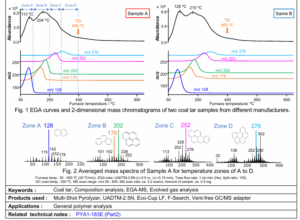
The EGA curves revealed distinct thermal behaviors for the two coal tar samples.
Sample A
- Zone A Peak: 113°C
- Zone B Peak: 204°C
Sample B
- Zone A Peak: 126°C
- Zone B Peak: 215°C
Although both samples exhibited similar thermal evolution patterns, noticeable differences were observed in the peak temperatures and intensity distributions.
These results suggest variations in chemical composition between the two coal tar products.
Identification of Aromatic Compounds
Average mass spectra were generated for each temperature zone of Sample A.
The analysis identified several major polycyclic aromatic hydrocarbons.
Zone A
Naphthalene
- Molecular Ion: m/z 128
Naphthalene represents one of the lighter aromatic compounds released during the early stages of heating.
Zone B
Phenanthrene
- Molecular Ion: m/z 178
Phenanthrene is a common polycyclic aromatic hydrocarbon found in coal-derived products.
Zone C
Pyrene
- Molecular Ion: m/z 202
Pyrene is released at higher temperatures and indicates the presence of heavier aromatic structures.
Zone D
Benzo[a]pyrene
- Molecular Ion: m/z 252
Benzoperylene
- Molecular Ion: m/z 276
These compounds represent high molecular weight aromatic hydrocarbons typically found in heavier fractions of coal tar.
The presence of these compounds confirms that each temperature zone contains different classes of aromatic constituents.
Comparison of Coal Tar Samples
The EGA curves demonstrated clear differences between Samples A and B.
Key Observations
- Different peak temperatures were observed.
- Thermal release patterns varied.
- Relative abundance of evolved compounds differed.
- Overall chemical composition showed measurable variation.
However, the average mass spectra of both samples were found to be highly similar, indicating that the primary compound classes remained largely the same.
This suggests that differences are more likely associated with concentration levels rather than entirely different chemical compositions.
Importance of Thermal Desorption Temperature Selection
One of the primary goals of EGA-MS is to determine the most appropriate thermal desorption temperature for subsequent GC/MS analysis.
The study revealed that most evolved compounds from both coal tar samples were released below 450°C.
Therefore:
Recommended Thermal Desorption Temperature
450°C
Selecting this temperature offers several advantages:
- Efficient release of target compounds
- Reduced thermal degradation
- Improved chromatographic performance
- Enhanced qualitative analysis
The EGA results provide a scientific basis for selecting thermal desorption conditions.
Applications of Coal Tar Characterization
Coal tar analysis is important across various industries.
Chemical Manufacturing
- Feedstock evaluation
- Process optimization
- Product development
Environmental Studies
- Pollutant identification
- Emission assessment
- Risk evaluation
Material Research
- Thermal stability investigations
- Aromatic hydrocarbon studies
- Carbon material development
Quality Control
- Product consistency verification
- Supplier comparison
- Manufacturing monitoring
Advantages of EGA-MS for Complex Mixtures
Complex materials such as coal tar benefit significantly from EGA-MS screening.
Major Advantages
- Minimal sample preparation
- Rapid analysis
- Direct thermal characterization
- Identification of temperature-dependent evolution patterns
- Optimization of thermal desorption conditions
- Improved understanding of sample composition
By combining EGA-MS with thermal desorption GC/MS, researchers can achieve comprehensive characterization of highly complex materials.
Conclusion
Coal tar is a chemically complex material containing a wide range of aromatic hydrocarbons that require advanced analytical techniques for accurate characterization. EGA-MS provides an effective preliminary screening method by revealing thermal evolution patterns and identifying major compound groups released during heating.
The study demonstrated that both coal tar samples contained polycyclic aromatic compounds such as naphthalene, phenanthrene, pyrene, benzo[a]pyrene, and benzoperylene, with most evolved gases released below 450°C. These findings support the selection of an optimal thermal desorption temperature for subsequent GC/MS analysis.
For advanced solutions in thermal desorption GC/MS, EGA-MS, and pyrolysis-based material characterization , Frontier Laboratories SEA provides innovative technologies designed for accurate analysis of complex materials and industrial samples.
References: This technical note was developed by Frontier Laboratories Ltd. 4-16-20 Saikon, Koriyama, Fukushima, 963-8862 JAPAN. www.frontier-lab.com