Understanding the thermal behavior of polymers is essential for material development, quality control, and failure analysis. One of the most effective techniques for studying thermal degradation is EGA-MS analysis , which provides detailed information about gases evolved during heating.
When performing thermal analysis, measurement conditions play a critical role in determining the accuracy and reproducibility of results. Among these conditions, the furnace temperature ramp rate significantly influences the peak temperature observed during decomposition.
This article examines how different furnace temperature ramp rates affect the peak temperature of polystyrene (PS) during EGA-MS analysis and explains why maintaining consistent analytical conditions is crucial for obtaining meaningful data.
Table of Contents
- What is EGA-MS?
- Importance of Furnace Temperature Ramp Rate
- Experimental Setup
- Materials and Instrumentation
- Measurement Conditions
- Results of EGA-MS Analysis
- Relationship Between Ramp Rate and Peak Temperature
- Why Peak Temperature Changes
- Significance for Polymer Analysis
- Best Practices for Reliable EGA-MS Results
- Applications of EGA-MS in Material Characterization
- Conclusion
What is EGA-MS?
Evolved Gas Analysis-Mass Spectrometry (EGA-MS) is a thermal analysis technique used to identify gases released from materials during heating. It enables researchers to investigate thermal decomposition, desorption behavior, and material stability without requiring chromatographic separation.
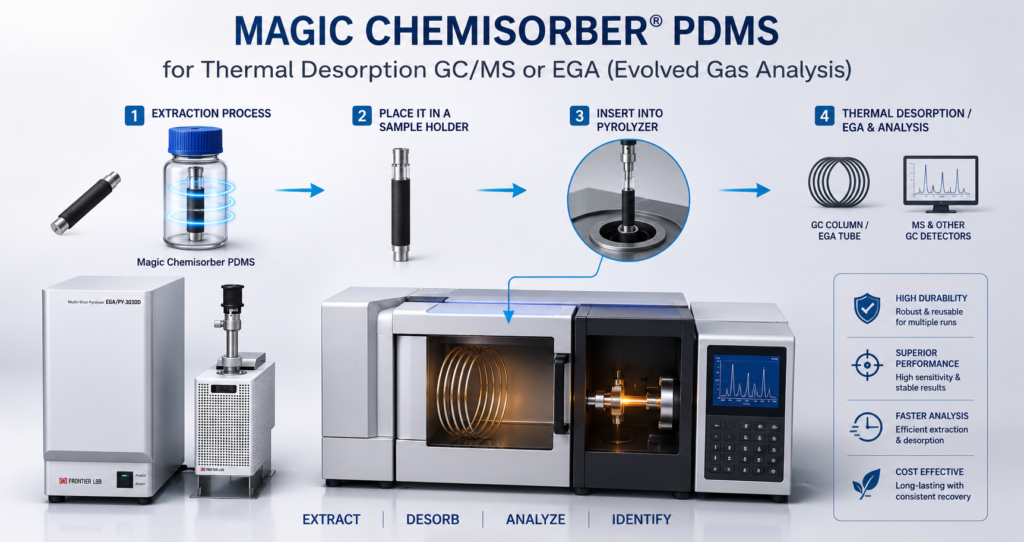
Modern Pyrolysis-GC/MS systems equipped with advanced pyrolyzers provide highly sensitive and reproducible EGA-MS measurements for a wide range of materials, including polymers, additives, composites, and industrial products.
Key Benefits of EGA-MS
- Rapid thermal characterization
- Direct analysis of evolved gases
- Evaluation of decomposition behavior
- Identification of thermal degradation pathways
- Quality control and research applications
- Material stability assessment
- Thermal behavior investigation
Importance of Furnace Temperature Ramp Rate
The furnace temperature ramp rate refers to the speed at which the furnace temperature increases during analysis.
For example:
- 1°C/min = Slow heating
- 40°C/min = Fast heating
Although the sample composition remains unchanged, varying the heating rate can significantly alter the observed thermal decomposition temperature.
The ramp rate directly influences:
- Thermal decomposition behavior
- Peak temperature position
- Reaction kinetics
- Heat transfer efficiency
- Data reproducibility
Therefore, controlling the heating rate is essential when comparing materials or evaluating thermal stability.
Experimental Setup
The study was conducted using a GC/MS system directly interfaced with a Multi-Shot Pyrolyzer.
The objective was to evaluate how changing the furnace temperature ramp rate affects the peak temperature observed during EGA-MS analysis of polystyrene.
To ensure accurate results, a constant sample amount of 0.2 mg was used throughout the study while only the heating rate was varied.
This approach allowed researchers to isolate the effect of furnace temperature ramp rate on thermal decomposition behavior.
Materials and Instrumentation
The following materials and instruments were used during the experiment.
Sample
Polystyrene (PS) Powder
- Sample Amount: 0.2 mg
Instruments
- Multi-Shot Pyrolyzer®
- GC/MS System
- Auto-Shot Sampler
- Vent-Free GC/MS Adapter
- UAD™-2.5N Deactivated Metal Tube
- Eco-Cup LF
These instruments provide precise temperature control and efficient transfer of evolved gases to the mass spectrometer for accurate thermal analysis.
Measurement Conditions
The furnace temperature was programmed under the following conditions:
Parameter | Condition |
Initial Temperature | 100°C |
Final Temperature | 700°C |
Ramp Rate Range | 1–40°C/min |
Carrier Gas | Helium |
Flow Rate | 1 mL/min |
Split Ratio | 1:50 |
GC Oven Temperature | 300°C |
MS Scan Range | m/z 29–550 |
Sample Weight | 0.2 mg |
All experimental parameters remained constant except the furnace temperature ramp rate.
Results of EGA-MS Analysis
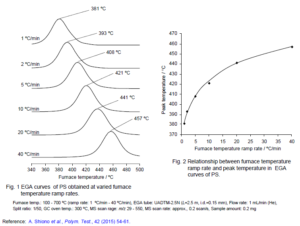
The EGA curves obtained at various furnace temperature ramp rates revealed a clear and consistent trend.
As the ramp rate increased, the thermal decomposition peak shifted toward higher temperatures.
Observed Peak Temperatures
Ramp Rate (°C/min) | Peak Temperature (°C) |
1 | 381 |
2 | 393 |
5 | 408 |
10 | 421 |
20 | 441 |
40 | 457 |
The results clearly demonstrate that the furnace temperature ramp rate significantly influences the observed decomposition temperature.
A difference of approximately 76°C was observed between the slowest and fastest heating rates.
Relationship Between Ramp Rate and Peak Temperature
The experimental results indicate a strong positive relationship between heating rate and peak temperature.
Key Findings
- Increasing ramp rate increases peak temperature.
- Faster heating delays the decomposition peak.
- Higher ramp rates cause decomposition to appear at higher temperatures.
- Peak temperature shifts become more pronounced at faster heating rates.
This relationship is particularly important when comparing thermal properties of materials across different experiments or laboratories.
Without consistent ramp rates, thermal analysis data may lead to inaccurate conclusions.
Why Peak Temperature Changes
Several scientific mechanisms explain the observed peak temperature shift.
1. Pyrolysis Reaction Kinetics
Thermal decomposition reactions require sufficient time to occur.
When the furnace temperature rises rapidly, the sample reaches higher temperatures before decomposition can fully proceed.
As a result, the decomposition peak appears at a higher temperature.
2. Heat Transfer Effects
Heat transfer plays a critical role during thermal analysis.
At faster heating rates:
- The sample surface heats quickly.
- Internal portions heat more slowly.
- Temperature gradients develop inside the sample.
These effects delay complete decomposition and shift the peak temperature.
3. Thermal Lag
Thermal lag occurs when the actual sample temperature differs from the programmed furnace temperature.
As heating rates increase, thermal lag becomes more significant, causing decomposition peaks to shift further toward higher temperatures.
Significance for Polymer Analysis
The findings have important implications for polymer analysis and material characterization.
Researchers frequently compare:
- Raw materials
- Manufacturing batches
- Polymer formulations
- Additive packages
- Composite materials
If different heating rates are used, observed thermal differences may result from analytical conditions rather than actual material properties.
Standardized analytical methods are therefore essential for obtaining meaningful and reproducible results.
Best Practices for Reliable EGA-MS Results
To ensure accurate thermal analysis results, laboratories should follow several best practices.
Use Consistent Heating Rates
Always maintain the same ramp rate when comparing multiple samples.
Maintain Consistent Sample Mass
Changes in sample amount can influence decomposition behavior and peak temperature.
Standardize Instrument Conditions
Keep the following parameters constant:
- Carrier gas flow rate
- Split ratio
- GC oven temperature
- Detector settings
Validate Methods
Perform repeated measurements to confirm method reproducibility.
Record Analytical Conditions
Document all testing parameters to improve traceability and facilitate future comparisons.
Applications of EGA-MS in Material Characterization
EGA-MS is widely used across research, manufacturing, and quality control environments.
Polymer Research
- Thermal stability evaluation
- Degradation mechanism studies
- Polymer development
Quality Control
- Batch verification
- Manufacturing consistency monitoring
- Product qualification
Failure Analysis
- Root cause investigations
- Thermal damage assessment
- Contamination identification
Research and Development
- Material optimization
- Additive screening
- Product innovation
The ability to accurately characterize thermal decomposition behavior makes EGA-MS an essential analytical tool for modern materials science.
Conclusion
The furnace temperature ramp rate significantly affects the peak temperature observed during EGA-MS analysis of polystyrene. As the heating rate increases from 1°C/min to 40°C/min, the decomposition peak shifts to higher temperatures due to reaction kinetics, thermal lag, and heat transfer limitations.
These findings emphasize the importance of maintaining consistent analytical conditions when conducting thermal decomposition studies, polymer characterization, and material evaluation. By standardizing furnace ramp rates and other measurement parameters, researchers can obtain more reliable and reproducible data for accurate interpretation of thermal behavior. Advanced solutions for Pyrolysis-GC/MS and thermal analysis help laboratories achieve precise material characterization and thermal decomposition analysis.
References: This technical note was developed by Frontier Laboratories Ltd. 4-16-20 Saikon, Koriyama, Fukushima, 963-8862 JAPAN. www.frontier-lab.com