Thermal Characterization of Chitin-Based Polymer Hybrids Using EGA-MS and EGA-GC/MS
Introduction to Chitin-Based Polymer Hybrids
Chitin is a natural polysaccharide found in the shells of crustaceans and the cuticles of insects. Due to its natural origin and chemical structure, chitin and its derivatives are of interest in the development of functional polymer materials.
One approach to developing new materials involves modifying chitin with polymer side chains to improve its compatibility with synthetic polymers. Chitin derivatives containing poly(2-alkyl-2-oxazoline) side chains have been blended with commodity polymers such as polyvinyl alcohol (PVA) and polyvinyl chloride (PVC) to investigate new functional material systems.
Understanding the thermal behavior and chemical composition of these polymer blends is important for material characterization and research.
Chitin-based polymer hybrid characterization using EGA-MS and EGA-GC/MS provides information about the thermal degradation behavior of individual polymers and their blends. By examining evolved compounds at different temperatures, researchers can investigate the contributions of the constituent polymer components.
In this study, EGA-MS, EGA-GC/MS, and Py-GC techniques were applied to a chitin-graft-poly(2-methyl-2-oxazoline)/PVA blend system.
Why Characterize Chitin-Based Polymer Blends?
Polymer blends combine two or more polymer components to develop materials with specific properties. However, understanding the composition and thermal behavior of these materials requires analytical techniques capable of examining their individual components and degradation products.
Chitin-based polymer hybrids are particularly interesting because they combine a natural polysaccharide derivative with synthetic polymer materials.
Thermal characterization can help researchers:
Examine the thermal degradation behavior of individual polymer components.
Investigate the degradation stages of polymer blends.
Identify evolved compounds released at different temperatures.
Understand the contribution of different polymer components to thermal degradation.
Support the characterization of new functional polymer materials.
EGA-MS and EGA-GC/MS offer complementary analytical information for investigating these complex material systems.
What Is EGA-MS Analysis?
Evolved Gas Analysis coupled with Mass Spectrometry (EGA-MS) is a technique used to investigate compounds released from a material during controlled heating.
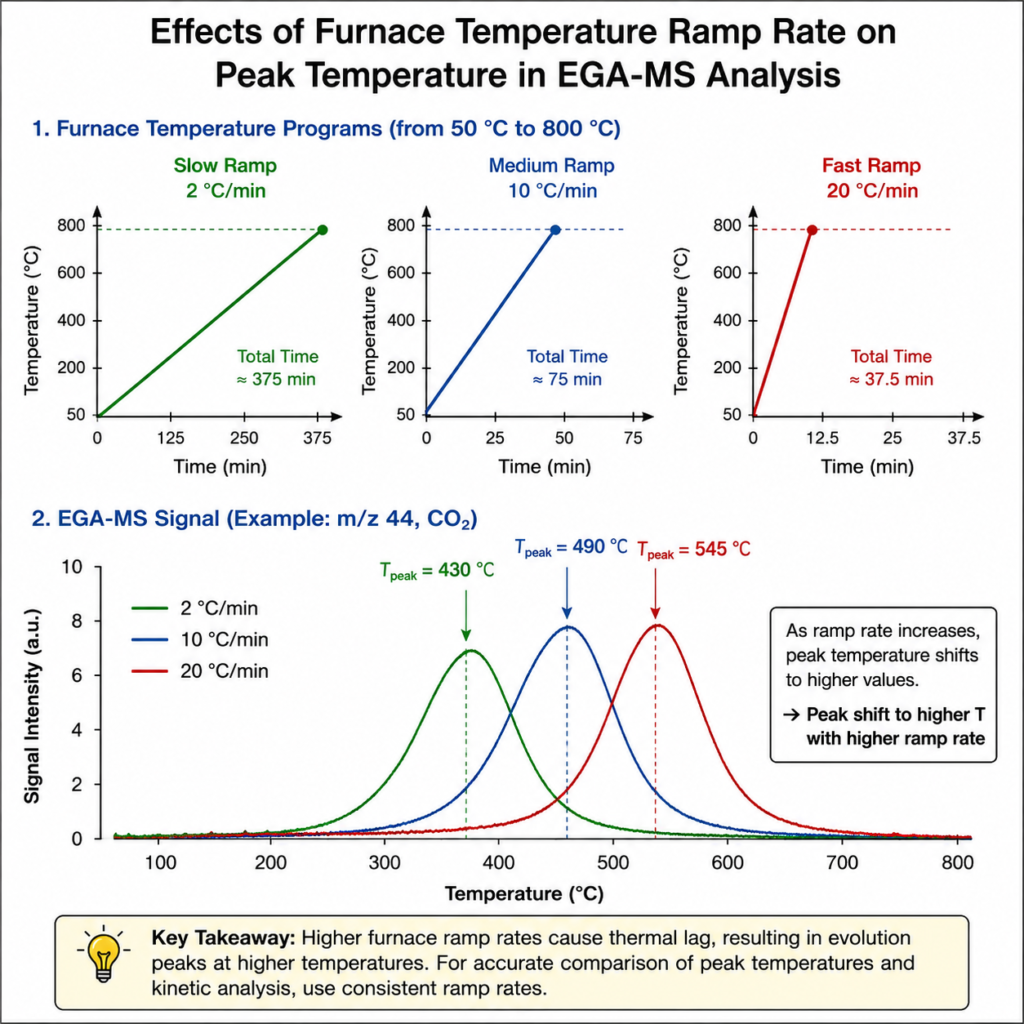
During analysis, the sample is heated according to a programmed temperature profile. The evolved gases and volatile degradation products are transferred to a mass spectrometer, where their signals are monitored.
The resulting thermogram provides information about the temperature ranges in which compounds are released.
For polymer blends, EGA-MS can help identify different thermal degradation stages and compare the behavior of individual polymers with that of the combined material.
In the characterization of chitin-based polymer hybrids, EGA-MS revealed two-stage thermal degradation behavior in the blend samples, reflecting the degradation of both constituent polymers.
How EGA-GC/MS Identifies Polymer Degradation Products
While EGA-MS provides an overview of thermal degradation behavior, EGA-GC/MS adds chromatographic separation to the analysis.
In EGA-GC/MS, compounds evolved during a selected temperature interval are collected and subsequently separated using gas chromatography. Mass spectrometry is then used to investigate their chemical identities.
This approach allows researchers to examine the degradation products associated with specific temperature ranges.
For chitin-derivative/PVA blends, EGA-GC/MS was used to investigate the compounds released during the first and second thermal degradation stages.
The results helped distinguish products associated with PVA degradation from those originating from the chitin derivative.
Analytical Approach for Chitin-Graft-Poly(2-Methyl-2-Oxazoline)/PVA Blends
The study examined a polymer blend containing chitin-graft-poly(2-methyl-2-oxazoline) and polyvinyl alcohol (PVA).
The chitin derivative was prepared by selectively grafting living poly(2-methyl-2-oxazoline) side chains onto free amino groups of partially N-deactivated chitin.
The reported characteristics of the chitin derivative included:
Degree of polymerization of poly(2-methyl-2-oxazoline) side chains: 19.6
Molecular weight distribution (Mw/Mn): 1.1
Degree of acetylation of chitin: 52%
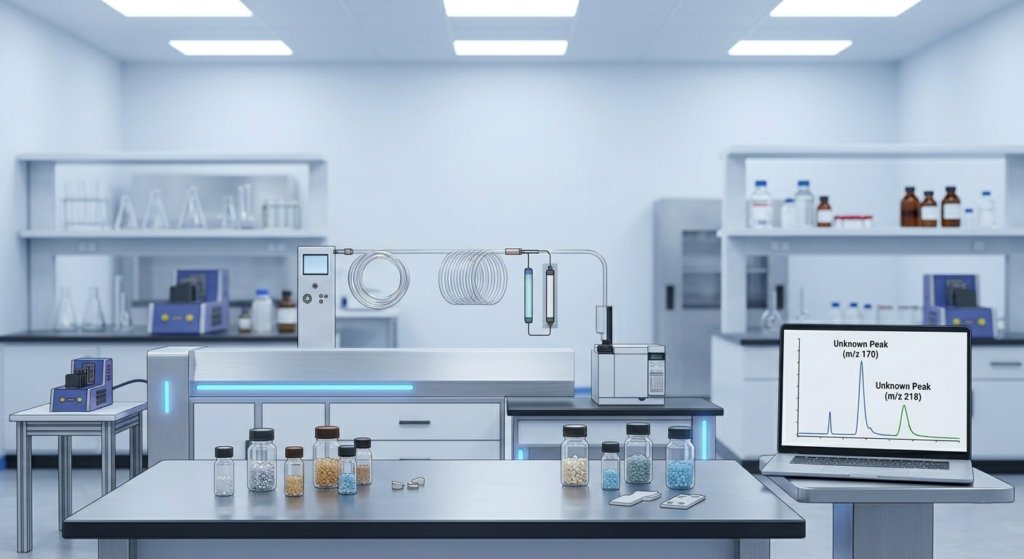
A pyrolyzer connected to a gas chromatograph was directly coupled to a quadrupole mass spectrometer through a deactivated stainless-steel capillary transfer line.
The analysis involved two main stages:
EGA-MS analysis: The thermal degradation behavior of the chitin derivative, PVA, and their blends was examined using programmed heating.
EGA-GC/MS analysis: The evolved products from selected temperature ranges were collected and analyzed to identify the compounds generated during each degradation stage.
This combined approach provided information about the thermal behavior and chemical composition of the polymer hybrid.
EGA-MS Results: Two-Stage Thermal Degradation of Polymer Blends
The EGA-MS thermograms showed differences between the individual polymer components and their blends.
Thermal Degradation of PVA
The total ion current (TIC) curve of PVA showed a two-stage thermal degradation pattern.
This behavior provided a reference for examining the degradation characteristics of the chitin-derivative/PVA blend system.
Thermal Degradation of Chitin-Based Polymer Blends
The blend samples also showed two-stage degradation behavior.
The two stages reflected the thermal degradation of the two constituent polymer components.
This observation demonstrated that the thermal response of the polymer hybrid contained contributions from both the PVA component and the chitin derivative.
EGA-MS therefore provided a useful overview of the temperature-dependent degradation behavior of the individual materials and their blends.
EGA-GC/MS Results: Identification of Evolved Degradation Products
To investigate the compounds responsible for the two degradation stages, EGA-GC/MS was performed on the B(60/40) blend sample.
The evolved products were collected over two temperature intervals:
First degradation stage: 240–340°C
Second degradation stage: 340–480°C
The chromatographic results revealed different groups of degradation products in each interval.
First Degradation Stage: 240–340°C
The first degradation stage primarily showed products associated with PVA.
The major identified products included:
Water
Unsaturated aldehydes
Aromatic aldehydes
These compounds were considered to be formed through dehydration of PVA, followed by scission of the resulting polyene chains.
The identification of these compounds provided insight into the thermal degradation pathway of the PVA component within the polymer blend.
Second Degradation Stage: 340–480°C
The second degradation stage showed various products originating from the chitin derivative.
The identified compounds included:
Acetamide from the chitin main chain.
Acetone from scission and/or rearrangement reactions involving the polyoxazoline side chains.
Other nitrogen-containing compounds associated with side-chain scission and/or rearrangement.
These degradation products provided additional chemical information about the chitin-based component of the hybrid material.
Summary of Thermal Degradation Products
| Temperature range | Main degradation contribution | Reported compounds |
|---|---|---|
| 240–340°C | Primarily PVA | Water, unsaturated aldehydes, aromatic aldehydes |
| 340–480°C | Chitin derivative | Acetamide, acetone, other nitrogen-containing compounds |
The different degradation products observed in these temperature intervals helped distinguish the contributions of the two polymer components.
Why Combine EGA-MS and EGA-GC/MS for Polymer Characterization?
Combining EGA-MS and EGA-GC/MS provides complementary information that can improve the understanding of complex polymer materials.
1. Identification of thermal degradation stages
EGA-MS provides a temperature-dependent profile of evolved compounds, helping identify different degradation stages.
2. Investigation of individual polymer contributions
Comparing the thermograms of individual polymers with those of their blends helps investigate how the constituent materials contribute to the overall thermal behavior.
3. Identification of evolved compounds
EGA-GC/MS separates compounds released within selected temperature intervals, allowing their chemical profiles to be investigated.
4. Characterization of complex polymer hybrids
The combined approach can provide information about degradation products originating from different components of a polymer blend.
5. Support for polymer research
These techniques can help researchers investigate the thermal behavior and chemical composition of newly developed polymer materials.
Role of Pyrolysis Techniques in Advanced Polymer Research
Thermal analysis techniques are useful for studying polymer materials that contain multiple components with different degradation characteristics.
EGA-MS provides information about the temperature-dependent release of compounds, while EGA-GC/MS helps separate and identify evolved products.
Py-GC/MS provides another analytical approach by examining the products generated through controlled pyrolysis.
Together, these techniques can support the investigation of polymer structures, degradation behavior, and chemical composition.
For more information about analytical approaches and their applications, explore Applied Pyrolysis Research.
Instrumentation for EGA-MS and EGA-GC/MS Analysis
A multi-functional pyrolyzer connected to a GC/MS system can be configured for different thermal analysis applications.
In the investigated study, a PY-2020D pyrolyzer was connected to a gas chromatograph and directly coupled to a quadrupole mass spectrometer through a deactivated stainless-steel capillary transfer line.
This configuration enabled the analysis of evolved products from the chitin-based polymer blends.
Frontier Laboratories provides analytical instrumentation for pyrolysis-based characterization and thermal analysis.
Explore the Frontier Laboratories product range to learn more about available analytical systems and configurations.
Broader Applications in Advanced Materials and Polymer Characterization
EGA-MS, EGA-GC/MS, and pyrolysis-GC/MS techniques support the investigation of complex materials across research laboratories and industrial sectors in India and Southeast Asia.
Advanced Materials Characterization: Investigating complex polymer hybrids, natural polymer derivatives, and advanced material systems through thermal degradation and chemical profiling.
Applied Pyrolysis Research: Exploring thermal analysis and pyrolysis-based techniques for understanding evolved compounds and characterizing complex materials.
Plastics & Rubber Analysis: Studying polymer composition, thermal degradation products, and the chemical characteristics of plastic and rubber materials.
Paints and Coatings Analysis: Investigating organic components and thermal behavior in coating materials and complex formulations.
Microplastics Analysis: Exploring analytical approaches for polymer identification and the characterization of microplastic materials.
These applications demonstrate the wider relevance of thermal analysis and pyrolysis-based techniques in material science. The appropriate analytical method depends on the material composition, target compounds, and research objectives.
To explore analytical instrumentation for polymer and advanced material characterization, visit the Frontier Laboratories SEA Products page. For application-specific guidance or technical consultation, contact Frontier Laboratories SEA.
Conclusion
EGA-MS and EGA-GC/MS provide complementary analytical information for characterizing chitin-based polymer hybrids.
In the investigated chitin-graft-poly(2-methyl-2-oxazoline)/PVA blend system, EGA-MS revealed two-stage thermal degradation behavior reflecting the contributions of the constituent polymers.
Further investigation using EGA-GC/MS identified different groups of degradation products in the two temperature intervals. The first stage, between 240°C and 340°C, primarily produced compounds associated with PVA degradation, while the second stage, between 340°C and 480°C, showed products originating from the chitin derivative.
These findings demonstrate how combining thermal profiling with evolved-product identification can help researchers understand the degradation behavior of complex polymer blends.
For laboratories and researchers working on natural polymer derivatives, polymer hybrids, and advanced materials, EGA-MS and EGA-GC/MS offer useful analytical approaches for thermal characterization.
Frequently Asked Questions (FAQs)
Chitin-based polymer hybrids are materials developed by combining chitin or modified chitin derivatives with other polymers. In the investigated system, a chitin derivative containing poly(2-methyl-2-oxazoline) side chains was blended with polyvinyl alcohol (PVA).
EGA-MS is used to examine compounds released from a material during controlled heating. It helps identify thermal degradation stages and compare the temperature-dependent behavior of individual polymers and their blends.
EGA-MS provides an overall profile of evolved compounds as a sample is heated. EGA-GC/MS adds chromatographic separation, allowing compounds collected within selected temperature intervals to be separated and chemically investigated.
The EGA-GC/MS investigation examined the first stage between 240°C and 340°C and the second stage between 340°C and 480°C. The first stage primarily showed PVA-related degradation products, while the second showed products originating from the chitin derivative.
The first stage produced major compounds including water, unsaturated aldehydes, and aromatic aldehydes. These were considered to form through PVA dehydration followed by scission of the resulting polyene chains.
The second stage included acetamide from the chitin main chain, acetone, and other nitrogen-containing compounds associated with scission and/or rearrangement of polyoxazoline side chains.
EGA-GC/MS allows evolved compounds from selected temperature ranges to be separated and analyzed. This helps researchers investigate which degradation products originate from different components of a polymer blend.
Yes. These techniques can be applied to investigate the thermal behavior and evolved compounds of suitable polymer materials. The analytical configuration and temperature program should be selected according to the sample and research objective.