Determination of DEHP in Edible Oil Using EGA-MS
Introduction to DEHP Analysis in Edible Oil
Phthalates are chemical compounds widely used as plasticizers in plastic products, including polyvinyl chloride (PVC). However, their potential health effects have led to restrictions on their use in various applications.
Bis(2-ethylhexyl) phthalate (DEHP) is one such compound that can contaminate food during manufacturing, processing, and storage, particularly through contact with plastic materials. Detecting and analysing DEHP in fatty foods such as edible oils is therefore an important analytical consideration.
Evolved Gas Analysis coupled with Mass Spectrometry (EGA-MS) provides a way to investigate the thermal behaviour of DEHP in an oil matrix. Understanding its elution temperature is an important initial step in developing a reliable analytical method for phthalate analysis in edible oils.
Why Is DEHP Analysis in Edible Oil Important?
DEHP may enter food through contact with materials containing plasticizers, including certain processing equipment and storage containers.
Because edible oils contain substantial amounts of lipids, analysing phthalates in these samples requires consideration of the oil matrix and the behaviour of the target compound during heating.
Reliable analytical methods can help laboratories investigate potential contamination and support testing of food-contact materials and edible oil samples.
For food-testing laboratories in India and Southeast Asia, understanding how DEHP behaves during thermal analysis can help inform analytical method development.
What Is EGA-MS Analysis?
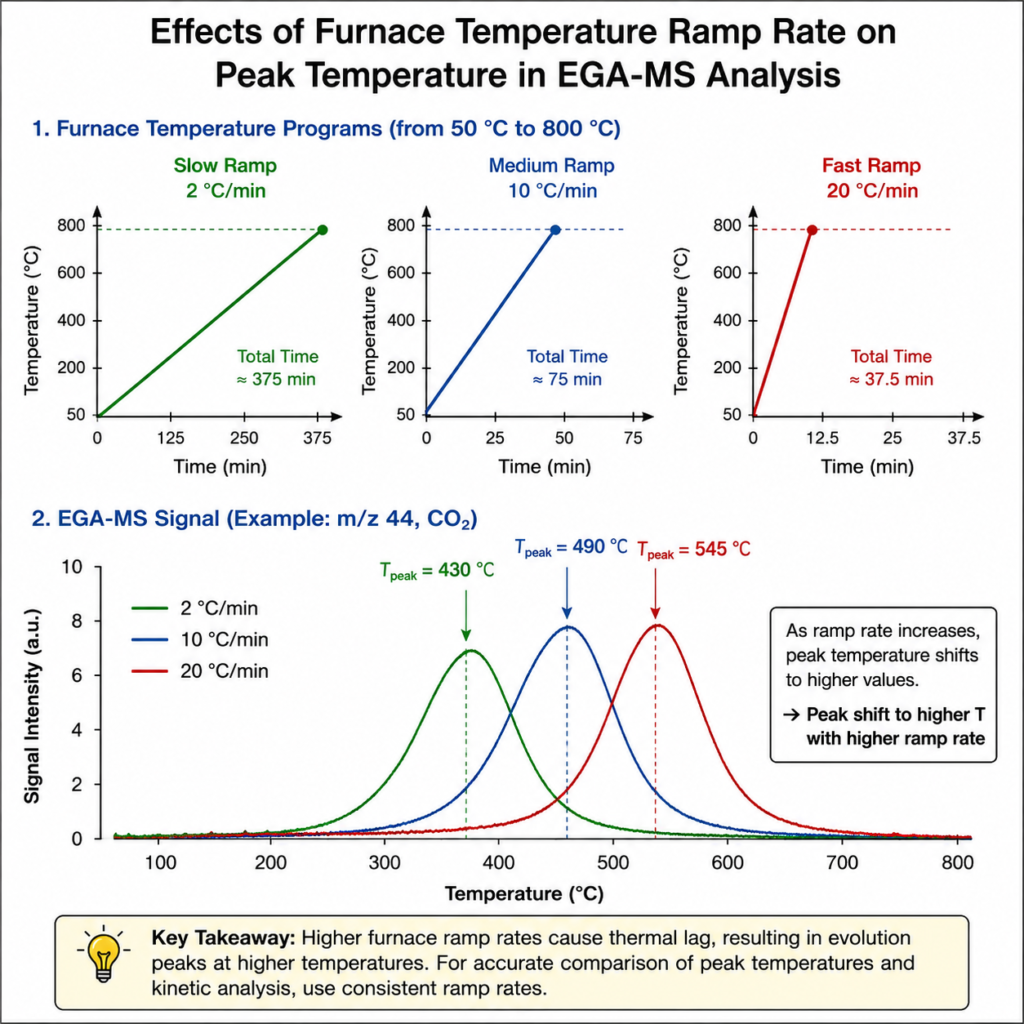
Evolved Gas Analysis (EGA) is a thermal analytical technique in which a sample is heated at a controlled rate while the compounds released from it are monitored.
When EGA is combined with mass spectrometry, the resulting data provide information about the temperature-dependent release of compounds and their mass spectral characteristics.
In DEHP analysis, EGA-MS can help distinguish the thermal behaviour of the target phthalate from that of the primary components of the oil matrix.
This information can guide the selection of appropriate analytical conditions for subsequent quantitative analysis.
Analytical Approach for DEHP in Olive Oil
The investigation examined the elution temperature of DEHP in commercially available olive oil using a Multi-functional Pyrolyzer coupled with GC/MS.
Olive oil samples containing 1% DEHP were prepared at different sample volumes, ranging from 1 µL to 10 µL. The samples were placed in sample cups and analysed under controlled heating conditions.
The EGA curves were then examined to determine how sample volume affected the elution behaviour of DEHP.
This approach allowed the relationship between sample amount and the observed thermal profile to be investigated before optimising the analytical method.
EGA-MS Results: DEHP and Olive Oil Components
The EGA curves provided information about the elution behaviour of DEHP and the main components of olive oil.
1. Thermal Behaviour of Olive Oil
Triglycerides are the main components of olive oil. In the total ion chromatogram (TIC) response, their volatilisation began at approximately 350°C under the conditions examined.
This observation provided a reference for understanding the thermal behaviour of the oil matrix during analysis.
2. Elution of DEHP
The extracted ion chromatogram (EIC) at m/z 149 was used to monitor DEHP.
The results indicated that DEHP began to elute within approximately 200–380°C. This temperature range differed from the observed volatilisation behaviour of the main triglyceride components.
Monitoring the characteristic ion helped investigate the DEHP profile in the presence of the olive oil matrix.
3. Effect of Sample Volume on Elution Temperature
An important finding was that the elution temperature of DEHP shifted to higher temperatures as the olive oil sample volume increased.
This behaviour may be associated with a reduction in effective thermal conductivity as the sample volume increases relative to its exposed surface area.
The finding demonstrates why sample amount must be considered when developing thermal desorption conditions for DEHP analysis in edible oils.
Why Sample Volume Matters in Thermal Desorption GC/MS
Sample volume can influence how efficiently heat is transferred through a sample during thermal analysis.
When a larger amount of oil is placed in a sample cup, the relationship between sample volume and exposed surface area changes. This may affect the rate at which DEHP is released from the matrix.
Consequently, changes in sample volume can alter the observed elution temperature and influence the selection of suitable thermal desorption conditions.
Evaluating this relationship is an important step in establishing consistent analytical conditions for phthalate analysis in complex samples.
Role of Thermal Desorption GC/MS in Phthalate Analysis
Thermal desorption GC/MS combines controlled heating, chromatographic separation, and mass spectrometric detection to investigate target compounds in a sample.
For DEHP analysis in olive oil, the technique allows researchers to examine the compound’s release profile and monitor its characteristic mass spectral response.
EGA-MS provides preliminary information about the thermal behaviour of the sample, helping researchers identify appropriate conditions for further analytical development.
This makes the technique useful for investigating phthalates and other additives in complex organic matrices.
Analytical Instrumentation and Conditions
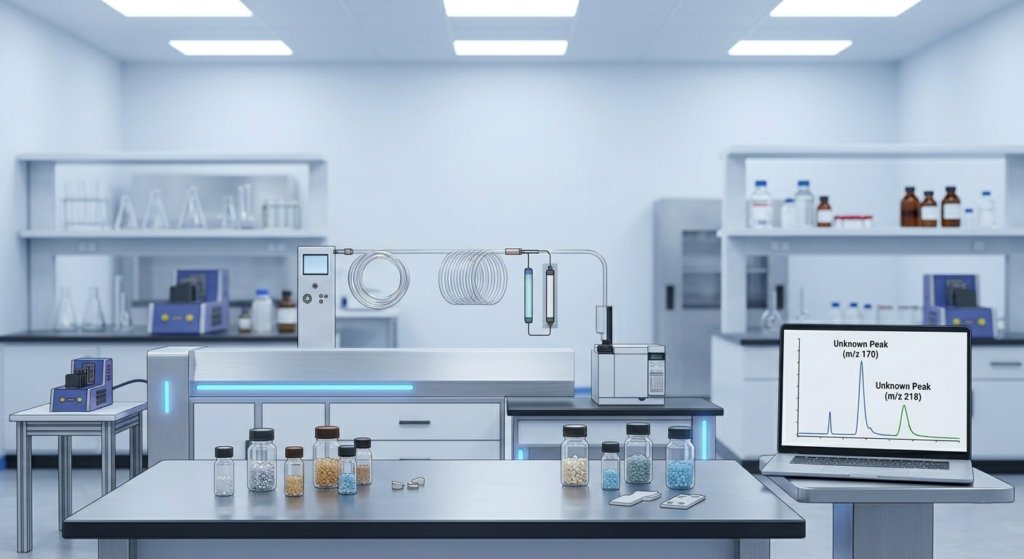
The analysis used a Multi-functional Pyrolyzer directly connected to a GC/MS system.
An EGA tube and a Vent-free GC/MS adapter were used to connect the GC injection port to the mass spectrometer. An appropriate sample cup was used to hold the olive oil sample.
The main experimental conditions were:
| Parameter | Condition |
|---|---|
| Sample matrix | Commercially available olive oil |
| Target compound | DEHP |
| DEHP added to samples | 1% |
| Sample volume | 1–10 µL |
| Pyrolyzer furnace temperature | 100–400°C |
| Heating rate | 20°C/min |
| Furnace interface temperature | 300°C |
| GC injector temperature | 300°C |
| EGA tube | 15 m length, 0.15 mm internal diameter |
| Carrier gas | Helium |
| Column flow | 1 mL/min |
| Split ratio | 1:20 |
| GC oven temperature | 300°C |
| Mass spectrometer ion source temperature | 230°C |
| Monitoring ion for DEHP | m/z 149 |
These conditions describe the experimental setup used to investigate the elution behaviour of DEHP at different sample volumes.
Applications of EGA-MS in Food and Fat Analysis
EGA-MS can support analytical investigations involving complex organic samples by providing information about the release of compounds during controlled heating.
Potential application areas include:
Edible oil analysis: Investigating the thermal behaviour of target compounds in oil matrices.
Phthalate analysis: Studying the elution characteristics of plasticizers such as DEHP.
Food contamination investigations: Supporting analytical method development for compounds that may migrate from food-contact materials.
Additive analysis: Examining selected additives in complex sample matrices.
Thermal method development: Evaluating how sample amount and heating conditions affect compound release.
The suitability of the method for routine testing depends on validation, calibration, sample preparation requirements, and the target concentration range.
Frontier Laboratories Multi-functional Pyrolyzer for EGA-MS
The Frontier Laboratories Multi-functional Pyrolyzer can be coupled with GC/MS to investigate the thermal behaviour of compounds in complex sample matrices.
In this application, the system was used to evaluate the effect of olive oil sample volume on the elution temperature of DEHP.
The resulting EGA profiles helped identify the temperature range associated with DEHP release and provided information relevant to the development of thermal desorption conditions.
Learn more about Frontier Laboratories’ analytical products for pyrolysis-GC/MS and related analytical applications.
Conclusion
DEHP analysis in edible oil requires an understanding of the target compound’s behaviour within a complex lipid matrix. EGA-MS provides a useful approach for investigating this behaviour before optimising a quantitative analytical method.
In the olive oil investigation, DEHP began to elute at approximately 200–380°C, while the main triglyceride components began to volatilise at around 350°C. The DEHP elution temperature also shifted higher as the sample volume increased.
These findings highlight the importance of sample volume when developing thermal desorption GC/MS methods for phthalate analysis. Further method optimisation and validation are necessary before applying the procedure to routine quantitative measurements.
Frequently Asked Questions (FAQs)
DEHP, or bis(2-ethylhexyl) phthalate, is a plasticizer used in certain plastic products. It may contaminate edible oil through contact with materials containing DEHP during food processing, handling, or storage.
EGA-MS monitors the temperature-dependent release of compounds and uses mass spectrometry to investigate their identity. In this application, the extracted ion chromatogram at m/z 149 was used to monitor DEHP.
Under the investigated conditions, DEHP began to elute within approximately 200–380°C. The observed elution temperature shifted higher as the sample volume increased.
Increasing the sample volume changes the relationship between sample volume and exposed surface area. This may reduce effective thermal conductivity and cause DEHP to elute at higher temperatures.
EGA-MS can help investigate the thermal behaviour of phthalates and support analytical method development. Reliable quantitative measurements require appropriate calibration, optimised conditions, and method validation.
A Frontier Laboratories Multi-functional Pyrolyzer coupled with GC/MS was used, along with an EGA tube and a Vent-free GC/MS adapter.
The investigation focused on understanding DEHP elution temperatures at different sample volumes. Additional optimisation and validation would be needed to establish a complete routine quantitative method.
Applications in Food Safety & Advanced Research
Accurate trace analysis of plasticizers is vital across several demanding industries:
Food Analysis & Edible Oils: Ensuring consumer safety by detecting low-level contaminants in fats, oils, and packaging materials.
Plastics & Rubber Analysis: Investigating additive migration and polymer degradation.
Advanced Materials Research: Studying thermal stability and material characterization.
For further reading on microplastic contamination and related environmental analysis, check out our insights on Microplastics Detection and Paints & Coatings Analysis.
For product inquiries, custom system configurations, or technical support, please Contact Frontier Lab SEA or explore our complete library of Technical Notes.