Simple Quantitative Analysis of Polyquaternium-4 Using Py-GC/MS
Introduction to Quantitative Analysis of Cationic Polymers
Cationic polymers containing quaternary ammonium salts are widely used in textile, paper, and film manufacturing. These materials can function as dye-fixing agents and antimicrobials, making their composition an important factor in product performance.
Determining the amount of a quaternary ammonium salt in a polymer formulation can be challenging. Conventional analytical approaches may require complicated sample preparation, including solvent extraction to remove interfering compounds.
Pyrolysis-Gas Chromatography/Mass Spectrometry (Py-GC/MS) offers an alternative approach for quantitative analysis. By monitoring a characteristic compound generated during thermal decomposition, researchers can analyse selected polymer components without complex pretreatment.
Why Is Quaternary Ammonium Salt Analysis Important?
Quaternary ammonium salts contribute to the functional properties of various polymer-based products. Their concentration can influence the performance of formulations used in textile, paper, and film applications.
Accurate quantitative analysis is therefore important for understanding material composition and evaluating product performance.
However, organic compounds present in complex formulations can interfere with analytical measurements. Reducing sample preparation while maintaining reproducible measurements is an important objective when developing an analytical method for these materials.
Py-GC/MS for Quantitative Polymer Analysis
Py-GC/MS combines controlled thermal decomposition with gas chromatography and mass spectrometry.
The polymer sample is heated in a pyrolyzer, producing compounds that are separated by gas chromatography and detected using mass spectrometry. The resulting chromatogram and mass spectra provide information about the compounds generated during heating.
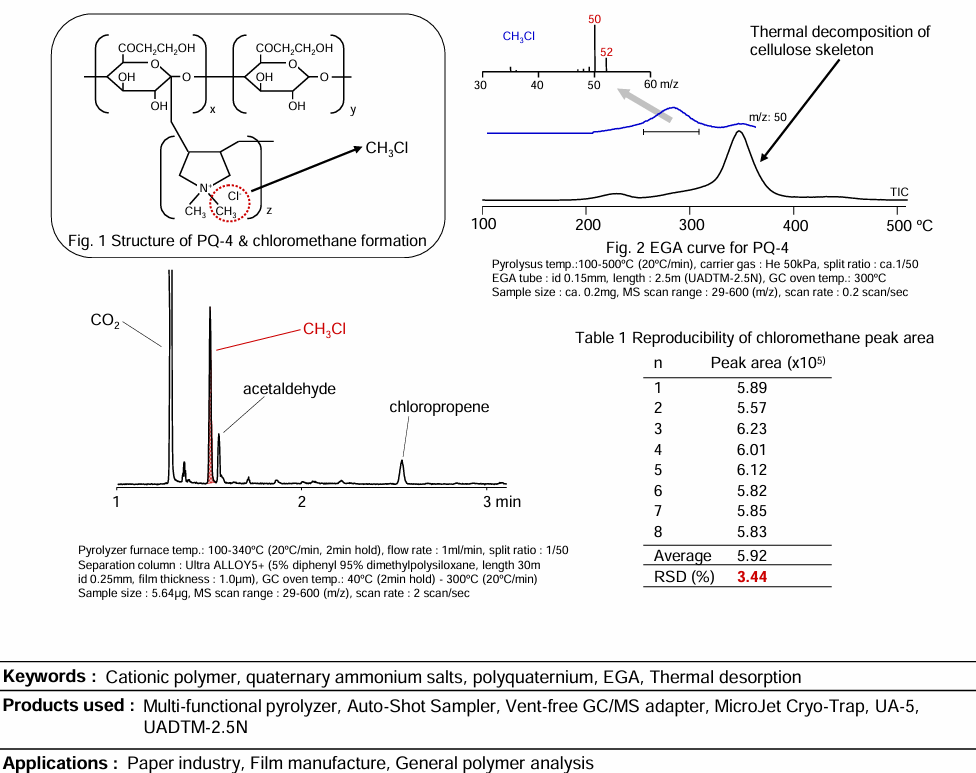
For quantitative analysis, a suitable compound associated with the target material can be monitored. In the case of Polyquaternium-4 (PQ-4), chloromethane formation was used as the basis for evaluating the quaternary ammonium salt.
This approach demonstrates how a characteristic thermal decomposition product can support quantitative analysis of a polymer component.
Analytical Approach: Polyquaternium-4 Analysis
Polyquaternium-4 (PQ-4), a cationic polymer containing a quaternary ammonium salt, was selected for the analysis.
The investigation used a Multi-functional Pyrolyzer coupled with GC/MS. Evolved Gas Analysis (EGA) was first used to examine the compounds released during heating and identify a suitable temperature region for monitoring chloromethane.
The EGA profile showed chloromethane formation in the temperature range of approximately 250–300°C. Based on this observation, the amount of chloromethane generated was used to investigate the quantitative analysis of PQ-4.
Identifying Chloromethane Through EGA-MS
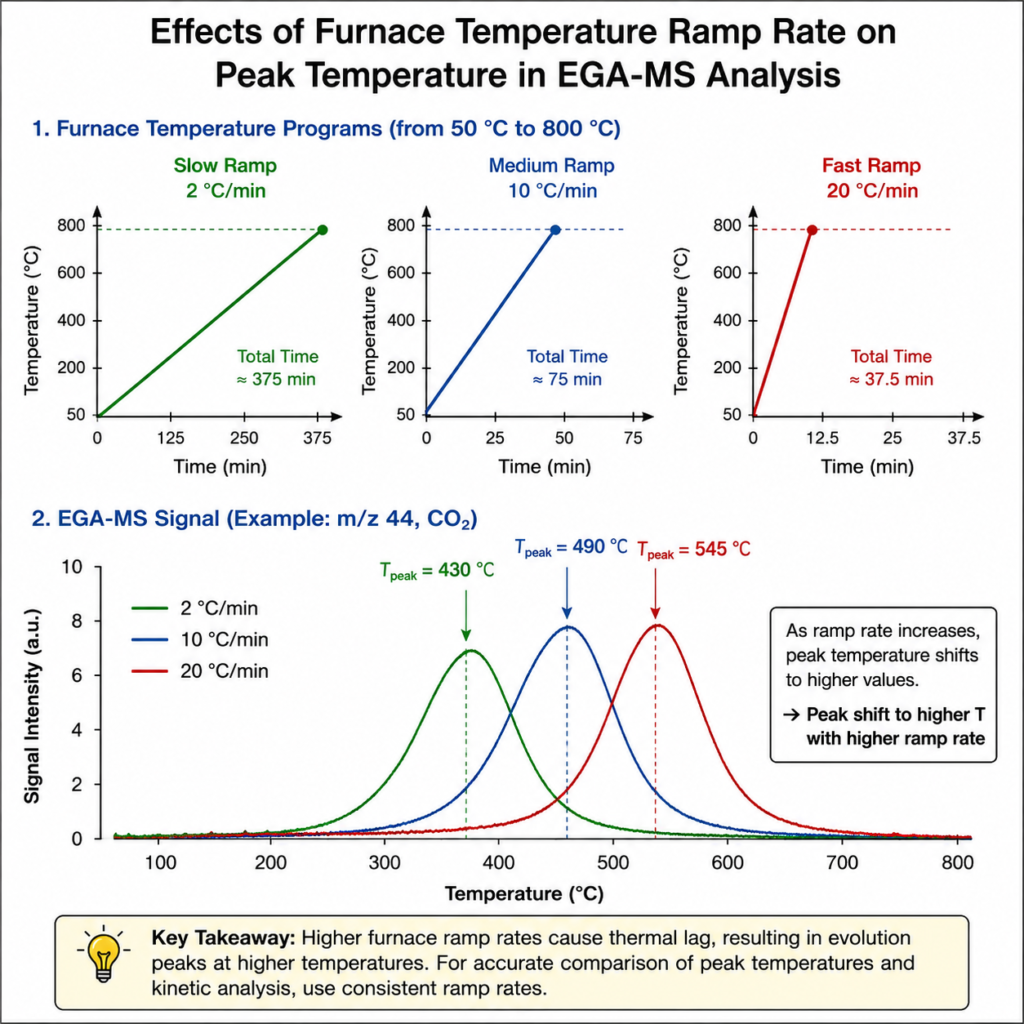
EGA-MS monitors compounds released from a sample as its temperature increases. The resulting EGA curve helps researchers understand the temperature-dependent behaviour of the material.
During PQ-4 analysis, chloromethane formation was observed in the 250–300°C region of the EGA curve.
This finding provided a basis for selecting chloromethane as the target compound for subsequent quantitative evaluation.
Identifying a suitable compound through EGA-MS can help guide analytical method development by indicating which evolved component may be useful for investigating the target material.
Quantitative Analysis Using Thermal Desorption-GC/MS
Following the EGA investigation, the thermally desorbed components of PQ-4 were analysed by GC/MS.
The sample was heated over a temperature range of 100–340°C, and the resulting chromatogram showed a prominent chloromethane peak at a retention time of approximately 1.5 minutes.
The peak area of chloromethane was evaluated through eight repeated measurements to investigate the reproducibility of the analytical response.
Measurement Results
| Parameter | Result |
|---|---|
| Target polymer | Polyquaternium-4 (PQ-4) |
| Target compound | Chloromethane |
| Chloromethane retention time | Approximately 1.5 minutes |
| Number of measurements | 8 |
| Average peak area | 5.92 × 10⁵ |
| Relative standard deviation (RSD) | 3.44% |
The relative standard deviation of 3.44% demonstrated good reproducibility of the chloromethane peak area under the reported experimental conditions. This supported the suitability of the method for quantitative analysis of PQ-4.
Advantages of Py-GC/MS for Cationic Polymer Analysis
The use of Py-GC/MS provides several potential advantages when developing quantitative methods for polymer materials.
1. Reduced sample pretreatment
The demonstrated approach enabled analysis without the complex pretreatment normally required to remove interfering compounds.
2. Target-compound monitoring
Chloromethane formation provided a measurable analytical response for investigating the quaternary ammonium salt in PQ-4.
3. Reproducible measurements
Eight repeated measurements produced a relative standard deviation of 3.44% for the chloromethane peak area.
4. Combined thermal and chemical information
EGA-MS helped identify the temperature region in which chloromethane formed, while GC/MS provided chromatographic separation and detection of the compound.
5. Potential for industrial polymer analysis
The approach is relevant to analytical method development for polymer-based materials used in paper, film, and other industrial applications.
Applications in Textile, Paper, and Film Industries
Cationic polymers containing quaternary ammonium salts are used in several industrial sectors.
Textile industry: Cationic polymers can be used as dye-fixing agents.
Paper industry: Polymer additives may contribute to the functional properties of paper products.
Film manufacturing: Cationic polymers can be incorporated into polymer-based formulations.
General polymer analysis: Py-GC/MS can support the investigation of selected components in polymer materials.
The appropriate analytical method depends on the target compound, sample composition, and required measurement performance.
Multi-functional Pyrolyzer for Polymer Analysis
The Frontier Laboratories Multi-functional Pyrolyzer can be coupled with GC/MS for thermal analysis and characterization of polymer materials.
In this application, the system was used to investigate chloromethane formation from Polyquaternium-4 and evaluate the reproducibility of the resulting chromatographic response.
The analytical configuration included a Multi-functional Pyrolyzer, Auto-Shot Sampler, Vent-free GC/MS adapter, MicroJet Cryo-Trap, and an Ultra ALLOY separation column.
Combining pyrolysis-based analysis with GC/MS can help laboratories develop analytical methods for selected polymer components and investigate the thermal behaviour of complex materials.
Explore more applications of pyrolysis-based analytical techniques in our Applied Pyrolysis Research section.
Conclusion
Quantitative analysis of cationic polymers can be challenging when conventional methods require complicated sample pretreatment. The demonstrated Py-GC/MS approach provides an alternative by using chloromethane formation to investigate Polyquaternium-4.
EGA-MS identified the temperature region associated with chloromethane formation, and subsequent GC/MS measurements produced a relative standard deviation of 3.44% across eight repeated measurements.
This application illustrates how pyrolysis-based analytical techniques can support reproducible quantitative analysis of polymer components used in textile, paper, film, and other industrial materials.
Contact
Frequently Asked Questions (FAQs)
Polyquaternium-4 is a cationic polymer containing quaternary ammonium salt functionality. Cationic polymers of this type are used in applications including dye fixing and antimicrobial formulations.
The polymer is heated using a pyrolyzer, and the generated compounds are separated by gas chromatography and detected by mass spectrometry. In this application, chloromethane formation was monitored to investigate the quantitative analysis of PQ-4.
EGA-MS showed chloromethane formation in the approximately 250–300°C temperature region. This observation provided the basis for using chloromethane as the target compound for quantitative evaluation.
Eight repeated measurements produced an average chloromethane peak area of 5.92 × 10⁵ and a relative standard deviation of 3.44%.
In this demonstrated application, the method was developed without complex sample pretreatment. Whether the same approach is suitable for other formulations depends on their composition and potential analytical interferences.