Ethylene Propylene Diene Monomer (EPDM) rubber is one of the most widely used synthetic elastomers in the automotive, construction, and industrial sectors due to its outstanding resistance to heat, ozone, weathering, and aging. However, prolonged exposure to ultraviolet (UV) radiation, oxygen, and elevated temperatures can gradually degrade EPDM, affecting its performance and service life.
Modern analytical techniques such as Online UV Irradiation coupled with Pyrolysis Gas Chromatography/Mass Spectrometry (UV/Py-GC/MS) provide a fast and reliable method to evaluate the photo, thermal, and oxidative degradation of EPDM rubber. This advanced testing approach helps manufacturers understand material durability, improve product quality, and develop longer-lasting rubber compounds.
What is EPDM Rubber?
EPDM (Ethylene Propylene Diene Monomer) is a synthetic rubber widely recognized for its:
- Excellent weather resistance
- High heat stability
- Outstanding ozone resistance
- Superior electrical insulation
- Long service life in outdoor environments
Because of these properties, EPDM is commonly used in:
- Automotive weather seals
- Roofing membranes
- Industrial gaskets
- Hoses and tubing
- Cable insulation
- Waterproofing systems
Although EPDM performs exceptionally well under harsh environmental conditions, continuous exposure to sunlight and oxygen eventually initiates chemical degradation.
Understanding Photo, Thermal, and Oxidative Degradation
EPDM degradation occurs mainly through three mechanisms:
1. Photodegradation
Ultraviolet (UV) radiation from sunlight breaks chemical bonds within the rubber polymer, leading to:
- Surface cracking
- Loss of elasticity
- Discoloration
- Reduced mechanical strength
- Thermal Degradation
High operating temperatures accelerate polymer chain scission and oxidation, causing:
- Hardening
- Brittleness
- Reduced flexibility
- Material failure
- Oxidative Degradation
Oxygen reacts with free radicals generated by heat and UV exposure, producing oxidation products that weaken the rubber structure over time.
Why Use Online UV/Py-GC/MS?
Traditional weathering tests often require weeks or months to observe degradation.
Online UV/Py-GC/MS significantly reduces testing time by simulating environmental exposure and immediately analyzing the degradation products generated during irradiation.
Key Benefits
- Rapid degradation analysis
- Simultaneous UV exposure and chemical characterization
- High sensitivity
- Identification of volatile degradation products
- Reliable evaluation of material aging
Experimental Method
To evaluate EPDM degradation, researchers used:
Sample
- EPDM rubber (JSR EP25)
- Diene content: 5.1 wt% Ethylidene Norbornene (ENB)
- Sample weight: 200 µg
UV Irradiation Conditions
- UV source: Xenon/Hg lamp
- Wavelength: 280–450 nm
- Irradiation intensity: 700 mW/cm²
- Temperature: 60°C
- Atmosphere: Air
- Exposure time: 1 hour
During irradiation, volatile compounds released from the degrading rubber were cryo-trapped using liquid nitrogen before being analyzed by Gas Chromatography-Mass Spectrometry (GC/MS).
After UV exposure, the remaining EPDM residue underwent Evolved Gas Analysis (EGA)-MS to assess thermal degradation characteristics.
Volatile Degradation Products Identified
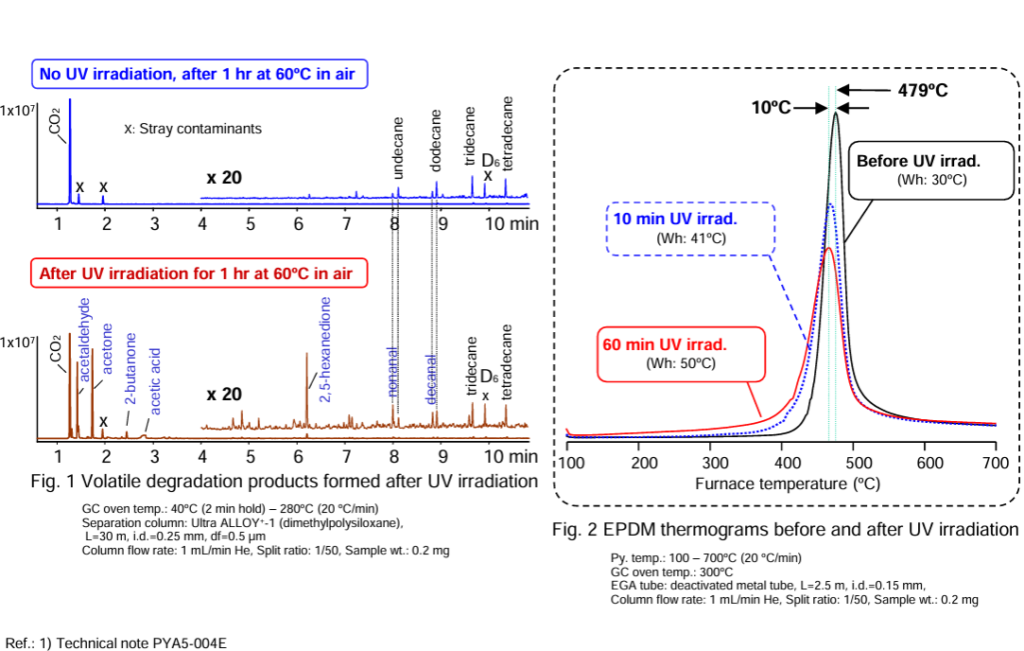
The UV-irradiated EPDM released several volatile compounds that were absent or present in much lower amounts in the non-irradiated sample.
Major degradation products included:
- Acetaldehyde
- Acetone
- 2-Butanone
- Acetic acid
- 2,5-Hexanedione
- Propylene
- Nonanal
- Decanal
Origin of These Compounds
Propylene-derived products
- Acetaldehyde
- Acetone
- Acetic acid
- Propylene
These originate from degradation of the propylene segments in the EPDM polymer.
Ethylene-derived products
Straight-chain aldehydes such as:
- Nonanal
- Decanal
These originate from oxidation of the ethylene sequences.
The identification of these compounds provides valuable insight into the degradation pathways occurring within EPDM during UV exposure.
EGA Thermogram Analysis
Evolved Gas Analysis (EGA) revealed significant changes in the thermal decomposition behavior after UV irradiation.
Key observations included:
- Reduction in peak intensity near 480°C
- Peak apex temperature shifted approximately 10°C lower
- Peak half-height width (Wh) increased from 30°C to 50°C
These changes indicate:
- Polymer chain degradation
- Increased oxidation
- Reduced thermal stability
- Formation of lower molecular weight fragments
As degradation progresses, the material decomposes more easily, resulting in lower decomposition temperatures and broader thermal decomposition profiles.
Why These Results Matter
Monitoring changes in:
- Peak intensity
- Peak temperature
- Peak width
provides a rapid method for assessing the aging condition of EPDM rubber.
Instead of waiting for long-term outdoor weathering studies, manufacturers can evaluate material performance within just a few hours.
This significantly accelerates:
- Material development
- Quality control
- Product validation
- Failure analysis
- Durability testing
Advantages of Online UV/Py-GC/MS
Compared with conventional weathering tests, this technique offers several benefits:
- Rapid evaluation within hours
- Real-time monitoring of degradation products
- Accurate identification of volatile compounds
- Sensitive detection of early-stage degradation
- Simultaneous assessment of photo, thermal, and oxidative aging
- Reduced testing costs and development time
Industrial Applications
Online UV/Py-GC/MS is particularly valuable in industries where EPDM durability is critical.
Applications include:
- Automotive components
- Roofing materials
- Construction products
- Electrical insulation
- Industrial seals and gaskets
- Polymer research laboratories
- Material quality assurance
Conclusion
EPDM rubber is renowned for its excellent resistance to weathering, heat, and oxidation. However, prolonged environmental exposure eventually causes chemical and structural degradation. Online UV/Py-GC/MS provides a fast, accurate, and efficient method for studying these degradation mechanisms.
By identifying volatile degradation products and analyzing thermal decomposition behavior through EGA, manufacturers can gain valuable insights into material aging, optimize EPDM formulations, and ensure long-term product reliability. Compared with traditional weathering methods, this analytical approach dramatically reduces testing time while delivering detailed information on photo, thermal, and oxidative degradation.
References: This technical note was developed by Frontier Laboratories Ltd. 4-16-20 Saikon, Koriyama, Fukushima, 963-8862 JAPAN. www.frontier-lab.com