Introduction
Microplastics have become one of the most significant environmental concerns worldwide. These tiny plastic particles, often smaller than 5 mm, are increasingly detected in drinking water, rivers, lakes, oceans, and even food. As research continues to uncover their potential impact on human health and ecosystems, accurate and efficient analytical methods are more important than ever.
Among the available technologies, Pyrolysis-Gas Chromatography/Mass Spectrometry (Py-GC/MS) has emerged as a powerful tool for identifying and quantifying microplastics. However, before analysis can begin, the particles must first be collected efficiently from water samples.
To simplify this process, Frontier Laboratories has developed the Smart Fine Particle Collector (SFPC)—an innovative sample preparation system designed specifically for collecting fine particles such as microplastics from aqueous samples.
Why Is Microplastic Collection Important?
The accuracy of microplastic analysis depends not only on the analytical instrument but also on how effectively the particles are collected from the sample.
Traditional filtration methods often involve:
- Multiple sample handling steps
- Longer preparation times
- Risk of particle loss
- Increased chances of contamination
The Smart Fine Particle Collector (SFPC) addresses these challenges by enabling efficient filtration and direct sample introduction into the pyrolyzer.
What is the Smart Fine Particle Collector (SFPC)?
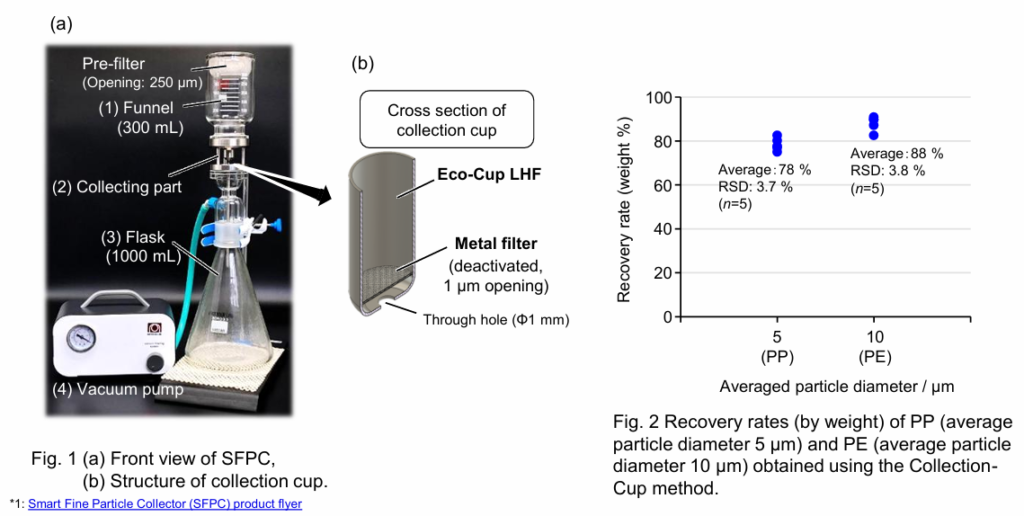
The Smart Fine Particle Collector (SFPC) is a vacuum filtration system optimized for collecting microplastics and other fine particles from water samples before Py-GC/MS analysis.
Its design minimizes handling while improving workflow efficiency and analytical reliability.
Main Components of the SFPC
The system consists of:
- Funnel
- Collecting Part
- Flask
- Vacuum Pump
This modular design supports different filtration approaches depending on analytical requirements.
Three Collection Methods
The SFPC offers three filtration options by changing the collecting module:
- Collection-Cup Method
- Filter Paper (S) Method
- Filter Paper (L) Method
Among these, the Collection-Cup Method is especially valuable for microplastic analysis.
Collection-Cup Method: Faster and Simpler Sample Preparation
The Collection-Cup Method uses an Eco-Cup LHF equipped with a deactivated metal filter featuring a 1 µm opening.
The collection cup includes:
- Eco-Cup LHF
- Metal filter
- Through-hole design at the bottom
Once filtration is complete, the entire collection cup can be placed directly into the pyrolyzer without transferring the sample.
Benefits
- Direct introduction into Py-GC/MS
- Reduced sample handling
- Lower contamination risk
- Improved workflow efficiency
- Suitable for fine microplastic particles
Performance Evaluation
To evaluate the system, Frontier Laboratories conducted performance testing using ultrapure water and microplastic powders.
Filtration Test
- Sample volume: 300 mL ultrapure water
- Filtration rate: 180 mL/min
This demonstrates rapid processing suitable for routine laboratory analysis.
Recovery Test
Two common plastic materials were evaluated:
Polymer | Average Particle Size | Average Recovery |
Polypropylene (PP) | 5 µm | 78% |
Polyethylene (PE) | 10 µm | 88% |
The recovery was determined by measuring the weight difference of the collection cup before and after filtration.
Excellent Reproducibility
Reliable analytical results require consistent sample recovery.
The SFPC demonstrated excellent repeatability:
Polymer | Relative Standard Deviation (RSD) |
PP | 3.7% |
PE | 3.8% |
The low RSD values indicate highly reproducible particle collection.
Key Advantages of the SFPC
The Smart Fine Particle Collector provides several practical benefits for laboratories performing microplastic analysis:
- Fast vacuum filtration
- Efficient recovery of fine particles
- Direct transfer to the pyrolyzer
- Reduced sample preparation time
- Lower risk of contamination
- Excellent reproducibility
- Compatible with Py-GC/MS workflows
- Suitable for drinking water and other aqueous samples
Applications
The SFPC is ideal for laboratories involved in:
- Microplastic analysis
- Drinking water testing
- Environmental monitoring
- Polymer analysis
- Foreign material analysis
- Research and development laboratories
- Academic research
- Quality control laboratories
Products Used
The study utilized:
- Smart Fine Particle Collector (SFPC)
- Eco-Cup LHF
- Deactivated Metal Filter (1 µm opening)
Together, these components provide an efficient workflow from particle collection to Py-GC/MS analysis.
Conclusion
As concerns over microplastic contamination continue to grow, laboratories require reliable and efficient sample preparation methods. The Smart Fine Particle Collector (SFPC) from Frontier Laboratories streamlines microplastic collection by combining rapid vacuum filtration with direct sample introduction into the pyrolyzer.
Performance testing demonstrated a filtration rate of 180 mL/min, recovery rates of 78% for 5 µm polypropylene and 88% for 10 µm polyethylene, along with excellent reproducibility. These features make the SFPC an effective solution for improving the speed, consistency, and reliability of microplastic analysis in drinking water and other aqueous samples.
References: This technical note was developed by Frontier Laboratories Ltd. 4-16-20 Saikon, Koriyama, Fukushima, 963-8862 JAPAN. www.frontier-lab.com