Table of Contents
- Introduction
- What is PES Polymer
- Importance of Gas Analysis in PES
- EGA-MS Technique Overview
- Experimental Method
- Results and Key Findings
- Gas Emission Analysis
- Industrial Applications
- Conclusion
Introduction
Polyethersulfone (PES) is a high-performance engineering plastic widely used in industries that demand exceptional mechanical strength and thermal stability. However, during high-temperature molding processes, PES can release gases that may impact product performance and manufacturing safety.
To better understand these emissions, advanced PES polymer analysis solutions are essential. One of the most reliable techniques is Evolved Gas Analysis (EGA)-MS, which helps identify gases released during thermal decomposition. This blog explores how EGA-MS is used to analyze PES in an air atmosphere and what insights it provides for industrial applications.
What is PES Polymer
Polyethersulfone (PES) belongs to the family of super engineering plastics, known for:
- High thermal resistance
- Excellent mechanical strength
- Superior dimensional stability
- Resistance to chemicals and oxidation
PES is widely used in:
- Electrical and electronic components
- Medical devices
- Automotive parts
- Industrial machinery
Its ability to replace metals in complex shapes makes it highly valuable, but also requires precise thermal and gas analysis.
Importance of Gas Analysis in PES
During molding, typically around 400°C, PES undergoes thermal changes that can result in:
- Release of volatile gases
- Formation of harmful compounds
- Potential degradation of material properties
Understanding these gas emissions helps manufacturers:
- Improve processing conditions
- Ensure product safety
- Reduce environmental impact
Using advanced polymer gas analysis technology , industries can detect even trace-level emissions accurately.
EGA-MS Technique Overview
Evolved Gas Analysis (EGA)-MS is an advanced analytical method that:
- Monitors gases released during heating
- Identifies compounds using mass spectrometry
- Provides thermal decomposition profiles
Combined with a Multi-functional Pyrolyzer®, this technique enables:
- High sensitivity detection
- Real-time analysis
- Minimal sample preparation
It is widely used for polymer research and quality control.
Experimental Method
The PES sample was analyzed using a GC/MS system equipped with a Multi-Shot Pyrolyzer® (EGA/PY-3030D).
Key Conditions:
- Sample size: 0.2 mg (later increased for low-temp analysis)
- Temperature range: 100°C to 700°C
- Heating rate: 20°C/min
- GC inlet temperature: 300°C
- GC oven temperature: 300°C
- Carrier gas: Helium
- Split ratio: 1/50
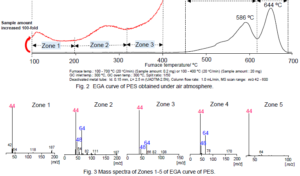
For detailed low-temperature analysis (100–400°C), the sample amount was increased 100 times to improve detection sensitivity.
Results and Key Findings
High-Temperature Behavior
The EGA curve showed two major peaks at:
- 586°C
- 644°C
These peaks correspond to the thermal decomposition (pyrolysis) of PES.
Low-Temperature Behavior
In the standard sample size:
- No significant peaks were observed between 100°C and 400°C
After increasing the sample amount:
- Minor gas emissions were detected
- The temperature range was divided into five zones (Zone 1–5)
This approach allowed for a more detailed understanding of gas evolution during typical molding conditions.
Gas Emission Analysis
Mass spectrometry results revealed key gases:
Detected Compounds:
- Carbon dioxide (CO₂ – m/z 44)
- Sulfur dioxide (SO₂ – m/z 48, 64)
These gases indicate:
- Breakdown of sulfur-containing structures
- Oxidative reactions occurring in air
The presence of SO₂ is particularly important because it is:
- Corrosive
- Harmful to equipment
- A potential safety concern
Using polymer thermal analysis solutions, these emissions can be monitored and controlled effectively.
Industrial Applications
1. Electronics Industry
Ensures stability of components exposed to high temperatures
2. Automotive Sector
Improves durability and safety of engine components
3. Medical Devices
Supports high-performance, heat-resistant materials
4. Polymer Manufacturing
Enhances quality control and processing efficiency
Understanding gas evolution helps industries:
- Prevent equipment corrosion
- Optimize molding processes
- Improve product reliability
Conclusion
The analysis of PES using EGA-MS provides valuable insights into its thermal decomposition and gas emission behavior. While major decomposition occurs at higher temperatures (above 500°C), trace gas emissions can still occur within typical processing ranges.
By using advanced PES polymer analysis solutions, manufacturers can better understand these behaviors, optimize production conditions, and reduce risks associated with harmful gas emissions.
EGA-MS combined with a Multi-functional Pyrolyzer® proves to be a powerful and reliable method for analyzing high-performance polymers like PES, ensuring improved safety, efficiency, and product quality across industries.