EGA Thermogram Analysis of UV-Degraded High Impact Polystyrene (HIPS): Correlation with Xe Weather Meter Testing
Introduction
Polymeric materials used in outdoor applications are constantly exposed to sunlight, oxygen, heat, and moisture. Over time, these environmental factors can cause photo-oxidative degradation, resulting in reduced mechanical strength, discoloration, cracking, and shorter product life.
Evaluating the weather resistance of polymers traditionally relies on Xe weather meter testing, which can require hundreds of hours before measurable degradation occurs. While effective, these long testing periods can slow product development and increase research costs.
An alternative approach combines a Micro UV Irradiator with Evolved Gas Analysis-Mass Spectrometry (EGA-MS) to rapidly evaluate polymer degradation. This study investigates UV-degraded High Impact Polystyrene (HIPS) and compares the results obtained using a Micro UV Irradiator with those from a conventional Xe weather meter.
The findings demonstrate that rapid laboratory-scale UV irradiation produces degradation profiles remarkably similar to those observed after long-term weathering tests.
What is High Impact Polystyrene (HIPS)?
High Impact Polystyrene (HIPS) is a modified form of polystyrene containing dispersed rubber particles that improve toughness and impact resistance.
HIPS is widely used in:
- Automotive interior components
- Electronic housings
- Appliance panels
- Refrigeration liners
- Packaging materials
- Consumer products
Because many HIPS products are exposed to sunlight and elevated temperatures, understanding their resistance to UV degradation is essential.
Why Study UV Degradation?
Ultraviolet radiation initiates chemical reactions within polymer chains.
As degradation progresses, materials may experience:
- Chain scission
- Oxidation
- Reduced molecular weight
- Loss of toughness
- Surface cracking
- Color changes
- Poor mechanical performance
Early detection of these changes helps manufacturers improve formulations and predict product lifespan.
What is EGA-MS?
Evolved Gas Analysis-Mass Spectrometry (EGA-MS) is a thermal analysis technique that monitors gases released from a material as it is heated.
Unlike conventional methods, EGA-MS provides rapid insight into:
- Thermal stability
- Degradation behavior
- Polymer decomposition
- Material aging
- Formulation changes
The technique is especially valuable for comparing fresh and weathered polymer samples.
Experimental Procedure
Micro UV Irradiation
A dichloromethane solution of HIPS (2 mg/mL) was placed in a sample cup and exposed to UV light using a Micro UV Irradiator.
Exposure times included:
- 30 minutes
- 1 hour
- 12 hours
The irradiation was performed:
- Furnace Temperature: 60°C
- Atmosphere: Air
Following irradiation, each sample underwent EGA-MS analysis.
Xe Weather Meter Testing
For comparison, HIPS plates were subjected to accelerated weathering using a conventional Xe weather meter.
Exposure durations included:
- 100 hours
- 300 hours
After irradiation, surface material was collected and analyzed using EGA-MS.
Instrumentation
The analysis utilized:
- Multi-Functional Pyrolyzer®
- Micro UV Irradiator
- Vent-Free GC/MS Adapter
- UAD™-2.5N Deactivated Metal Tube
- GC/MS System
EGA-MS Measurement Conditions
Parameter | Condition |
Furnace Temperature | 100–700°C |
Heating Rate | 20°C/min |
Carrier Gas | Helium |
Flow Rate | 1 mL/min |
Split Ratio | 1:50 |
GC Oven Temperature | 300°C |
Sample Amount | 20 µg |
Results of Micro UV Irradiation
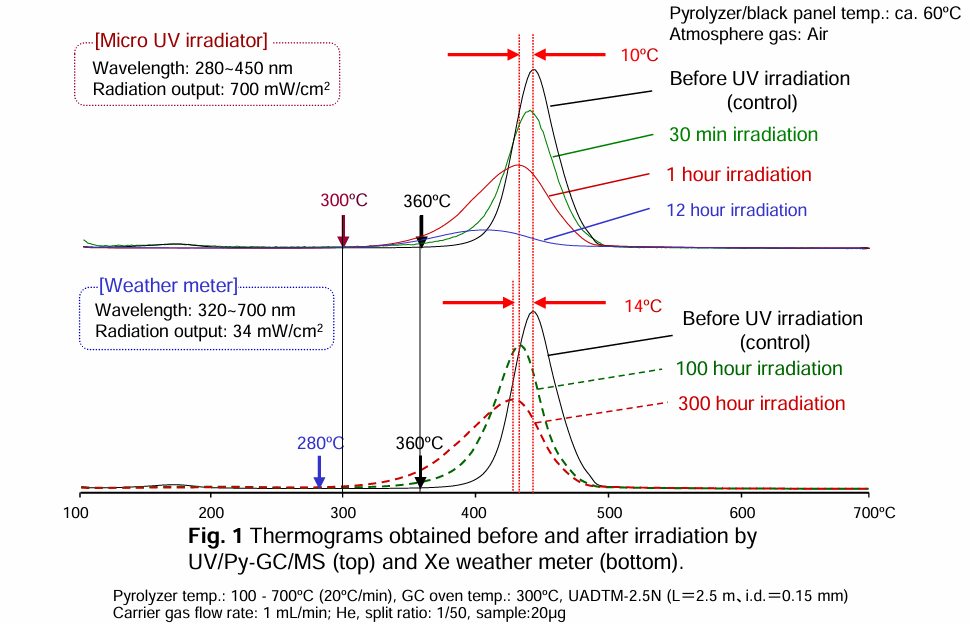
The EGA thermograms clearly demonstrated progressive degradation with increasing UV exposure.
Before Irradiation
The untreated HIPS sample exhibited:
- Pyrolysis onset around 360°C
- Sharp decomposition peak
- High thermal stability
After 1 Hour of UV Irradiation
Several significant changes were observed:
- Peak apex decreased by approximately 10°C
- Pyrolysis onset shifted from 360°C to 300°C
- Broader decomposition peak
These changes indicate that UV exposure had already begun degrading the polymer backbone.
Molecular Weight Reduction
Size-exclusion chromatography further confirmed degradation.
Average molecular weight decreased from:
285,000 → 240,000
This reduction demonstrates polymer chain scission caused by UV exposure.
Results of Xe Weather Meter Testing
After prolonged weathering:
300 Hours Exposure
Researchers observed:
- Peak apex shifted downward by 14°C
- Pyrolysis onset moved from 360°C to 280°C
These results indicate extensive photo-oxidative degradation similar to that produced by the Micro UV Irradiator.
Correlation Between Both Methods
One of the most significant findings was the remarkable similarity between both degradation profiles.
Although the exposure methods differed considerably in duration:
Micro UV Irradiator
- 1 hour
Xe Weather Meter
- 300 hours
Both produced nearly identical EGA thermograms.
This strong correlation validates the Micro UV Irradiator as a rapid screening tool for polymer weatherability.
Why Does Thermal Stability Decrease?
UV radiation breaks polymer chains through oxidation.
As molecular weight decreases:
- Polymer chains become shorter.
- Heat resistance declines.
- Decomposition begins at lower temperatures.
- EGA thermograms shift toward lower temperatures.
These thermal changes provide direct evidence of material aging.
Advantages of Using a Micro UV Irradiator
Compared with conventional weather testing, the Micro UV Irradiator offers several important benefits.
Faster Testing
Obtain degradation results within hours instead of hundreds of hours.
Reduced Development Time
Accelerate formulation optimization during R&D.
Lower Testing Costs
Reduce laboratory operating expenses by minimizing lengthy weathering experiments.
Improved Screening
Evaluate a larger number of polymer formulations quickly.
Reliable Correlation
Generate degradation profiles comparable to conventional Xe weather meter testing.
Applications
This analytical approach is valuable for:
- Polymer formulation development
- UV stability evaluation
- Weatherability studies
- Quality control
- Material failure analysis
- Automotive plastics
- Consumer products
- Packaging materials
- Electronics housings
- Outdoor polymer applications
Best Practices for Polymer Weathering Studies
To obtain reliable degradation data:
- Maintain consistent irradiation conditions.
- Standardize EGA-MS parameters.
- Compare identical sample weights.
- Monitor molecular weight changes.
- Validate results using complementary analytical techniques.
Conclusion
This study demonstrates that Evolved Gas Analysis-Mass Spectrometry (EGA-MS) is an effective technique for evaluating the thermal degradation of High Impact Polystyrene following UV exposure.
The excellent agreement between Micro UV Irradiator testing and conventional Xe weather meter experiments shows that rapid UV irradiation can accurately simulate long-term weathering effects. By significantly reducing testing time while maintaining reliable results, this approach enables faster material development, lower testing costs, and more efficient evaluation of polymer durability.
For manufacturers and researchers developing weather-resistant polymers, advanced Pyrolysis-GC/MS, EGA-MS, and polymer analysis solutions provide a powerful platform for accelerated degradation studies, thermal stability assessment, and comprehensive material characterization.
References: This technical note was developed by Frontier Laboratories Ltd. 4-16-20 Saikon, Koriyama, Fukushima, 963-8862 JAPAN. www.frontier-lab.com