
Styrenic polymers such as polystyrene (PS), ABS, AS, and AES are widely used across packaging, automotive, electronics, and forensic applications. While these materials often appear similar, accurately differentiating them is critical for quality control, material verification, and failure analysis.
Traditional Pyrolysis-GC/MS is commonly used for polymer identification, but complex pyrograms can make data interpretation time-consuming and analyst-dependent. This technical note highlights how Evolved Gas Analysis–Mass Spectrometry (EGA-MS), combined with Principal Component Analysis (PCA), offers a faster and more reliable alternative for differentiating styrenic polymers.
[Background]
Pyrolysis (Py)-GC/MS is commonly used to differentiate unknown polymeric materials. However, the pyrograms are often complex, which means that the data processing and polymer differentiation often requires an experienced analyst and time. There is an alternative to PY-GC/MS: evolved gas analysis (EGA)-MS. EGA-MS gives the analyst a thermal profile of the sample and the mass spectra of the components evolving from the sample as it is heated. 15 styrenic polymers, such as polystyrene (PS), copolymers of PS, and polymers of styrene derivatives, were analyzed using EGA-MS. The styrenic polymers were differentiated using the EGA thermogram and principal component analysis (PCA) of the EGA thermograms.
[Experimental]
EGA-MS measurements were performed using a Multi-Shot Pyrolyzer (EGA/PY-3030D, Frontier Labs), which was directly interfaced to the split injector of a GC/MS system. A deactivated stainless steel capillary tube (L=2.5 m, id.=0.15 mm) was used to connect the GC injection port to the MS ion source. The average mass spectra of each styrenic polymer were stored in a mass spectral library (MS-Lib). In addition to the mass spectrum, profile parameters, such as peak apex temperature, higher and lower temperatures at half height, were used to assist in differentiating the various polymers.
[Results]
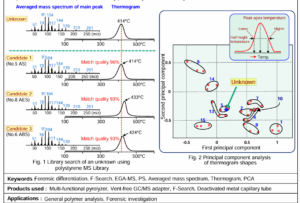
First, the average mass spectrum of the unknown polymers were compared to the 15 spectra previously added to the MS-Lib library, If the match quality for a given unknown polymer was significantly higher than any of the other library entries, it was considered as ‘identified’. However, some of the samples had very similar averaged mass spectra because the major pyrolyzate was styrene – see Fig. 1. For these unknowns, a PCA was performed using three parameters found in every EGA thermogram.
In most cases, the choices could be narrowed down to a single candidate. For example, Fig. 1 shows that the EGA thermogram of the unknown sample is similar to those of No.5 (AS), No.6 (ABS) and No. 8 (AES). The match quality of the average mass spectrum for all three polymers is greater than 90%. Fig. 2 illustrates how PCA can be used to complement the library search results and facilitate the identification of the unknown polymer. This example illustrates how similar structures can be rapidly screened and differentiated using the averaged mass spectra of the thermograms obtained using EGA-MS and the PCA of the thermogram profile parameters. Using EGA-MS in lieu of, or as a complement to, PY-GC/MS improves laboratory productivity and the accuracy of the identification.
To learn more about how EGA-MS combined with PCA can be used to rapidly differentiate styrenic polymers such as PS, ABS, AS, and AES, simply connect with us.
References: This technical note was developed by Frontier Laboratories Ltd. 4-16-20 Saikon, Koriyama, Fukushima, 963-8862 JAPAN. www.frontier-lab.com