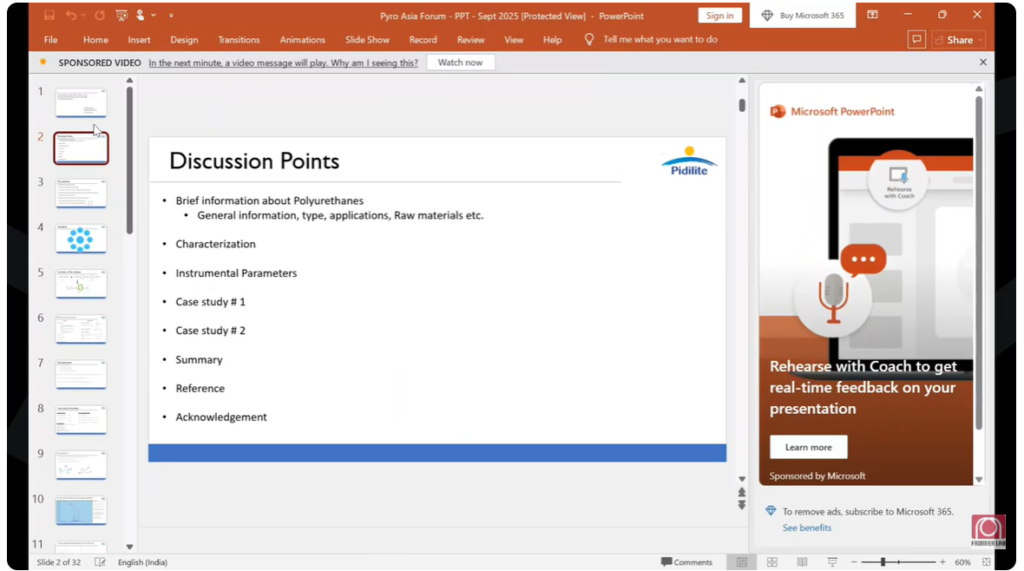
Polyurethane (PU) materials are everywhere — from flexible foams and coatings to adhesives and elastomers. But when it comes to polyurethane characterization, things can get complex. Because PU is often crosslinked and formulation-dependent, traditional testing methods may not always provide clear answers.
So how can laboratories accurately analyze PU materials?
In this Pyro Asia Forum Bi-Monthly Webinar, we explore how Double-Shot Pyrolysis GC-MS offers a smarter and more detailed approach to polyurethane analysis.
Unlike conventional methods, double-shot PY-GCMS works in two controlled heating steps:
• The first step gently releases additives, plasticizers, and low-molecular components
• The second step breaks down the polymer backbone to reveal structural information
This separation makes it easier to understand:
The chemical structure of polyurethane
Additives and formulation differences
Degradation behavior
Causes of material failure
Quality control variations
For laboratories working with thermoset polymer analysis or PU polymer identification, this technique provides both clarity and efficiency.
If you are involved in polymer research, failure analysis, or quality assurance, this webinar will give you practical insight into how double-shot pyrolysis GC-MS improves polyurethane characterization.
👉 Watch the full webinar on YouTube to learn more.