
Laboratories are frequently required to rapidly identify and differentiate unknown polymer materials, particularly amide-based polymers such as polyamides (nylons). Conventional Pyrolysis-GC/MS is commonly used for this purpose, but it often requires extensive sample preparation and complex data interpretation.
This technical study demonstrates how Evolved Gas Analysis–Mass Spectrometry (EGA-MS), combined with averaged mass spectra and Principal Component Analysis (PCA), provides a faster and more automated approach for the differentiation of polyamides. The method enables reliable identification even when polymers exhibit very similar thermal decomposition behavior.
Background
Laboratories are often asked to quickly differentiate a wide variety of unknown polymers. This is routinely done using pyrolysis (Py)-GC/MS. An alternative method has been adapted by laboratories seeking to simplify sample preparation, reduce analysis time and automate data processing. Evolved Gas Analysis (EGA)-MS has proven to be a useful tool for the differentiation of amide-based polymers. Eight amide-based polymers (Nylons) are identified by comparing their average mass spectra and applying principal component analysis (PCA) to the EGA thermograms.
Experimental
Nine different Nylons formulations were analyzed. EGA-MS measurements were made using a Multi-Shot Pyrolyzer (EGA/PY-3030D, Frontier Labs), which was directly interfaced to the split injector of a GC/MS system. A deactivated capillary tube (L=2.5 m, id.=0.15 mm) was used to connect the GC injection port to the MS ion source.
The average mass spectra of the major peak in the EGA thermograms were added to a mass spectral library (MS-Lib). Also, if the library search results were inconclusive, a principal component analysis, using EGA profile parameters such as the peak apex temperature, the higher and lower temperatures at half height as variables was used to further differentiate each polymer.
Results
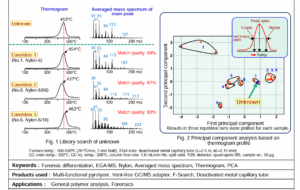
The average mass spectrum of each unknown sample was compared to those previously added to the MS-Lib using F-Search. Fig. 1 shows three candidates, in order of decreasing match quality, with mass spectra similar to that of the unknown. As is often the case, there are multiple candidates with 80% or greater match quality, which make it difficult to differentiate using only the MS-Lib search results.
In this example, the major pyrolyzates are aliphatic amines and aliphatic nitriles, and the averaged mass spectra are similar. PCA was performed using parameters contained in the EGA thermogram. For example, Fig. 2 clearly shows that the PCA analysis of the unknown gives a value very close to that of candidate No.1 and it is easily differentiated from No. 6 and No. 8.
Additional tests using arbitrarily selected combinations of two of the eight samples were performed. The identification of each polyimide in the pair was successful 80% of the time. Combining the averaged mass spectra from an EGA with PCA (based on the EGA thermograms parameters) is a viable method for the rapid screening and differentiation of a number of different polymer groups, including polyimides.
To learn more about how EGA-MS combined with PCA can be used for rapid and reliable differentiation of polyamides and other polymer groups, simply connect with us.
References: This technical note was developed by Frontier Laboratories Ltd. 4-16-20 Saikon, Koriyama, Fukushima, 963-8862 JAPAN. www.frontier-lab.com