
Product failures often begin at the molecular level, long before they become visible on the surface. In polymer-based products, even minor changes in raw materials or additives can cause serious performance issues over time.
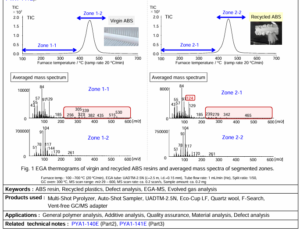
This technical study demonstrates how Evolved Gas Analysis–Mass Spectrometry (EGA-MS) can be used as a powerful screening tool to quickly identify hidden material differences in ABS resin components. By comparing virgin and recycled ABS materials, this method reveals chemical changes that are otherwise impossible to detect using visual inspection or conventional testing.
With only micro-level samples required, EGA-MS enables fast, accurate material evaluation—making it an essential technique for quality control, defect investigation, and product reliability testing.
[Background]
Acrylonitrile-butadiene rubber (NBR) is a synthetic rubber which has excellent properties such as high oil resistance and wear resistance. It contains various additives to improve weather resistance, mechanical properties, etc. Therefore, not only main components of the NBR material but also additives need to be analyzed to assess the polymer properties. In this note, Evolved Gas Analysis (EGA)-MS is conducted as the fundamental investigation for the compositional analysis of NBR by pyrolysis GC/MS to determine the pyrolysis temperature. In addition, chemical species were surveyed from the averaged mass spectrum of each temperature zone of EGA curves.
[Experimental]
A GC/MS system with a Multi-Shot Pyrolyzer (EGA/PY-3030D) directly interfaced to the GC injector was used for EGA-MS measurements. A deactivated metal tube (UADTM-2.5N) and a Vent-free GC/MS adapter were installed between the GC injector and the mass detector. Two types of NBRs with varied compounding ratios were used as samples. The NBR samples were scraped off with a cutting knife, and then the scraped pieces were put into an Eco-Cup, precisely weighed (ca. 0.1 mg each), and introduced into the pyrolyzer furnace for EGA-MS measurements.
[Results]
EGA curves and averaged mass spectra of the NBR samples are shown in Fig. 1. Additives should mainly appear in the lower temperature zone, i.e. Zones 1-A and 2-A. Peaks detected in Zones 1-B and 2-B are derived from the pyrolysis of NBR. It is confirmed that the polymer type is both NBR based on the library search of the averaged mass spectra using the F-Search. For both NBR samples, evolution of gases from the polymer component was completed by 600 ºC. Thus, pyrolysis temperature in Py-GC/MS was determined to be 600 ºC. In the next note (PYA1-173E), the qualitative analysis of polymer and additives in NBR samples was conducted by Py-GC/MS. Further, the quantitative analysis of monomer composition (compositional ratio of acrylonitrile to butadiene) was carried out.
To learn more about how EGA-MS and the micro-furnace pyrolyzer can be used for defect analysis and material evaluation of ABS resins, simply connect with us.
References: This technical note was developed by Frontier Laboratories Ltd. 4-16-20 Saikon, Koriyama, Fukushima, 963-8862 JAPAN. www.frontier-lab.com