Introduction
Brominated flame retardants (BFRs) are widely used in electrical and electronic products to improve fire safety. However, certain brominated flame retardants are regulated under the Restriction of Hazardous Substances (RoHS) Directive due to their potential environmental and health impacts.
Accurate detection and quantification of these compounds are essential for manufacturers, testing laboratories, and regulatory agencies. One of the most effective analytical approaches is Thermal Desorption-GC (TD-GC) with Pyrolysis-GC/MS technology, which enables rapid and reliable analysis of brominated flame retardants in polymer materials.
This article explores how optimizing the Py-GC interface (ITF) and GC injection port temperatures significantly improves the quantitative analysis of Decabromodiphenyl Ether (DeBDE) in polystyrene.
What Are Brominated Flame Retardants?
Brominated flame retardants are chemical additives incorporated into plastics and electronic components to reduce flammability.
They are commonly found in:
- Electronic housings
- Printed circuit boards
- Electrical cables
- Consumer electronics
- Automotive components
- Plastic enclosures
Among these compounds, Decabromodiphenyl Ether (DeBDE) has been widely used and is closely monitored under RoHS regulations.
Why Quantitative Analysis Matters
Manufacturers must accurately determine brominated flame retardant concentrations to:
- Ensure RoHS compliance
- Verify product safety
- Support quality control
- Monitor manufacturing consistency
- Meet environmental regulations
Reliable analytical methods help laboratories generate reproducible and accurate results.
What is Thermal Desorption-GC?
Thermal Desorption-Gas Chromatography (TD-GC) is an analytical technique that gently heats a sample to release volatile and semi-volatile compounds before chromatographic separation.
Compared to solvent-intensive methods, TD-GC offers:
- Faster sample preparation
- High sensitivity
- Reduced contamination risk
- Improved quantitative accuracy
- Excellent repeatability
Experimental Setup
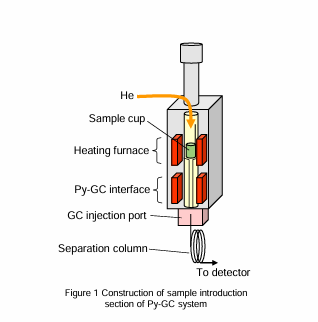
The study used a Double-Shot Pyrolyzer® directly connected to a GC equipped with a Flame Ionization Detector (FID).
Sample Preparation
A sample solution containing:
- Polystyrene (PS)
- Approximately 5% Decabromodiphenyl Ether (DeBDE)
was prepared in tetrahydrofuran (THF).
After drying, the sample was analyzed using Thermal Desorption-GC.
Measurement Conditions
Parameter | Condition |
Thermal Desorption Temperature | 100–350°C |
Heating Rate | 20°C/min |
Sample Size | 50 µg |
Column | UA-PBDE |
Carrier Gas Flow | 1 mL/min |
Split Ratio | 1:50 |
Detector | FID |
Effect of Interface Temperature on Quantification
A major objective of the study was to determine the optimal temperature for:
- Py-GC Interface (ITF)
- GC Injection Port
Temperatures between 250°C and 400°C were evaluated.
Key Findings
Peak Intensity
The study found that the DeBDE peak intensity remained stable between:
300°C and 370°C
Outside this range:
Below 300°C
Peak intensity decreased because DeBDE was likely adsorbed within the analytical flow path.
Above 400°C
Peak intensity also decreased due to thermal decomposition of DeBDE.
This demonstrates the importance of maintaining appropriate interface temperatures during analysis.
Reproducibility
The reproducibility of the analytical results was evaluated using Relative Standard Deviation (RSD).
Researchers observed:
- Approximately 2% RSD between 300°C and 370°C
- Poorer reproducibility below 300°C
- Increased variability above 400°C
These results indicate that stable interface temperatures are essential for reliable quantitative analysis.
Optimum Operating Temperature
Based on both peak intensity and reproducibility, researchers identified:
320°C
as the optimal temperature for both:
- Py-GC Interface
- GC Injection Port
At this temperature:
- DeBDE adsorption is minimized.
- Thermal decomposition is avoided.
- Quantitative accuracy is maximized.
- Excellent repeatability is achieved.
Why Temperature Optimization is Critical
Incorrect interface temperatures can lead to:
- Reduced analytical sensitivity
- Poor reproducibility
- Loss of target compounds
- Incorrect quantification
- Regulatory compliance issues
Optimizing analytical conditions ensures consistent and accurate results.
Applications
Thermal Desorption-GC is widely used in:
- RoHS compliance testing
- Electronics manufacturing
- Polymer quality control
- Environmental laboratories
- Flame retardant analysis
- Research and development
- Material characterization
Benefits of TD-GC for Brominated Flame Retardant Analysis
- Rapid quantitative analysis
- High reproducibility
- Minimal sample preparation
- Excellent sensitivity
- Reliable RoHS compliance testing
- Improved laboratory efficiency
Conclusion
Accurate quantification of brominated flame retardants is essential for ensuring product safety and regulatory compliance. This study demonstrates that optimizing the Py-GC interface and GC injection port temperatures significantly improves the reliability of Thermal Desorption-GC analysis.
An operating temperature of 320°C provided the best balance between preventing compound adsorption and avoiding thermal decomposition, resulting in stable peak intensities and excellent reproducibility.
For laboratories involved in Pyrolysis-GC/MS, Thermal Desorption-GC, and polymer analysis, optimized analytical conditions are key to achieving accurate, reproducible, and compliant brominated flame retardant testing.
References: This technical note was developed by Frontier Laboratories Ltd. 4-16-20 Saikon, Koriyama, Fukushima, 963-8862 JAPAN. www.frontier-lab.com