With the enforcement of stricter environmental regulations such as the revised RoHS Directive, accurate identification of polymers and additives in electrical cable materials has become increasingly important. Understanding the thermal behavior and chemical composition of cable materials is essential for quality assurance, regulatory compliance, and materials development.
Evolved Gas Analysis–Mass Spectrometry (EGA-MS) offers a powerful and efficient approach to analyze polymers and additives by monitoring gases released during controlled heating. In this technical note, Frontier Lab demonstrates the application of EGA-MS to analyze Pellet A, a raw cable material used in home electrical appliances.
Background
Due to the recent enforcement of the revised RoHS Directive, analytical methods for polymers and additives contained in electrical cables have gained much interest. In this note, the evolved gas analysis (EGA)-MS of Pellet A, a raw material for cables used in home electric appliances, is described.
Experimental
Pellet A was pulverized by cryo-milling and used for the analysis. A GC/MS system with a Multi-Shot Pyrolyzer directly interfaced to the GC injector was used. A deactivated metal tube connected the GC injector to the MS detector. About 0.2 mg sample was put in a sample cup (Eco-Cup) and introduced into the pyrolyzer furnace for EGA-MS analysis.
Results
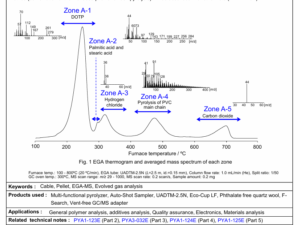
EGA thermogram of Pellet A is divided into 5 zones (Fig. 1).
For Zone A-1, based on the library search on its averaged mass spectrum using F-Search, the large peak at around 250 ºC is ascribed to dioctyl terephthalate (DOTP), a plasticizer. It was also supported by the library search on its characteristic ions. DOTP was probably compounded as an additive, and its amount is suggested to be high, due to the high intensity of the peak.
Similarly, from the averaged mass spectrum of the Zone A-2, the peak is ascribed to palmitic acid (characteristic ion: m/z 256) and stearic acid (characteristic ion: m/z 284).
The peaks in Zones A-3 and A-4 are originated from the decomposition of polyvinyl chloride (PVC), from the observation of HCl (m/z 36) and naphthalene (m/z 128) in the averaged mass spectra.
The averaged mass spectrum of Zone A-5 suggests the emission of carbon dioxide (m/z 44) in this zone, probably due to the release of carbon dioxide from calcium carbonate used as a filler by heating.
For more detailed analysis, chromatographic analysis using the double-shot method (combination of thermal desorption and flash pyrolysis) will be described in another note (PYA1-123E).
To learn more about how EGA-MS and multi-functional pyrolyzers can be used for precise identification of polymers and additives in cable materials, simply connect with us.
References: This technical note was developed by Frontier Laboratories Ltd. 4-16-20 Saikon, Koriyama, Fukushima, 963-8862 JAPAN. www.frontier-lab.com