Understanding polymer behavior under real-world conditions is critical for accurate material evaluation. While Evolved Gas Analysis–Mass Spectrometry (EGA-MS) is commonly performed under inert atmospheres, many applications—such as thermal oxidative degradation—require analysis in air or oxygen-containing environments.
In this technical study, Frontier Lab demonstrates how EGA-MS can be effectively applied under air and oxidative atmospheres using an improved flow system. By comparing conventional and newly developed flow configurations, this study highlights how signal quality, thermal behavior, and oxidation effects can be accurately controlled and evaluated during polystyrene (PS) analysis.
Background
In the previous note (PYA3-033E), a new flow system that can analyze samples under an air atmosphere was introduced. In this note, EGA-MS analysis of polystyrene (PS) was performed using each flow system described in the previous note, and the resulting EGA thermograms, average mass spectra, and S/N ratios were compared. The oxygen concentration flowing into the MSD was also calculated. Furthermore, EGA-MS analysis under the oxidative atmosphere was carried out for each flow system.
Experimental
25 mg of PS was dissolved in 1 mL of dichloromethane, and 5 μL of the solution was placed in a sample cup. After solvent evaporation, a PS thin film of approximately 0.125 mg was obtained.
The peak height (S) was defined as the height from the baseline to the peak maximum, and the noise (N) was defined as the peak-to-peak height of the baseline in the range of 160 to 180 ºC where the baseline is relatively flat.
Results
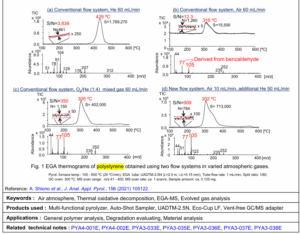
EGA thermograms obtained under different flow systems are shown. Under the He atmosphere, the peak temperature was 429 ºC, while under the oxidative atmosphere, the peak temperature was observed in the range of 302 to 315 ºC, which is significantly lower than that under He.
Average mass spectra under the He atmosphere show typical PS oligomer ions, whereas under the oxidative atmosphere, ions derived from benzaldehyde were observed.
In the conventional flow system, the S/N under air was 12.3, which was much lower than that under He. However, when air diluted with He was introduced using the new flow system, the S/N significantly improved to 909, while the oxygen concentration flowing into the MSD was reduced to 3.3%.
To learn more about how EGA-MS and advanced flow system designs can be used to evaluate polymer behavior under air and oxidative atmospheres, simply connect with us.
References: This technical note was developed by Frontier Laboratories Ltd. 4-16-20 Saikon, Koriyama, Fukushima, 963-8862 JAPAN. www.frontier-lab.com