Thermal–based chemical identification of botanicals often requires multiple extraction and analysis steps, taking hours or even days to complete.
However, with Evolved Gas Analysis–Mass Spectrometry (EGA-MS), the complete thermal decomposition profile of a plant sample can be obtained in just a few minutes, without any chemical pretreatment. This significantly reduces the time needed to differentiate botanicals—such as various Lavandula species—based on their characteristic decomposition behavior.
Today, laboratories in food, fragrance, herbal, and environmental industries are increasingly adopting EGA-MS as part of their routine analytical workflow
because of its ability to rapidly generate species-specific chemical fingerprints. For botanicals like Lavender, where multiple species share similar compositions, EGA-MS provides an efficient and reliable way to verify authenticity and assess quality.
The micro-furnace pyrolyzer plays a key role in this analysis.
This multi-functional system allows nearly any organic material—solid or liquid—to be thermally characterized across a variety of modes, including:
Evolved Gas Analysis (EGA)
Multi-step Thermal Desorption (TD)
Pyrolysis (PY)
Double-Shot (TD→PY)
Heart-cut modes
UV irradiation (optional)
The micro-furnace directly links to the GC injection port, enabling direct, on-column transfer of all pyrolyzates without the need for a transfer line. This ensures that both low- and high-molecular-weight compounds, as well as polar components, are captured accurately—critical for separating and identifying subtle differences between similar Lavender species.
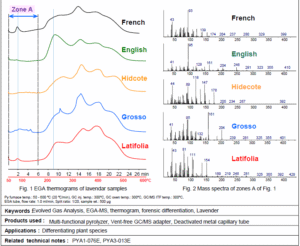
In this technical study, EGA-MS was used to compare multiple Lavender species—including English Lavender, French Lavender, Grosso, Hidcote, and Latifolia.
Although these plants look similar and share overlapping fragrance components, their EGA thermograms revealed clear thermal decomposition differences. These distinct patterns, combined with mass spectral analysis, allowed reliable differentiation of each species.
Background: Lavandula (common name Lavender) is a genus of 39 species of flowering plants in the mint family, Lamiac. Lavender is an ornamental plant with colorful flowers and a strong characteristic fragrance. Commercially the plant is grown mainly for the production of the lavender essential oil which has medicinal properties. Extracts are also used as fragrances for bath products and added to various foods (e.g., salad dressing, tea, etc). The essential oil from each species is subtly different and so there is interest in a simple analytical technique for differentiating the various species of Lavender. Evolved Gas Analysis (EGA)-MS will give us a thermal profile of the sample constituents(1). The sample is analyzed ‘as is’ – no sample pretreatment is necessary.
Experimental: The EGA-MS data was performed using a Multi-Shot Pyrolyzer (EGA/PY-3030D). The EGA tube (deactivated 2.5m x 0.15 mm id) was interfaced to the MS interface using a vent-free GC/MS adapter.
Results: The EGA thermogram of each Lavender specie is shown below. As expected, the thermal profiles are similar yet there are sufficient differences to identify the five species. For example, English can be differentiated from Hidcote and French using the relative abundances at 2 minutes and 9.1 minutes. The average mass spectrum of zones A, B, and C of French, English and Hidecote, respectively, are shown in Fig. 2 Comparing the mass spectra, differentiation is made easier. More exact differentiation can be done using extracted ion chromatograms.
To learn more about how EGA-MS and the micro-furnace pyrolyzer can be used to differentiate Lavandula species through thermal decomposition profiling, simply connect with us.
References: This technical note was developed by Frontier Laboratories Ltd. 4-16-20 Saikon, Koriyama, Fukushima, 963-8862 JAPAN. www.frontier-lab.com